QUESTION IMAGE
Question
question 5 week 3 - eoc practice (ra1fl) text alternative a) {x|-4 < x < 0} b) {x|x > -2} c) {x|x < -2} d) {x|x < -4 or x > 0}
Step1: Analyze the graph's shape
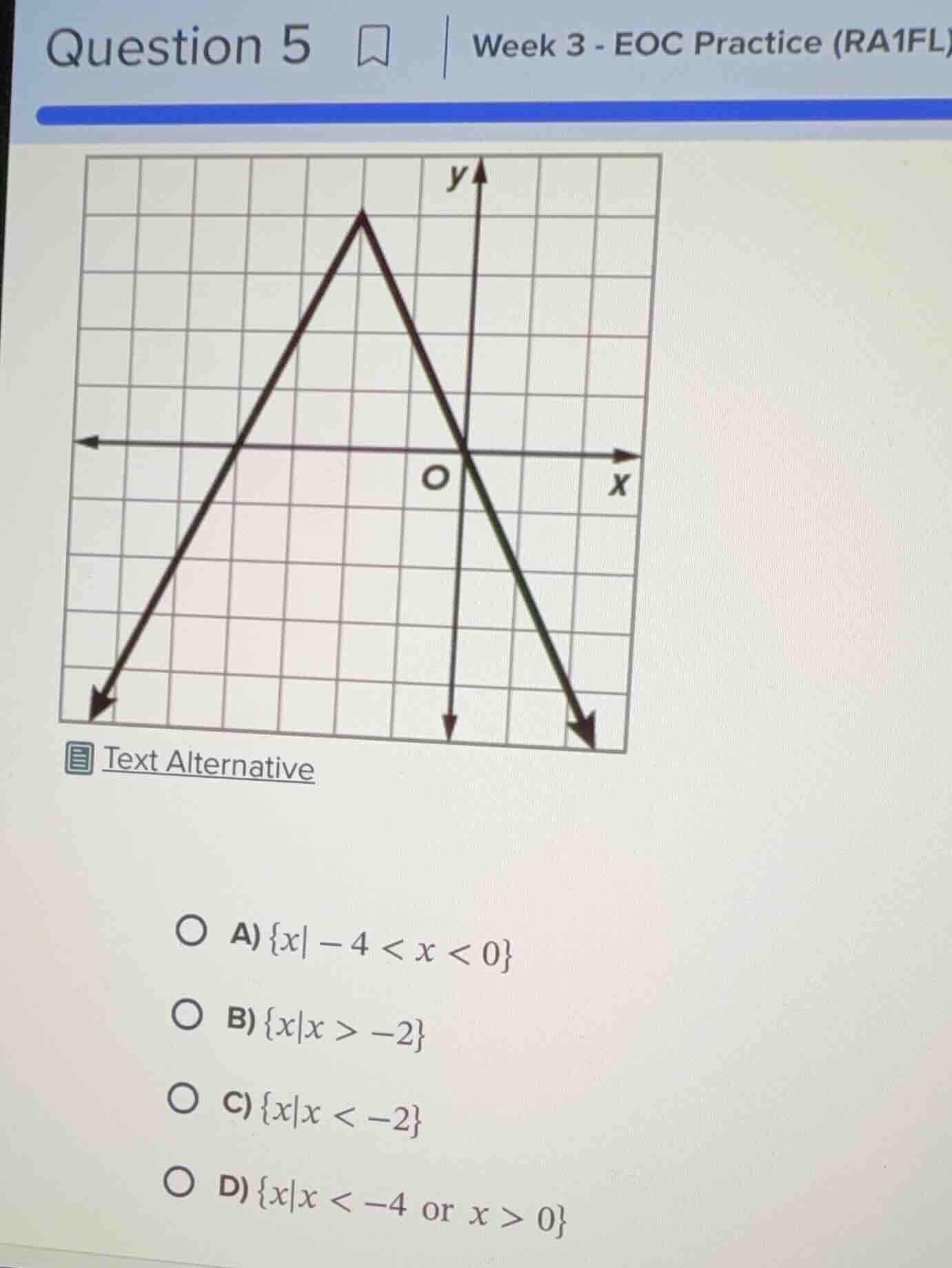
The graph is a V - shaped graph (absolute - value - like graph) with a vertex. First, we need to find the vertex's x - coordinate and the direction of the graph's increase and decrease. From the graph, we can see that the vertex is at \(x=-2\) (by observing the symmetry of the graph). The left - hand side of the vertex (for \(x < - 2\)) has a positive slope (the graph is increasing), and the right - hand side (for \(x > - 2\)) has a negative slope (the graph is decreasing). But we need to find the domain where the function is decreasing? Wait, no, maybe we need to find the domain where the function is below a certain line or the solution of an inequality. Wait, actually, the graph intersects the x - axis at \(x=-4\) and \(x = 0\). Wait, let's re - examine. The graph crosses the x - axis at \(x=-4\) (left intersection) and \(x = 0\) (right intersection). The vertex is at \(x=-2\). Now, if we consider the regions where the graph is below the x - axis? Wait, no, the arrows are going down. Wait, the graph is a piece - wise linear function. Let's find the intervals. The left part: from \(x=-\infty\) to \(x=-2\), the graph is increasing (going up from bottom left to the vertex at \(x = - 2\)). From \(x=-2\) to \(x=\infty\), the graph is decreasing (going down from the vertex to bottom right). But the options are about the domain of x. Wait, maybe the question is about where the function is negative? Wait, the graph is below the x - axis when \(x < - 4\) or \(x>0\), because between \(x=-4\) and \(x = 0\), the graph is above the x - axis (since the vertex is above the x - axis). Let's check the options:
Option A: \(\{x|-4 < x < 0\}\) is the interval where the graph is above the x - axis (since between - 4 and 0, the graph is above the x - axis). But if the question is about where the graph is below the x - axis, then it's \(x < - 4\) or \(x>0\), which is option D. Wait, let's confirm the x - intercepts. From the graph, the left x - intercept is at \(x=-4\) (because when we count the grid, from the origin, moving 4 units to the left) and the right x - intercept is at \(x = 0\) (the origin). The vertex is at \(x=-2\) (2 units to the left of the origin) and some positive y - value. So, the graph is above the x - axis between \(x=-4\) and \(x = 0\) (since the vertex is above the x - axis) and below the x - axis when \(x < - 4\) or \(x>0\) (because the arrows are going down, so outside the interval \((-4,0)\), the graph is below the x - axis). So the solution of the inequality (maybe \(y<0\)) would be \(x < - 4\) or \(x>0\), which is option D.
Step2: Verify each option
- Option A: \(\{x|-4 < x < 0\}\): This is the interval between the two x - intercepts, where the graph is above the x - axis (since the vertex is above the x - axis), so this is the region where \(y>0\), not what we want if we are looking for \(y < 0\).
- Option B: \(\{x|x > - 2\}\): The region \(x > - 2\) includes part of the region where \(y>0\) (between - 2 and 0) and part where \(y < 0\) (x>0). So this is not correct.
- Option C: \(\{x|x < - 2\}\): The region \(x < - 2\) includes part where \(y < 0\) (x < - 4) and part where \(y>0\) (between - 4 and - 2). So this is not correct.
- Option D: \(\{x|x < - 4\) or \(x>0\}\): For \(x < - 4\), the graph is below the x - axis (since to the left of \(x=-4\), the graph is going down below the x - axis). For \(x>0\), the graph is also below the x - axis (to the right of \(x = 0\), the graph is going down below the x - axis). So this is the correct interval where the graph is below the x - axis.

Snap & solve any problem in the app
Get step-by-step solutions on Sovi AI
Photo-based solutions with guided steps
Explore more problems and detailed explanations
D) \(\{x|x < - 4\) or \(x>0\}\)