QUESTION IMAGE
Question
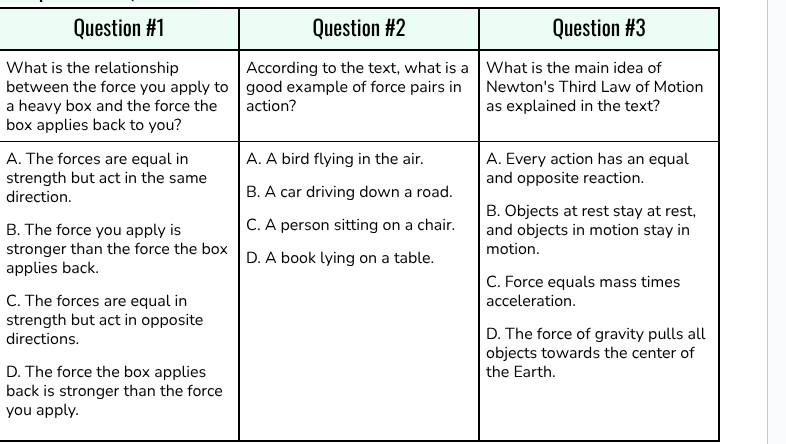
question #1
what is the relationship between the force you apply to a heavy box and the force the box applies back to you?
a. the forces are equal in strength but act in the same direction.
b. the force you apply is stronger than the force the box applies back.
c. the forces are equal in strength but act in opposite directions.
d. the force the box applies back is stronger than the force you apply.
question #2
according to the text, what is a good example of force pairs in action?
a. a bird flying in the air.
b. a car driving down a road.
c. a person sitting on a chair.
d. a book lying on a table.
question #3
what is the main idea of newton’s third law of motion as explained in the text?
a. every action has an equal and opposite reaction.
b. objects at rest stay at rest, and objects in motion stay in motion.
c. force equals mass times acceleration.
d. the force of gravity pulls all objects towards the center of the earth.
apply a force to a box, the box applies a force back on you. These forces (action - reaction pair) should be equal in magnitude (strength) and opposite in direction.
- Option A says they act in the same direction, which is incorrect.
- Option B and D suggest unequal forces, which goes against Newton's Third Law.
- Option C states equal strength and opposite directions, which matches the law.
We need to identify a good example of force pairs (action - reaction) in action. Let's analyze each option:
- Option A: A bird flying - The bird pushes air down (action), and the air pushes the bird up (reaction) - this is a force pair. But let's check others.
- Option B: A car driving down a road - The main force here is the friction between tires and road, but it's not a clear action - reaction pair example as the other options.
- Option C: A person sitting on a chair - The person exerts a force on the chair (action), and the chair exerts an equal and opposite force on the person (reaction) - this is a classic normal force action - reaction pair.
- Option D: A book lying on a table - Similar to option C, but the action - reaction in sitting on a chair is more about the interaction between two objects (person and chair) where the person is actively applying force (weight) and the chair reacting. However, among the options, a person sitting on a chair is a good example of force pairs (the person's weight on the chair and the chair's normal force on the person). Wait, actually, let's re - evaluate. Wait, the action - reaction pairs: when a person sits on a chair, the person pushes the chair down (action), the chair pushes the person up (reaction). A book on a table: the book pushes the table down, the table pushes the book up. But the question is about "force pairs in action" - maybe the best example here is a person sitting on a chair as it's a more dynamic interaction? Wait, no. Wait, the key is to find the action - reaction pair. Let's think again. The correct example of force pairs (action and reaction) is when two objects interact, exerting forces on each other. A person sitting on a chair: the person (object 1) exerts a force on the chair (object 2), and the chair (object 2) exerts a force on the person (object 1). So this is a force pair. A bird flying: the bird and the air. But the option of a person sitting on a chair is a more straightforward example of two objects interacting with equal and opposite forces. So option C is correct.
We need to find the main idea of Newton's Third Law of Motion. Let's recall the laws:
- Option A: "Every action has an equal and opposite reaction" is Newton's Third Law.
- Option B: "Objects at rest stay at rest, and objects in motion stay in motion" is Newton's First Law (Law of Inertia).
- Option C: "Force equals mass times acceleration" is Newton's Second Law.
- Option D: "The force of gravity pulls all objects towards the center of the Earth" is about gravity, not Newton's Third Law.
So the main idea of Newton's Third Law is captured in option A.

Snap & solve any problem in the app
Get step-by-step solutions on Sovi AI
Photo-based solutions with guided steps
Explore more problems and detailed explanations
C. The forces are equal in strength but act in opposite directions.