QUESTION IMAGE
Question
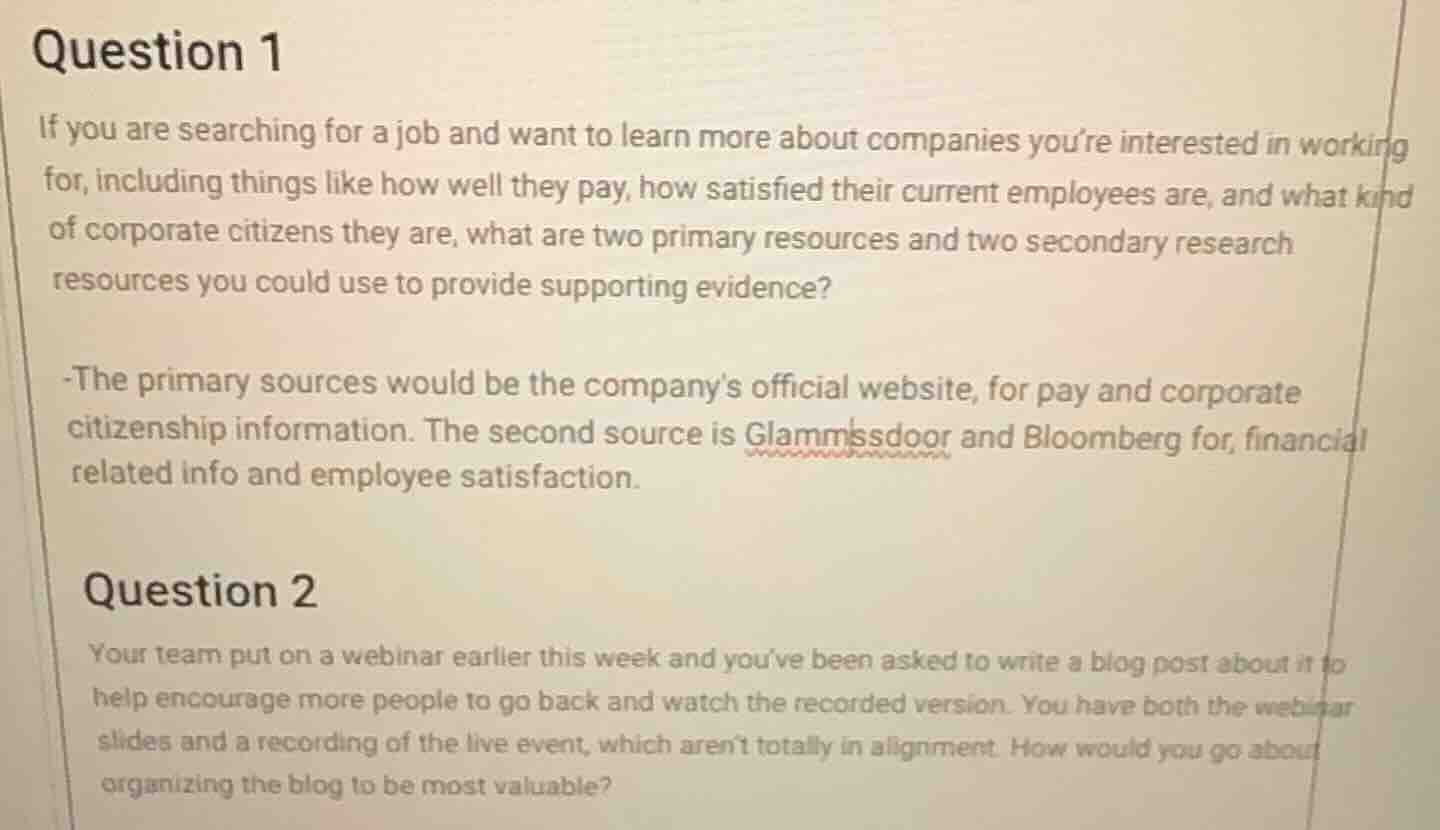
question 1
if you are searching for a job and want to learn more about companies you’re interested in working for, including things like how well they pay, how satisfied their current employees are, and what kind of corporate citizens they are, what are two primary resources and two secondary research resources you could use to provide supporting evidence?
-the primary sources would be the company’s official website, for pay and corporate citizenship information. the second source is glammssdoor and bloomberg for, financial related info and employee satisfaction.
question 2
your team put on a webinar earlier this week and you’ve been asked to write a blog post about it to help encourage more people to go back and watch the recorded version. you have both the webinar slides and a recording of the live event, which aren’t totally in alignment. how would you go about organizing the blog to be most valuable?
Question 1
Primary resources are original, direct sources. The company's official website is primary as it provides first - hand info on pay (e.g., career pages) and corporate citizenship (e.g., CSR reports). Glassdoor (note: corrected from "Glammssdoor") is a primary - like source for employee satisfaction (employee reviews) and Bloomberg for financial info (company financial reports, market data). Secondary resources could be industry reports (e.g., from IBISWorld) which analyze multiple companies in the industry including pay and corporate behavior, and academic research papers on corporate citizenship and employee satisfaction in similar industries. But for the primary and secondary as per the question's initial attempt: Primary: 1. Company’s official website (for pay scales, corporate social responsibility details). 2. Glassdoor (employee - generated reviews on satisfaction, pay). Secondary: 1. Bloomberg (financial analysis, market - based pay comparisons). 2. Industry - specific magazines (e.g., Forbes, Fortune) that report on company performance, pay, and corporate citizenship.
- Audit the Content: First, compare the webinar slides and the recording to identify discrepancies (e.g., extra info in recording, different examples in slides).
- Structure Around Value: Decide on the core value the webinar offers (e.g., key takeaways, skills taught). Organize the blog with an engaging intro (hook about webinar value), then a section for key points (using slides for structure, filling in with recording details), a “behind - the - scenes” section about the live event (using recording anecdotes), and a clear CTA (call - to - action) to watch the recording.
- Clarify Discrepancies: If there are minor discrepancies, note them (e.g., “In the live webinar, we expanded on X (from slide Y) with example Z”). If major, reconcile by prioritizing the most accurate or valuable info.
- Visual and Verbal Integration: Use slide snippets (with permission) to highlight key points and transcribe impactful parts of the recording (e.g., a funny or insightful quote from the presenter) to make the blog engaging.

Snap & solve any problem in the app
Get step-by-step solutions on Sovi AI
Photo-based solutions with guided steps
Explore more problems and detailed explanations
Primary resources:
- Company’s official website (provides first - hand information on pay and corporate citizenship).
- Glassdoor (provides employee - generated information on job satisfaction and pay).
Secondary resources:
- Bloomberg (provides financial - related information about the company).
- Industry - specific magazines (e.g., Forbes) (provide secondary analysis on the company’s corporate citizenship and employee - related aspects).