QUESTION IMAGE
Question
questions 14 and 15 refer to the following.
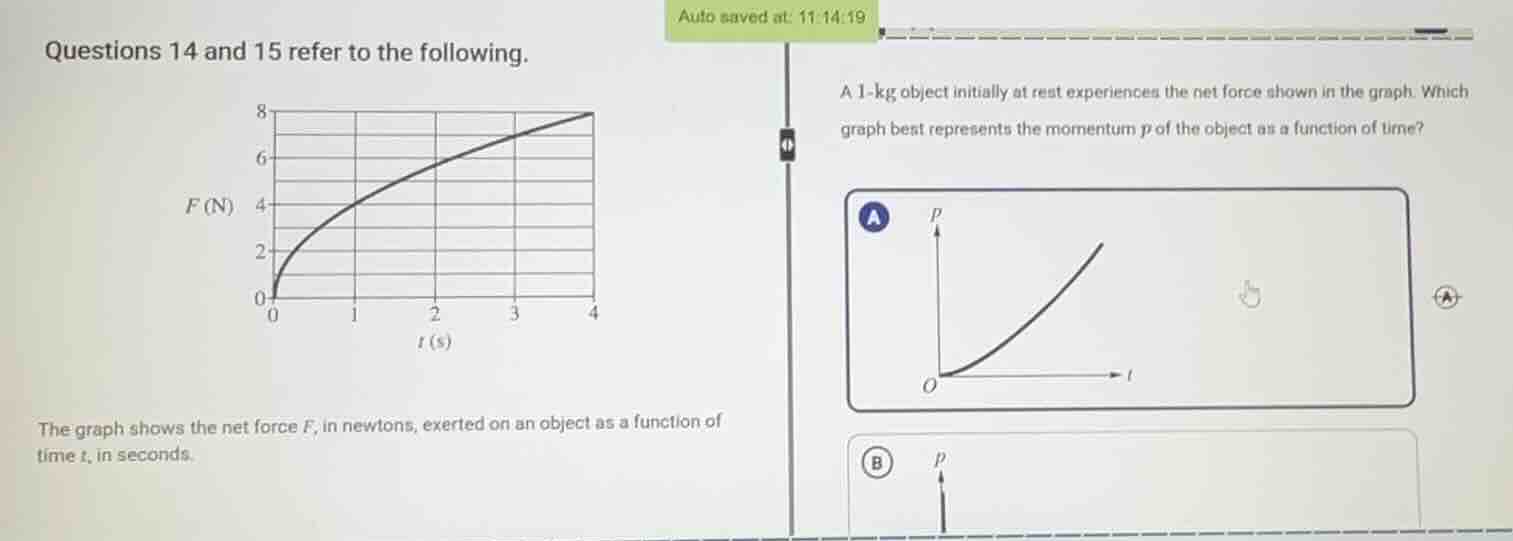
the graph shows the net force ( f ), in newtons, exerted on an object as a function of time ( t ), in seconds.
a 1-kg object initially at rest experiences the net force shown in the graph. which graph best represents the momentum ( p ) of the object as a function of time?
(graph of ( f ) vs ( t ): ( f ) (n) on y-axis, ( t ) (s) on x-axis, curve from (0,0) increasing with decreasing slope, passing near (1,4), (2,6), (3,7), (4,8))
option a: graph of ( p ) vs ( t ), curve from (0,0) increasing with increasing slope
option b: (partially shown, vertical axis ( p ), horizontal ( t ))
Step1: Relate force and momentum
By the impulse-momentum theorem, the change in momentum $\Delta p$ equals the impulse, which is the integral of force over time:
$$\Delta p = p(t) - p_0 = \int_{0}^{t} F(t') dt'$$
Since the object starts at rest, $p_0 = 0$, so $p(t) = \int_{0}^{t} F(t') dt'$. This means momentum is the area under the $F(t)$ curve up to time $t$.
Step2: Analyze $F(t)$ curve shape
The given $F(t)$ curve is increasing, and its slope (rate of force increase) is decreasing (concave down).
Step3: Analyze $p(t)$ curve shape
The momentum $p(t)$ is the integral of $F(t)$. For a concave-down increasing $F(t)$:
- $p(t)$ will be increasing (since $F(t) > 0$ for all $t$).
- The slope of $p(t)$ is $F(t)$, which is increasing but at a decreasing rate. This means $p(t)$ is a concave-up curve (its slope increases over time, matching the increasing $F(t)$).

Snap & solve any problem in the app
Get step-by-step solutions on Sovi AI
Photo-based solutions with guided steps
Explore more problems and detailed explanations
A. <The graph with an upward-curving (concave up) line starting from the origin, showing increasing momentum with an increasing slope>