QUESTION IMAGE
Question
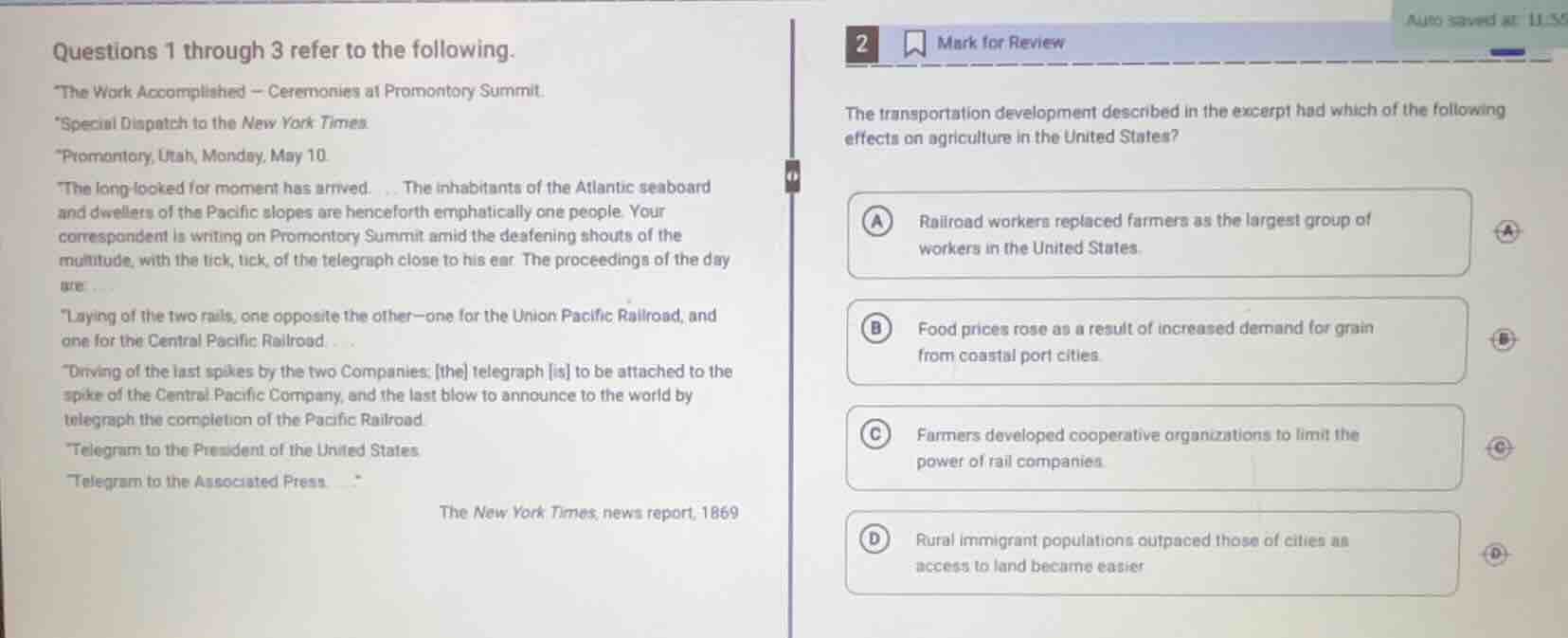
questions 1 through 3 refer to the following.
\the work accomplished -- ceremonies at promontory summit.
\special dispatch to the new york times
\promontory, utah, monday, may 10.
\the long looked for moment has arrived. ... the inhabitants of the atlantic seaboard and dwellers of the pacific slopes are henceforth emphatically one people. your correspondent is writing on promontory summit amid the deafening shouts of the multitude, with the tick, tick, of the telegraph close to his ear. the proceedings of the day are:
\laying of the two rails, one opposite the other-one for the union pacific railroad, and one for the central pacific railroad. ...
\driving of the last spikes by the two companies: the telegraph is to be attached to the spike of the central pacific company, and the last blow to announce to the world by telegraph the completion of the pacific railroad.
\telegram to the president of the united states.
\telegram to the associated press. \
the new york times, news report, 1869
2 mark for review
the transportation development described in the excerpt had which of the following effects on agriculture in the united states?
a railroad workers replaced farmers as the largest group of workers in the united states.
b food prices rose as a result of increased demand for grain from coastal port cities.
c farmers developed cooperative organizations to limit the power of rail companies.
d rural immigrant populations outpaced those of cities as access to land became easier
The excerpt describes the completion of the First Transcontinental Railroad in 1869. This railroad drastically reduced transportation costs and time for agricultural goods, connecting rural farm areas to distant coastal markets. The increased access to larger markets raised demand for grain, which in turn drove up food prices.
- Option A is incorrect: Railroad workers never became the largest U.S. worker group, as agricultural labor remained dominant for decades.
- Option C is incorrect: Farmer cooperatives to counter rail power emerged later, in the 1870s-1880s (e.g., the Granger Movement), not immediately at the railroad's completion in 1869.
- Option D is incorrect: The railroad actually facilitated urbanization, drawing people to cities, so rural immigrant populations did not outpace urban ones.

Snap & solve any problem in the app
Get step-by-step solutions on Sovi AI
Photo-based solutions with guided steps
Explore more problems and detailed explanations
B. Food prices rose as a result of increased demand for grain from coastal port cities.