QUESTION IMAGE
Question
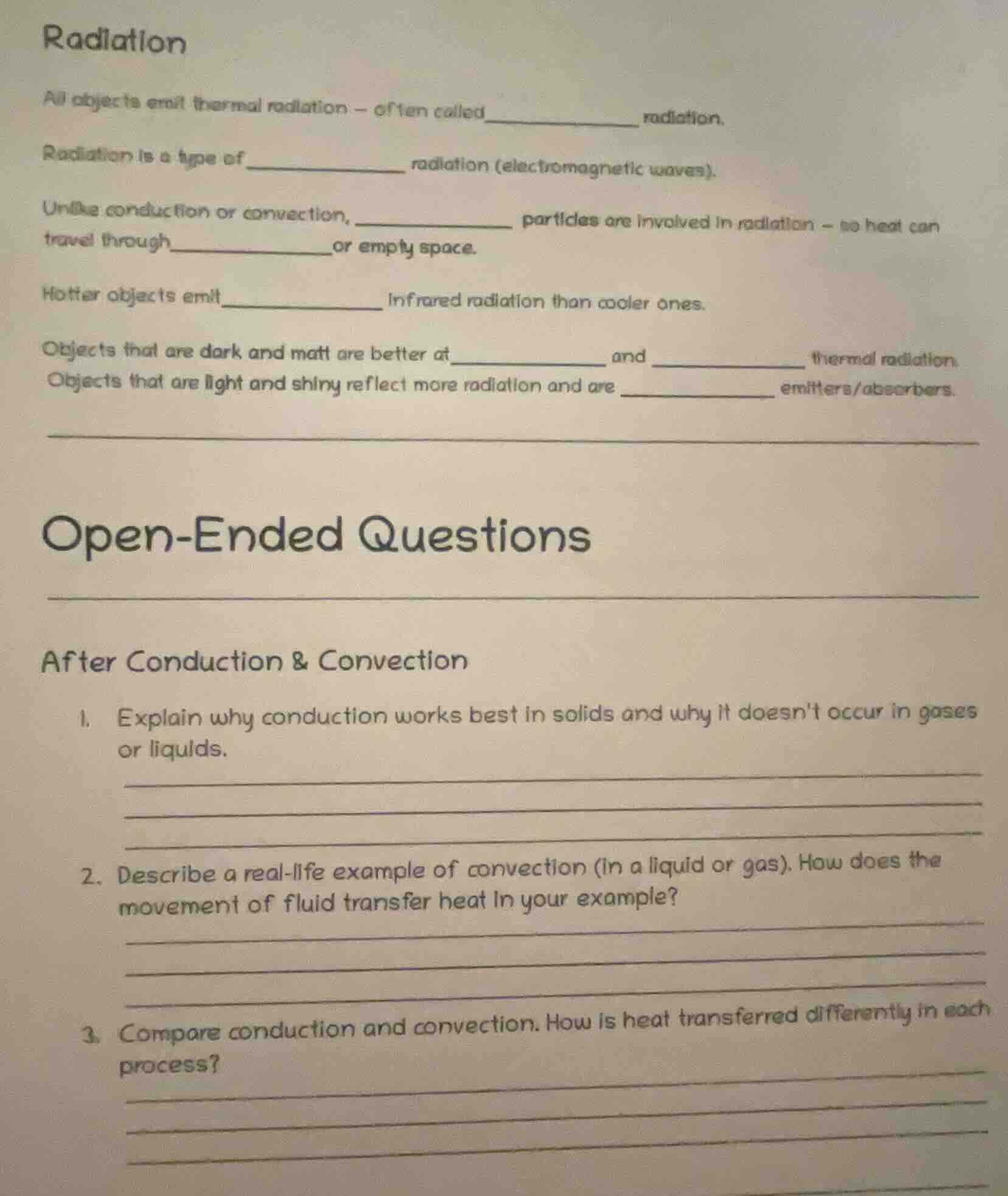
radiation
all objects emit thermal radiation – often called__________ radiation.
radiation is a type of__________ radiation (electromagnetic waves).
unlike conduction or convection,________ particles are involved in radiation – so heat can travel through________or empty space.
hotter objects emit__________ infrared radiation than cooler ones.
objects that are dark and matt are better at________ and ________ thermal radiation.
objects that are light and shiny reflect more radiation and are __________ emitters/absorbers.
open - ended questions
after conduction & convection
- explain why conduction works best in solids and why it doesnt occur in gases or liquids.
- describe a real - life example of convection (in a liquid or gas). how does the movement of fluid transfer heat in your example?
- compare conduction and convection. how is heat transferred differently in each process?

Snap & solve any problem in the app
Get step-by-step solutions on Sovi AI
Photo-based solutions with guided steps
Explore more problems and detailed explanations
infrared
electromagnetic
no; a vacuum
more
absorbing; emitting; poor
- Conduction works best in solids because their particles are tightly packed, allowing efficient transfer of kinetic energy between adjacent particles. In gases and liquids, particles are spaced far apart, so direct particle-to-particle energy transfer is negligible.
- Example: Boiling water. The water at the bottom is heated, becomes less dense, rises, transfers heat to cooler upper water, cools, becomes denser, sinks, and is reheated, creating a convection current that transfers heat throughout the water.
- Conduction transfers heat via direct particle-to-particle collisions (no bulk particle movement). Convection transfers heat via the bulk movement of fluid particles carrying thermal energy.