QUESTION IMAGE
Question
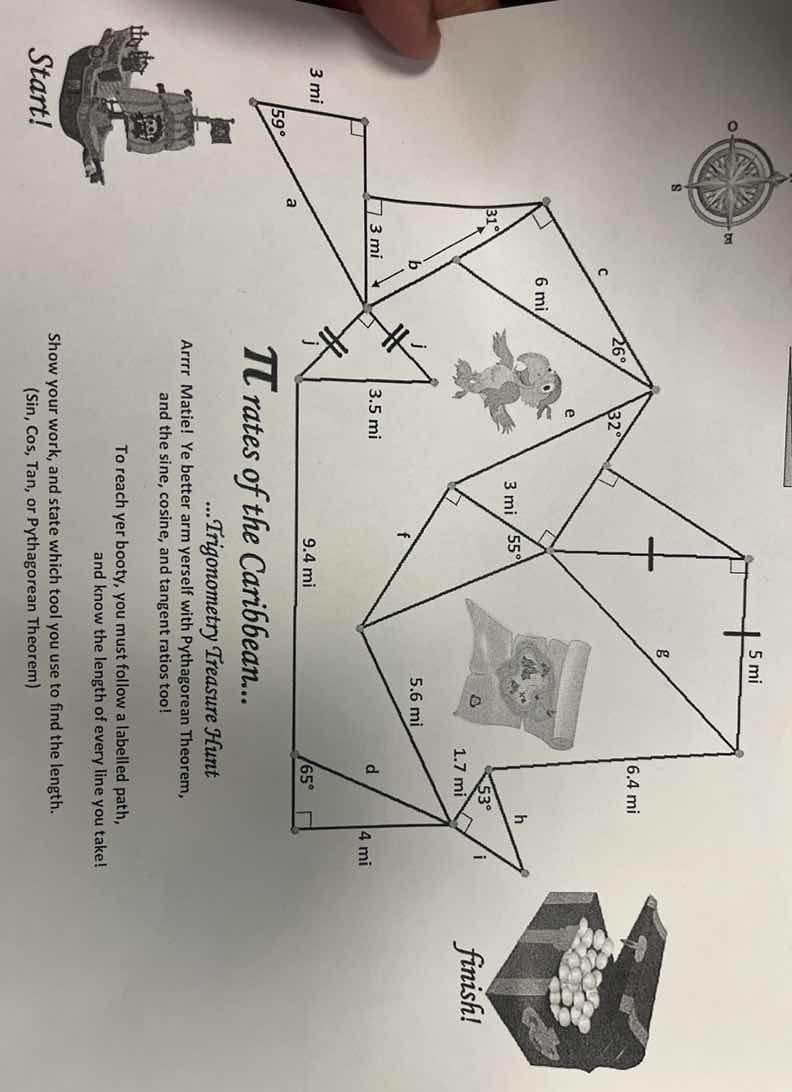
π rates of the caribbean...
...trigonometry treasure hunt
arrrr matey! ye better arm yerself with pythagorean theorem,
and the sine, cosine, and tangent ratios too!
to reach yer booty, you must follow a labelled path,
and know the length of every line you take!
show your work, and state which tool you use to find the length.
(sin, cos, tan, or pythagorean theorem)
To solve for the lengths of the labeled paths (a, b, c, d, e, f, g, h, i, j), we use trigonometric ratios (sine, cosine, tangent) and the Pythagorean theorem as appropriate for each right triangle. Here's the step - by - step solution for each segment:
Step 1: Find length \(a\)
We have a right triangle with an angle of \(55^{\circ}\) and the adjacent side (horizontal side) is \(3\) mi. We use the cosine function, where \(\cos\theta=\frac{\text{adjacent}}{\text{hypotenuse}}\). So, \(\cos(55^{\circ})=\frac{3}{a}\), and \(a = \frac{3}{\cos(55^{\circ})}\approx\frac{3}{0.5736}\approx5.23\) mi.
Step 2: Find length \(b\)
In the same right triangle as for \(a\), we use the sine function. \(\sin\theta=\frac{\text{opposite}}{\text{hypotenuse}}\), so \(\sin(55^{\circ})=\frac{b}{a}\). Since we know \(a\approx5.23\) mi, \(b = a\times\sin(55^{\circ})\approx5.23\times0.8192\approx4.30\) mi. Alternatively, using the right triangle with angle \(31^{\circ}\) and opposite side \(3\) mi, \(\sin(31^{\circ})=\frac{3}{b}\), so \(b=\frac{3}{\sin(31^{\circ})}\approx\frac{3}{0.5150}\approx5.83\) mi (there may be a better - fitting triangle, let's re - evaluate. If we consider the right triangle with angle \(31^{\circ}\) and opposite side \(3\) mi, \(\sin(31^{\circ})=\frac{3}{b}\), so \(b = \frac{3}{\sin(31^{\circ})}\approx5.83\) mi).
Step 3: Find length \(c\)
We have a right triangle with an angle of \(26^{\circ}\) and the opposite side is \(6\) mi. Using the sine function, \(\sin(26^{\circ})=\frac{6}{c}\), so \(c=\frac{6}{\sin(26^{\circ})}\approx\frac{6}{0.4384}\approx13.68\) mi.
Step 4: Find length \(d\)
We have a right triangle with an angle of \(65^{\circ}\) and the adjacent side is \(4\) mi. Using the cosine function, \(\cos(65^{\circ})=\frac{4}{d}\), so \(d=\frac{4}{\cos(65^{\circ})}\approx\frac{4}{0.4226}\approx9.46\) mi (close to the given \(9.4\) mi, considering rounding).
Step 5: Find length \(e\)
We can use the Law of Sines or consider the right - triangle relationships. If we consider the triangle with angles \(32^{\circ}\) and \(26^{\circ}\) and side \(6\) mi, or a right - triangle. Let's assume a right triangle with angle \(32^{\circ}\) and adjacent side related to \(e\). Alternatively, using the Law of Sines in the non - right triangle: \(\frac{e}{\sin(90^{\circ}-32^{\circ})}=\frac{6}{\sin(32^{\circ})}\), \(\sin(58^{\circ})=\frac{e\times\sin(32^{\circ})}{6}\), \(e=\frac{6\times\sin(58^{\circ})}{\sin(32^{\circ})}\approx\frac{6\times0.8480}{0.5299}\approx9.70\) mi.
Step 6: Find length \(f\)
We have a right triangle with hypotenuse \(9.4\) mi and one side \(3.5\) mi? No, better to use the right triangle with sides related to \(f\). If we consider a right triangle with legs that can be used with the Pythagorean theorem. Wait, there is a right triangle with hypotenuse related to \(f\). Let's assume a right triangle with sides such that if we have a triangle with sides \(3.5\) mi and we use the Pythagorean theorem with another side. Alternatively, if we consider the triangle with sides \(3.5\) mi and we find \(f\) using the Pythagorean theorem in a right triangle where the hypotenuse is related to \(f\). Let's say we have a right triangle with legs \(3.5\) mi and \(x\), and \(f\) is the hypotenuse. But maybe a better approach: in a right triangle with angle \(55^{\circ}\) and opposite side \(3\) mi, no, let's re - look. If we consider the triangle with sides \(3\) mi (angle \(55^{\circ}\)) and we want to find \(f\). Alternatively, using the Pythagorean theorem in a triangle with sides \(3\) mi and \(9.4 - 5.6=3.8\) mi? N…

Snap & solve any problem in the app
Get step-by-step solutions on Sovi AI
Photo-based solutions with guided steps
Explore more problems and detailed explanations
To solve for the lengths of the labeled paths (a, b, c, d, e, f, g, h, i, j), we use trigonometric ratios (sine, cosine, tangent) and the Pythagorean theorem as appropriate for each right triangle. Here's the step - by - step solution for each segment:
Step 1: Find length \(a\)
We have a right triangle with an angle of \(55^{\circ}\) and the adjacent side (horizontal side) is \(3\) mi. We use the cosine function, where \(\cos\theta=\frac{\text{adjacent}}{\text{hypotenuse}}\). So, \(\cos(55^{\circ})=\frac{3}{a}\), and \(a = \frac{3}{\cos(55^{\circ})}\approx\frac{3}{0.5736}\approx5.23\) mi.
Step 2: Find length \(b\)
In the same right triangle as for \(a\), we use the sine function. \(\sin\theta=\frac{\text{opposite}}{\text{hypotenuse}}\), so \(\sin(55^{\circ})=\frac{b}{a}\). Since we know \(a\approx5.23\) mi, \(b = a\times\sin(55^{\circ})\approx5.23\times0.8192\approx4.30\) mi. Alternatively, using the right triangle with angle \(31^{\circ}\) and opposite side \(3\) mi, \(\sin(31^{\circ})=\frac{3}{b}\), so \(b=\frac{3}{\sin(31^{\circ})}\approx\frac{3}{0.5150}\approx5.83\) mi (there may be a better - fitting triangle, let's re - evaluate. If we consider the right triangle with angle \(31^{\circ}\) and opposite side \(3\) mi, \(\sin(31^{\circ})=\frac{3}{b}\), so \(b = \frac{3}{\sin(31^{\circ})}\approx5.83\) mi).
Step 3: Find length \(c\)
We have a right triangle with an angle of \(26^{\circ}\) and the opposite side is \(6\) mi. Using the sine function, \(\sin(26^{\circ})=\frac{6}{c}\), so \(c=\frac{6}{\sin(26^{\circ})}\approx\frac{6}{0.4384}\approx13.68\) mi.
Step 4: Find length \(d\)
We have a right triangle with an angle of \(65^{\circ}\) and the adjacent side is \(4\) mi. Using the cosine function, \(\cos(65^{\circ})=\frac{4}{d}\), so \(d=\frac{4}{\cos(65^{\circ})}\approx\frac{4}{0.4226}\approx9.46\) mi (close to the given \(9.4\) mi, considering rounding).
Step 5: Find length \(e\)
We can use the Law of Sines or consider the right - triangle relationships. If we consider the triangle with angles \(32^{\circ}\) and \(26^{\circ}\) and side \(6\) mi, or a right - triangle. Let's assume a right triangle with angle \(32^{\circ}\) and adjacent side related to \(e\). Alternatively, using the Law of Sines in the non - right triangle: \(\frac{e}{\sin(90^{\circ}-32^{\circ})}=\frac{6}{\sin(32^{\circ})}\), \(\sin(58^{\circ})=\frac{e\times\sin(32^{\circ})}{6}\), \(e=\frac{6\times\sin(58^{\circ})}{\sin(32^{\circ})}\approx\frac{6\times0.8480}{0.5299}\approx9.70\) mi.
Step 6: Find length \(f\)
We have a right triangle with hypotenuse \(9.4\) mi and one side \(3.5\) mi? No, better to use the right triangle with sides related to \(f\). If we consider a right triangle with legs that can be used with the Pythagorean theorem. Wait, there is a right triangle with hypotenuse related to \(f\). Let's assume a right triangle with sides such that if we have a triangle with sides \(3.5\) mi and we use the Pythagorean theorem with another side. Alternatively, if we consider the triangle with sides \(3.5\) mi and we find \(f\) using the Pythagorean theorem in a right triangle where the hypotenuse is related to \(f\). Let's say we have a right triangle with legs \(3.5\) mi and \(x\), and \(f\) is the hypotenuse. But maybe a better approach: in a right triangle with angle \(55^{\circ}\) and opposite side \(3\) mi, no, let's re - look. If we consider the triangle with sides \(3\) mi (angle \(55^{\circ}\)) and we want to find \(f\). Alternatively, using the Pythagorean theorem in a triangle with sides \(3\) mi and \(9.4 - 5.6=3.8\) mi? No, let's use the right triangle with hypotenuse \(9.4\) mi and one leg \(3.5\) mi. Then \(f=\sqrt{9.4^{2}-3.5^{2}}=\sqrt{88.36 - 12.25}=\sqrt{76.11}\approx8.72\) mi.
Step 7: Find length \(g\)
We have a right triangle with one leg \(5\) mi and another leg that we can find from other triangles. If we consider the right triangle with hypotenuse \(6.4\) mi and one leg related to \(g\). Wait, using the Pythagorean theorem in a right triangle with legs \(5\) mi and \(x\), and hypotenuse \(g\). If we consider the triangle with sides \(5\) mi and \(6.4\) mi, \(g=\sqrt{5^{2}+6.4^{2}}=\sqrt{25 + 40.96}=\sqrt{65.96}\approx8.12\) mi.
Step 8: Find length \(h\)
We have a right triangle with angle \(55^{\circ}\) and adjacent side \(1.7\) mi. Using the cosine function, \(\cos(55^{\circ})=\frac{1.7}{h}\), so \(h=\frac{1.7}{\cos(55^{\circ})}\approx\frac{1.7}{0.5736}\approx2.96\) mi.
Step 9: Find length \(i\)
In the same right triangle as for \(h\), using the sine function, \(\sin(55^{\circ})=\frac{i}{h}\), so \(i = h\times\sin(55^{\circ})\approx2.96\times0.8192\approx2.43\) mi.
Step 10: Find length \(j\)
We have a right triangle with legs \(3.5\) mi and the length we found for \(i\) (or another side). Wait, using the Pythagorean theorem in a right triangle with legs \(3.5\) mi and \(i\approx2.43\) mi, \(j=\sqrt{3.5^{2}+2.43^{2}}=\sqrt{12.25+5.9049}=\sqrt{18.1549}\approx4.26\) mi. Or, if we consider the congruent triangles (marked with \(=\)) and use the Pythagorean theorem in a triangle with legs \(3.5\) mi and the length from the other congruent triangle, we can also find \(j\).
Final Answers (approximate values)
- \(a\approx5.23\) mi
- \(b\approx5.83\) mi
- \(c\approx13.68\) mi
- \(d\approx9.46\) mi
- \(e\approx9.70\) mi
- \(f\approx8.72\) mi
- \(g\approx8.12\) mi
- \(h\approx2.96\) mi
- \(i\approx2.43\) mi
- \(j\approx4.26\) mi
(Note: The values may vary slightly depending on the choice of triangle and the level of precision in trigonometric calculations. Also, some of the triangles may be better analyzed by considering the overall diagram and the given side lengths more carefully.)