QUESTION IMAGE
Question
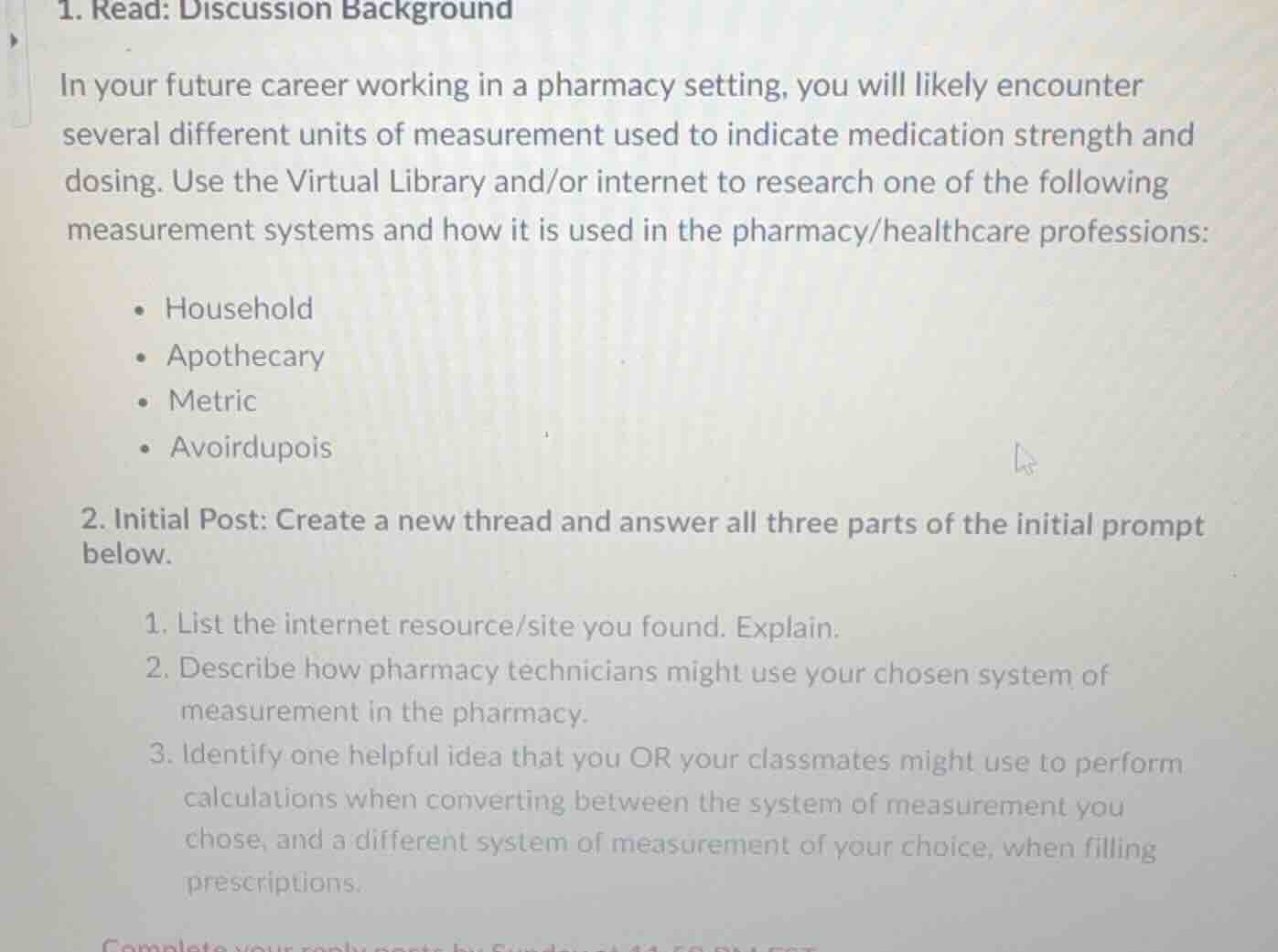
- read: discussion background
in your future career working in a pharmacy setting, you will likely encounter several different units of measurement used to indicate medication strength and dosing. use the virtual library and/or internet to research one of the following measurement systems and how it is used in the pharmacy/healthcare professions:
- household
- apothecary
- metric
- avoirdupois
- initial post: create a new thread and answer all three parts of the initial prompt below.
- list the internet resource/site you found. explain.
- describe how pharmacy technicians might use your chosen system of measurement in the pharmacy.
- identify one helpful idea that you or your classmates might use to perform calculations when converting between the system of measurement you chose, and a different system of measurement of your choice, when filling prescriptions.
To address this, we'll choose the Metric system (a common choice for pharmacy due to its standardization) and follow the three - part prompt:
Part 1: Internet Resource
- Resource: https://www.pharmacytimes.com/view/measurement-systems-in-pharmacy - practice
- Explanation: This website is a well - known resource in the pharmacy field. It offers in - depth articles on various aspects of pharmacy practice, including measurement systems. It is likely to have accurate and up - to - date information about how the metric system is used in pharmacy, as well as comparisons with other systems.
Part 2: Use of the Metric System by Pharmacy Technicians
Pharmacy technicians use the metric system in multiple ways:
- Drug Dosage Calculation: When preparing liquid medications (e.g., syrups), they use milliliters ($mL$) to measure the volume of the liquid. For solid medications like tablets or capsules, they use milligrams ($mg$) or grams ($g$) to measure the mass of the active ingredient. For example, if a prescription calls for 500 $mg$ of amoxicillin, the technician will use the metric system to ensure the correct amount is dispensed.
- Compounding Medications: In compounding, where they mix different ingredients to create a custom - made medication, the metric system is used to measure the quantities of each ingredient precisely. For instance, if they are making a topical cream and need to add 2 $g$ of a particular active ingredient to 100 $g$ of the base cream, the metric system allows for accurate measurement.
- Inventory Management: When managing the inventory of medications, they use metric units to record the quantity of each drug in stock. For example, a bottle of ibuprofen tablets might be recorded as containing 100 tablets, each with 200 $mg$ of ibuprofen, and the total mass of ibuprofen in the bottle can be calculated using metric units.
Part 3: Conversion Idea
Let's consider converting between the Metric and Household systems (since patients often use household measurements at home).
- Helpful Idea: Create a simple conversion chart or use a mobile app with conversion formulas. For example, we know that 1 teaspoon (a common household volume unit) is approximately equal to 5 $mL$ (a metric volume unit). So, if a prescription says to take 10 $mL$ of a liquid medication, the technician can tell the patient that this is approximately 2 teaspoons. When doing the conversion, the formula is: Number of teaspoons = $\frac{Volume\ in\ mL}{5}$. Similarly, for weight, if a patient is used to thinking in ounces (household weight unit), and the medication is measured in grams, we know that 1 ounce is approximately 28.35 $g$. So, to convert grams to ounces, the formula is: Ounces = $\frac{Grams}{28.35}$. This way, when filling prescriptions, technicians can help patients understand the dosage in a unit they are familiar with while still using the metric system for accurate dispensing.
Final Answer (Summary of the Three - Part Response)
- Resource: https://www.pharmacytimes.com/view/measurement-systems-in-pharmacy - practice (a reliable pharmacy - focused site with info on measurement systems).
- Use in Pharmacy: Used for drug dosage calculation, compounding, and inventory management (e.g., $mL$, $mg$, $g$ for liquids/solids).
- Conversion Idea: Use a conversion chart/app with formulas (e.g., 1 tsp ≈ 5 $mL$; 1 oz ≈ 28.35 $g$) to convert between Metric and Household systems for patient understanding.

Snap & solve any problem in the app
Get step-by-step solutions on Sovi AI
Photo-based solutions with guided steps
Explore more problems and detailed explanations
To address this, we'll choose the Metric system (a common choice for pharmacy due to its standardization) and follow the three - part prompt:
Part 1: Internet Resource
- Resource: https://www.pharmacytimes.com/view/measurement-systems-in-pharmacy - practice
- Explanation: This website is a well - known resource in the pharmacy field. It offers in - depth articles on various aspects of pharmacy practice, including measurement systems. It is likely to have accurate and up - to - date information about how the metric system is used in pharmacy, as well as comparisons with other systems.
Part 2: Use of the Metric System by Pharmacy Technicians
Pharmacy technicians use the metric system in multiple ways:
- Drug Dosage Calculation: When preparing liquid medications (e.g., syrups), they use milliliters ($mL$) to measure the volume of the liquid. For solid medications like tablets or capsules, they use milligrams ($mg$) or grams ($g$) to measure the mass of the active ingredient. For example, if a prescription calls for 500 $mg$ of amoxicillin, the technician will use the metric system to ensure the correct amount is dispensed.
- Compounding Medications: In compounding, where they mix different ingredients to create a custom - made medication, the metric system is used to measure the quantities of each ingredient precisely. For instance, if they are making a topical cream and need to add 2 $g$ of a particular active ingredient to 100 $g$ of the base cream, the metric system allows for accurate measurement.
- Inventory Management: When managing the inventory of medications, they use metric units to record the quantity of each drug in stock. For example, a bottle of ibuprofen tablets might be recorded as containing 100 tablets, each with 200 $mg$ of ibuprofen, and the total mass of ibuprofen in the bottle can be calculated using metric units.
Part 3: Conversion Idea
Let's consider converting between the Metric and Household systems (since patients often use household measurements at home).
- Helpful Idea: Create a simple conversion chart or use a mobile app with conversion formulas. For example, we know that 1 teaspoon (a common household volume unit) is approximately equal to 5 $mL$ (a metric volume unit). So, if a prescription says to take 10 $mL$ of a liquid medication, the technician can tell the patient that this is approximately 2 teaspoons. When doing the conversion, the formula is: Number of teaspoons = $\frac{Volume\ in\ mL}{5}$. Similarly, for weight, if a patient is used to thinking in ounces (household weight unit), and the medication is measured in grams, we know that 1 ounce is approximately 28.35 $g$. So, to convert grams to ounces, the formula is: Ounces = $\frac{Grams}{28.35}$. This way, when filling prescriptions, technicians can help patients understand the dosage in a unit they are familiar with while still using the metric system for accurate dispensing.
Final Answer (Summary of the Three - Part Response)
- Resource: https://www.pharmacytimes.com/view/measurement-systems-in-pharmacy - practice (a reliable pharmacy - focused site with info on measurement systems).
- Use in Pharmacy: Used for drug dosage calculation, compounding, and inventory management (e.g., $mL$, $mg$, $g$ for liquids/solids).
- Conversion Idea: Use a conversion chart/app with formulas (e.g., 1 tsp ≈ 5 $mL$; 1 oz ≈ 28.35 $g$) to convert between Metric and Household systems for patient understanding.