QUESTION IMAGE
Question
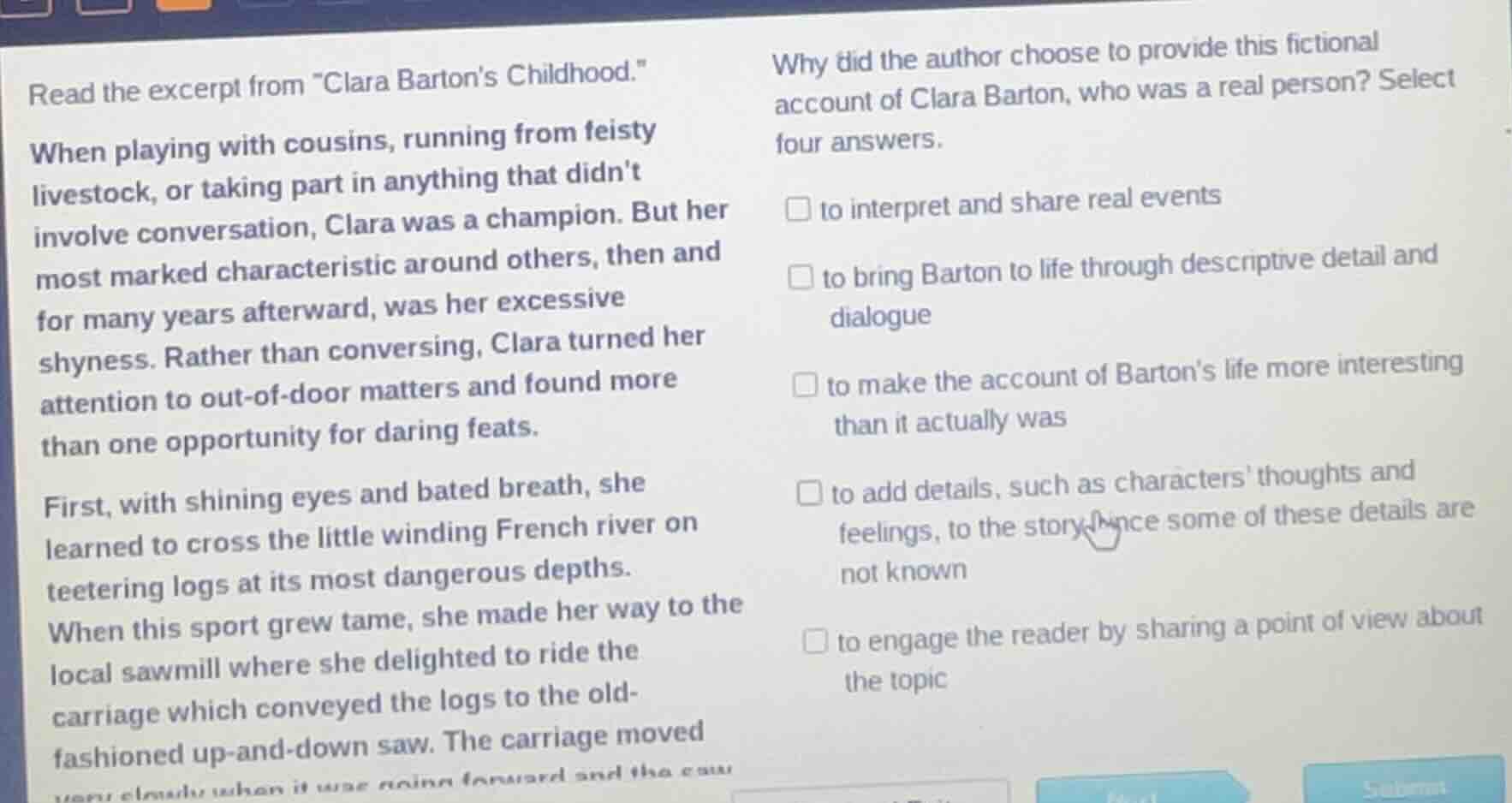
read the excerpt from \clara bartons childhood.\when playing with cousins, running from feisty livestock, or taking part in anything that didnt involve conversation, clara was a champion. but her most marked characteristic around others, then and for many years afterward, was her excessive shyness. rather than conversing, clara turned her attention to out-of-door matters and found more than one opportunity for daring feats.first, with shining eyes and bated breath, she learned to cross the little winding french river on teetering logs at its most dangerous depths.when this sport grew tame, she made her way to the local sawmill where she delighted to ride the carriage which conveyed the logs to the old-fashioned up-and-down saw. the carriage movedwhy did the author choose to provide this fictional account of clara barton, who was a real person? select four answers.□ to interpret and share real events□ to bring barton to life through descriptive detail and dialogue□ to make the account of bartons life more interesting than it actually was□ to add details, such as characters thoughts and feelings, to the story since some of these details are not known□ to engage the reader by sharing a point of view about the topic
Fictionalized accounts of real people serve to humanize them, add engaging context, interpret real events, and include plausible unrecorded details, while they do not fabricate to make the life seem more interesting than it was.
- Interpreting real events is a core goal of fictionalized biography, as it frames facts with narrative.
- Descriptive details and dialogue bring a real person to life for readers, making them relatable.
- Adding unrecorded details like thoughts/feelings fills gaps in historical records with plausible context.
- Sharing a specific point of view engages readers by making the account more personal and immersive.

Snap & solve any problem in the app
Get step-by-step solutions on Sovi AI
Photo-based solutions with guided steps
Explore more problems and detailed explanations
- to interpret and share real events
- to bring Barton to life through descriptive detail and dialogue
- to add details, such as characters' thoughts and feelings, to the story since some of these details are not known
- to engage the reader by sharing a point of view about the topic