QUESTION IMAGE
Question
read the excerpt from
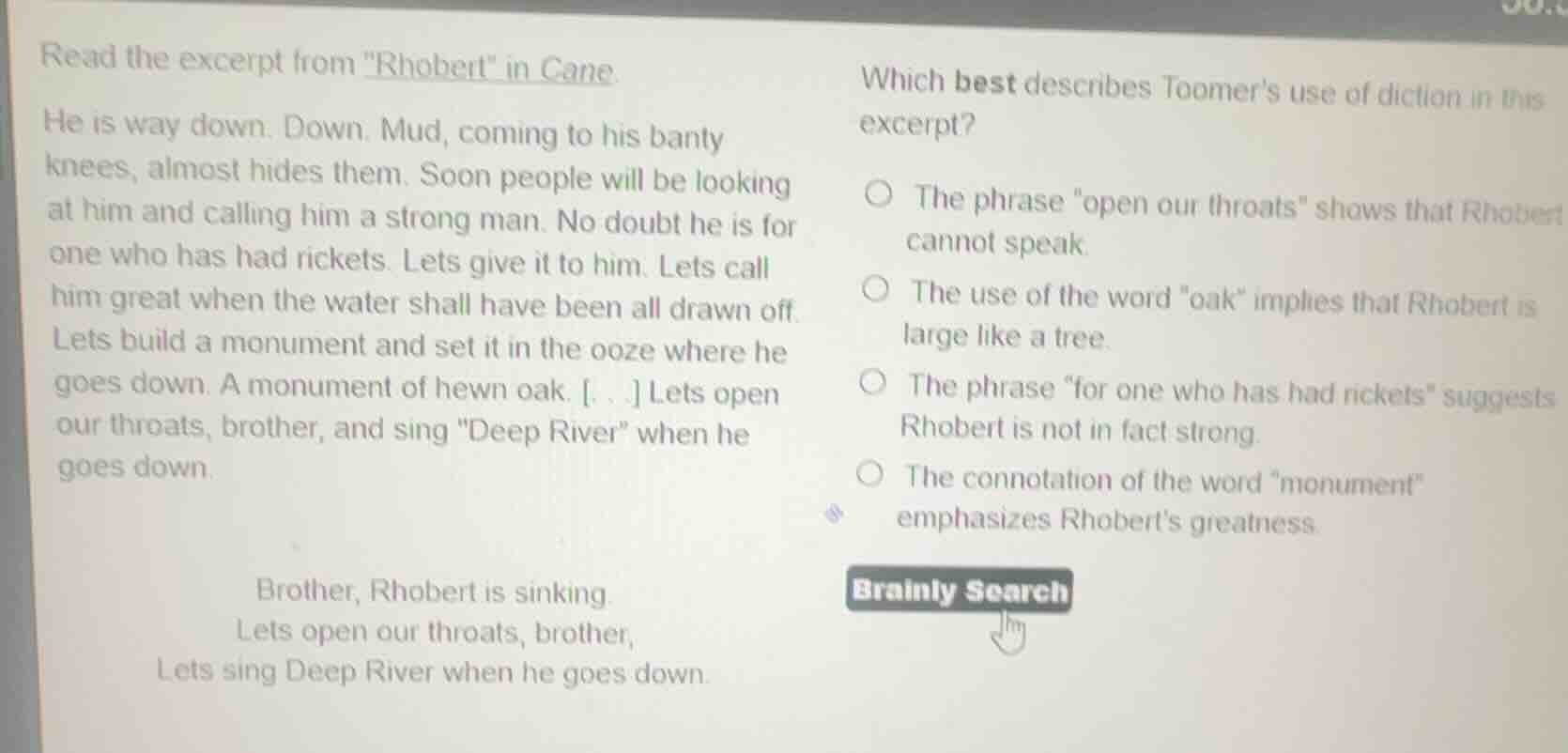
hobert\ in cane.he is way down. down. mud, coming to his banty knees, almost hides them. soon people will be looking at him and calling him a strong man. no doubt he is for one who has had rickets. lets give it to him. lets call him great when the water shall have been all drawn off. lets build a monument and set it in the ooze where he goes down. a monument of hewn oak. . . . lets open our throats, brother, and sing \deep river\ when he goes down.brother, rhobert is sinking.lets open our throats, brother,lets sing deep river when he goes down.which best describes toomers use of diction in this excerpt?○ the phrase \open our throats\ shows that rhobert cannot speak.○ the use of the word \oak\ implies that rhobert is large like a tree.○ the phrase \for one who has had rickets\ suggests rhobert is not in fact strong.○ the connotation of the word \monument\ emphasizes rhoberts greatness.
- The first option is incorrect: "open our throats" refers to singing, not that Rhobert cannot speak.
- The second option is incorrect: "oak" describes the monument, not Rhobert's size.
- The third option is correct: Rickets is a condition that causes weak bones, so the phrase undermines the idea that Rhobert is actually strong, contrasting with the sarcastic call to label him "great."
- The fourth option is incorrect: The monument is proposed to be placed in "ooze" where Rhobert sinks, which is sarcastic, not a sincere emphasis of his greatness.

Snap & solve any problem in the app
Get step-by-step solutions on Sovi AI
Photo-based solutions with guided steps
Explore more problems and detailed explanations
C. The phrase "for one who has had rickets" suggests Rhobert is not in fact strong.