QUESTION IMAGE
Question
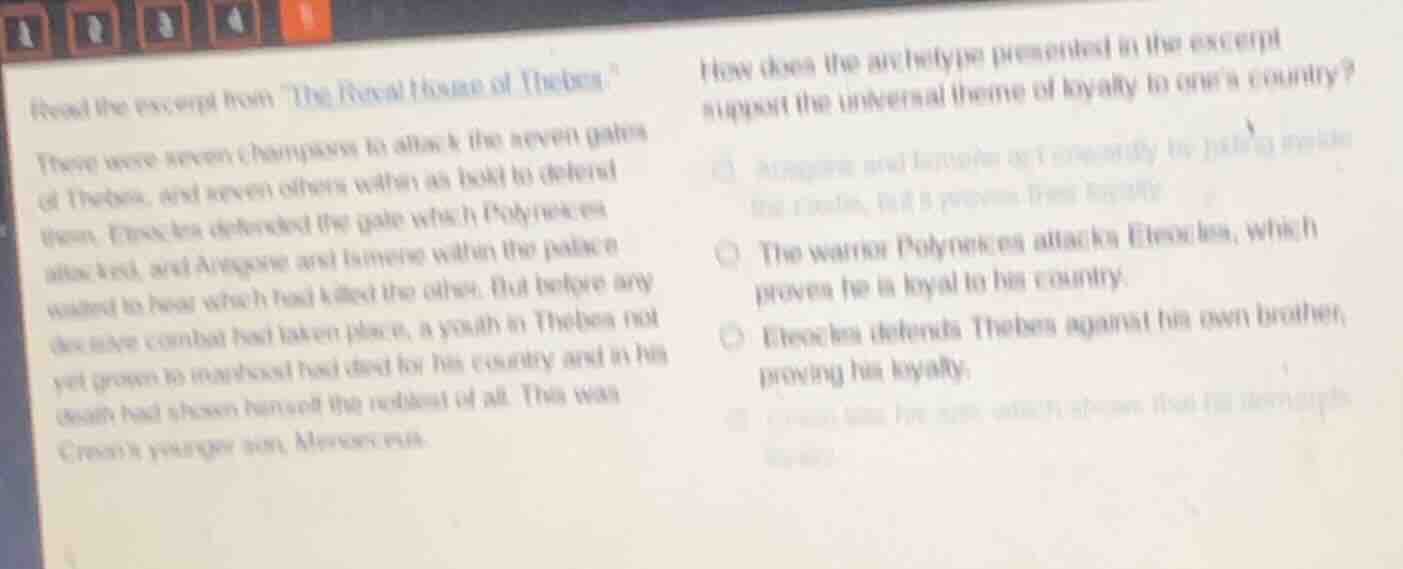
read the excerpt from the royal house of thebes
there were seven champions to attack the seven gates of thebes, and seven others within as bold to defend them. eteocles defended the gate which polynices attacked, and antigone and ismene within the palace waited to hear which had killed the other. but before any decisive combat had taken place, a youth in thebes not yet grown to manhood had died for his country and in his death had shown himself the noblest of all. this was creon’s younger son, menoeceus.
how does the archetype presented in the excerpt support the universal theme of loyalty to one’s country?
(options are partially visible, but the structure is a multiple - choice question about literary analysis of archetype and theme in a text excerpt)
To determine the correct option, we analyze each choice:
- Option 1: The description about "Amphion and Zethus" doesn't clearly relate to loyalty to the country as per the excerpt.
- Option 2: Polynices attacking doesn't show loyalty to his country; attacking Thebes (his own country's gate) is against loyalty.
- Option 3: Eteocles defends Thebes against his own brother (Polynices), which shows he is loyal to his country as he is protecting it from an attacker (even if the attacker is his brother).
- Option 4: The text about "Creon's five men" is unclear and doesn't match the excerpt's focus on Eteocles and Polynices' conflict related to Thebes' defense.
So the correct option is the one where Eteocles defends Thebes against his brother, proving loyalty.

Snap & solve any problem in the app
Get step-by-step solutions on Sovi AI
Photo-based solutions with guided steps
Explore more problems and detailed explanations
C. Eteocles defends Thebes against his own brother, proving his loyalty.