QUESTION IMAGE
Question
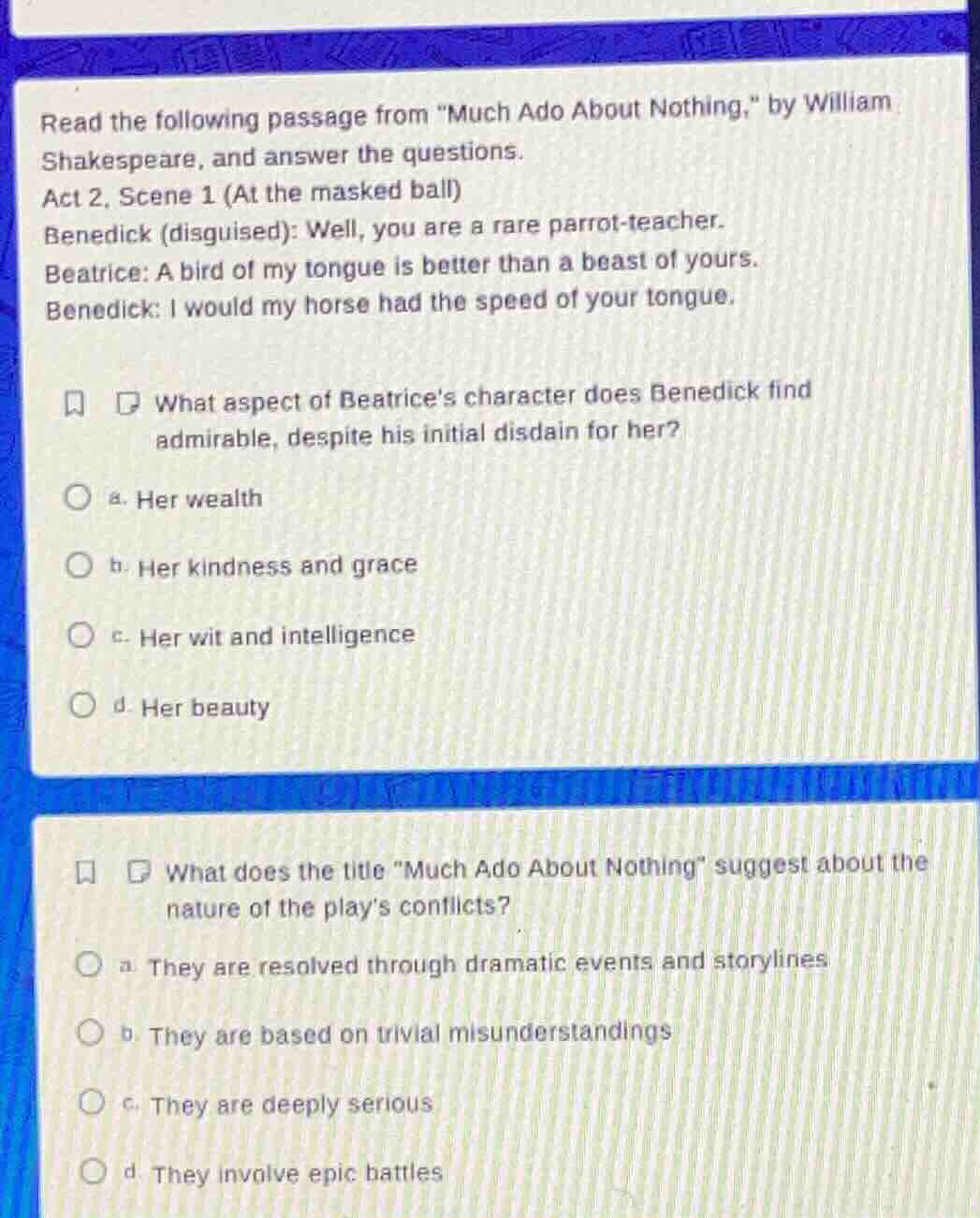
read the following passage from \much ado about nothing,\ by william shakespeare, and answer the questions. act 2, scene 1 (at the masked ball) benedick (disguised): well, you are a rare parrot - teacher. beatrice: a bird of my tongue is better than a beast of yours. benedick: i would my horse had the speed of your tongue. what aspect of beatrices character does benedick find admirable, despite his initial disdain for her? a. her wealth b. her kindness and grace c. her wit and intelligence d. her beauty what does the title \much ado about nothing\ suggest about the nature of the plays conflicts? a. they are resolved through dramatic events and storylines b. they are based on trivial misunderstandings c. they are deeply serious d. they involve epic battles
First Question:
In the passage, Benedick comments on Beatrice's "tongue" (her way of speaking). His remarks like "a bird of my tongue is better than a beast of yours" and "I would my horse had the speed of your tongue" highlight her quick - witted and intelligent speech. Option a (wealth) is not mentioned, option b (kindness and grace) is not shown in the dialogue, and option d (beauty) is not discussed. So the aspect he finds admirable is her wit and intelligence.
The title "Much Ado About Nothing" means that a lot of fuss is made over things that are trivial. In the play, the conflicts often arise from misunderstandings that are not very significant. Option a (resolved through dramatic events) doesn't fit the title's implication. Option c (deeply serious) is opposite to the idea of "nothing" in the title. Option d (involve epic battles) is also not in line with the title's meaning as the play's conflicts are not epic. So the conflicts are based on trivial misunderstandings.

Snap & solve any problem in the app
Get step-by-step solutions on Sovi AI
Photo-based solutions with guided steps
Explore more problems and detailed explanations
c. Her wit and intelligence