QUESTION IMAGE
Question
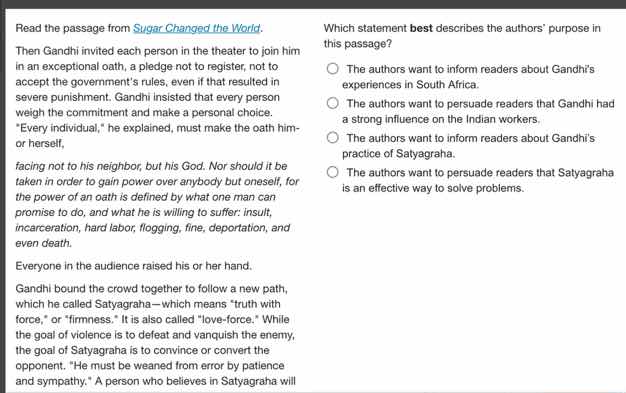
read the passage from sugar changed the world. then gandhi invited each person in the theater to join him in an exceptional oath, a pledge not to register, not to accept the government’s rules, even if that resulted in severe punishment. gandhi insisted that every person “weigh the commitment and make a personal choice. every individual,” he explained, must make the oath him - or herself, not to his neighbor, but his god. nor should it be taken in order to gain power over anybody but oneself, for the power of an oath is defined by what one man can promise to do, and what is willing to suffer: insult, incarceration, hard labor, flogging, fine, deportation, and even death. everyone in the audience raised his or her hand. gandhi bound the crowd together to follow a new path, which he called satyagraha — which means “truth with force,” or “firmness.” it is also called “love - force.” while the goal of violence is to defeat and annihilate the enemy, the goal of satyagraha is to convince or convert the opponent. “he must be weaned from error by patience and sympathy.” a person who believes in satyagraha will which statement best describes the authors’ purpose in this passage? the authors want to inform readers about gandhi’s experiences in south africa. the authors want to persuade readers that gandhi had a strong influence on indian workers. the authors want to inform readers about gandhi’s practice of satyagraha. the authors want to persuade readers that satyagraha is an effective way to solve problems.
The passage explains Gandhi's practice of Satyagraha, including its meaning ("truth with force" or "firmness", also "love - force"), its principles (using patience and sympathy to convince the opponent, not using violence), and how Gandhi got people to commit to it. The first option is incorrect as the passage isn't mainly about his South Africa experiences. The second option is wrong as the passage doesn't focus on his influence on Indian workers. The fourth option is incorrect as the passage is informative about Satyagraha, not persuasive about it being an effective problem - solving way. The third option accurately describes the purpose as the passage is informing readers about Gandhi's practice of Satyagraha.

Snap & solve any problem in the app
Get step-by-step solutions on Sovi AI
Photo-based solutions with guided steps
Explore more problems and detailed explanations
C. The authors want to inform readers about Gandhi’s practice of Satyagraha.