QUESTION IMAGE
Question
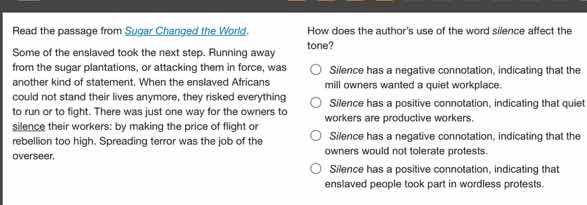
read the passage from sugar changed the world.
some of the enslaved took the next step. running away from the sugar plantations, or attacking them in force, was another kind of statement. when the enslaved africans could not stand their lives anymore, they risked everything to run or to fight. there was just one way for the owners to silence their workers: by making the price of flight or overseer.
how does the author’s use of the word silence affect the tone?
- silence has a negative connotation, indicating that the mill owners wanted a quiet workplace.
- silence has a positive connotation, indicating that quiet workers are productive workers.
- silence has a negative connotation, indicating that the owners would not tolerate protest.
- silence has a positive connotation, indicating that the enslaved people took part in wordless protests.
To determine the effect of "silence" on tone, we analyze the context. The passage is about enslaved people and owners' control. Owners used "silence" (via high flight costs, terror) to suppress rebellion. So "silence" here has a negative connotation (owners' oppressive control, not tolerating protest). Let's evaluate options:
- Option 1: "quiet workplace" is irrelevant to the context of slavery and rebellion. Eliminate.
- Option 2: "positive connotation" and "quiet workers are productive" don't match the oppressive context. Eliminate.
- Option 3: Matches the negative connotation (owners suppressing protest via "silence" tactics). Correct.
- Option 4: "positive connotation" and "wordless protests" are incorrect; the context is about owners' suppression, not enslaved protests being wordless/positive. Eliminate.

Snap & solve any problem in the app
Get step-by-step solutions on Sovi AI
Photo-based solutions with guided steps
Explore more problems and detailed explanations
C. Silence has a negative connotation, indicating that the owners would not tolerate protest.