QUESTION IMAGE
Question
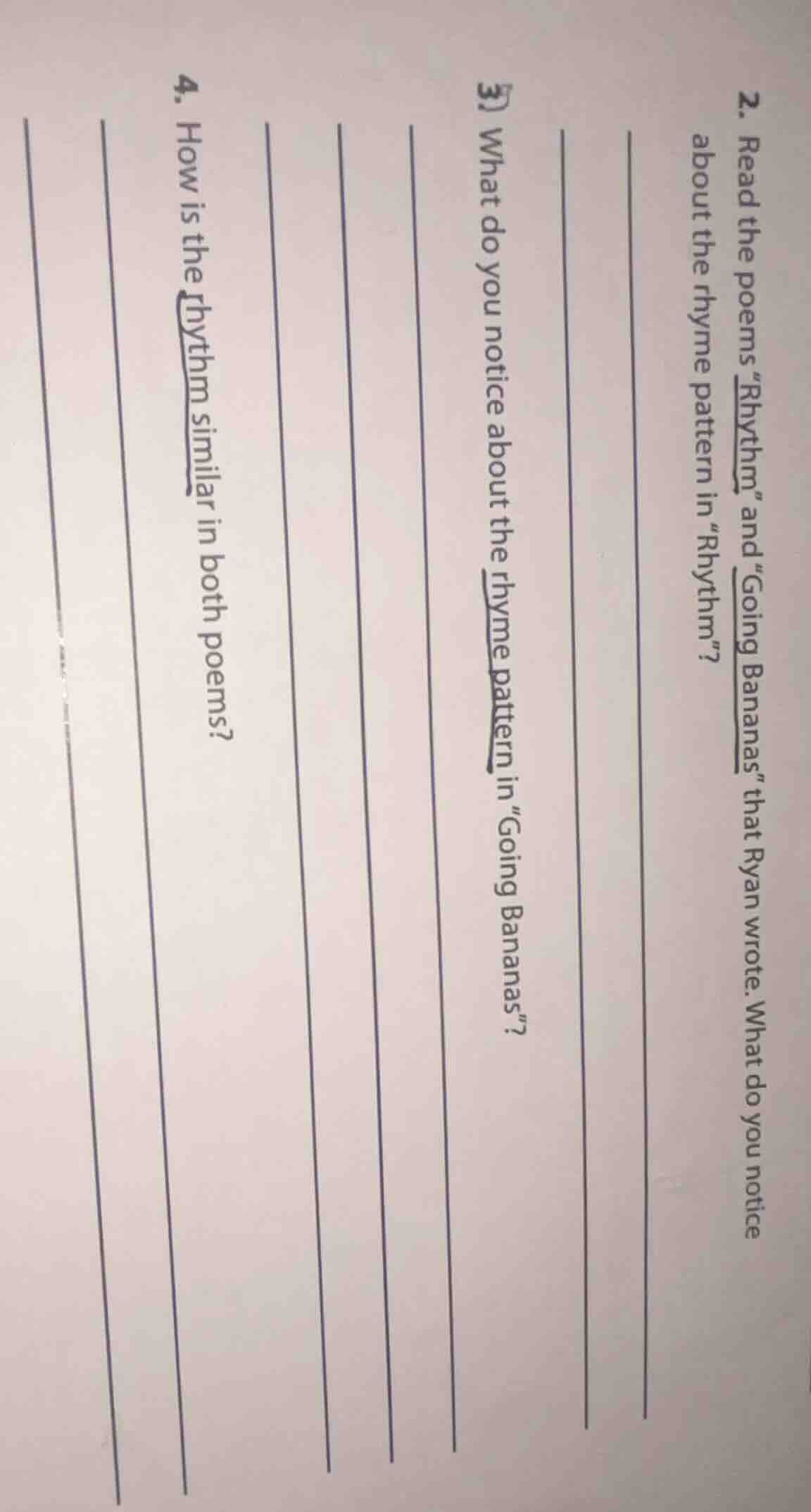
- read the poems
hythm\ and \going bananas\ that ryan wrote. what do you notice about the rhyme pattern in
hythm\?
- what do you notice about the rhyme pattern in \going bananas\?
- how is the rhythm similar in both poems?
To answer these questions, we would need the actual text of the poems "Rhythm" and "Going Bananas" by Ryan. Since the poems are not provided, we can't analyze their rhyme patterns or rhythmic similarities directly. However, here's a general approach to answering such questions once the poems are available:
For Question 2 (Rhyme pattern in "Rhythm"):
- Identify Rhyme Scheme: Label the end of each line with a letter (e.g., A, B, C) based on which lines rhyme. If line 1 and line 3 rhyme, they get the same letter; if line 2 and line 4 rhyme, they get another letter. For example, if the poem has lines ending with "cat", "hat", "dog", "log", the rhyme scheme would be AABB.
- Note Rhyme Type: Determine if it's a perfect rhyme (same vowel and consonant sounds, like "cat" and "hat") or a slant rhyme (similar but not identical sounds, like "love" and "move").
- Observe Repetition: See if there's a consistent pattern (e.g., couplets, tercets, quatrains) or if the rhyme scheme changes throughout the poem.
For Question 3 (Rhyme pattern in "Going Bananas"):
Follow the same steps as above: label the end of each line, identify the rhyme scheme (e.g., ABAB, AABB, ABCB), note the type of rhyme, and observe any patterns or changes.
For Question 4 (Similarity in Rhythm):
- Meter Analysis: Check the number of syllables per line and the stress pattern (e.g., iambic pentameter has 10 syllables per line with a stress on the second syllable of each pair). See if both poems have a consistent meter (e.g., both use iambic tetrameter with 8 syllables per line and a stress on every other syllable).
- Rhythmic Devices: Look for devices like alliteration (repetition of initial consonant sounds), assonance (repetition of vowel sounds), or onomatopoeia (words that imitate sounds) that contribute to the rhythm. See if both poems use similar devices.
- Line Length and Structure: Check if both poems have a similar number of syllables per line or if they use similar line breaks (e.g., both have short, punchy lines or long, flowing lines).
If you can provide the text of the poems, I can help with a more detailed analysis!

Snap & solve any problem in the app
Get step-by-step solutions on Sovi AI
Photo-based solutions with guided steps
Explore more problems and detailed explanations
To answer these questions, we would need the actual text of the poems "Rhythm" and "Going Bananas" by Ryan. Since the poems are not provided, we can't analyze their rhyme patterns or rhythmic similarities directly. However, here's a general approach to answering such questions once the poems are available:
For Question 2 (Rhyme pattern in "Rhythm"):
- Identify Rhyme Scheme: Label the end of each line with a letter (e.g., A, B, C) based on which lines rhyme. If line 1 and line 3 rhyme, they get the same letter; if line 2 and line 4 rhyme, they get another letter. For example, if the poem has lines ending with "cat", "hat", "dog", "log", the rhyme scheme would be AABB.
- Note Rhyme Type: Determine if it's a perfect rhyme (same vowel and consonant sounds, like "cat" and "hat") or a slant rhyme (similar but not identical sounds, like "love" and "move").
- Observe Repetition: See if there's a consistent pattern (e.g., couplets, tercets, quatrains) or if the rhyme scheme changes throughout the poem.
For Question 3 (Rhyme pattern in "Going Bananas"):
Follow the same steps as above: label the end of each line, identify the rhyme scheme (e.g., ABAB, AABB, ABCB), note the type of rhyme, and observe any patterns or changes.
For Question 4 (Similarity in Rhythm):
- Meter Analysis: Check the number of syllables per line and the stress pattern (e.g., iambic pentameter has 10 syllables per line with a stress on the second syllable of each pair). See if both poems have a consistent meter (e.g., both use iambic tetrameter with 8 syllables per line and a stress on every other syllable).
- Rhythmic Devices: Look for devices like alliteration (repetition of initial consonant sounds), assonance (repetition of vowel sounds), or onomatopoeia (words that imitate sounds) that contribute to the rhythm. See if both poems use similar devices.
- Line Length and Structure: Check if both poems have a similar number of syllables per line or if they use similar line breaks (e.g., both have short, punchy lines or long, flowing lines).
If you can provide the text of the poems, I can help with a more detailed analysis!