QUESTION IMAGE
Question
reading like a historian
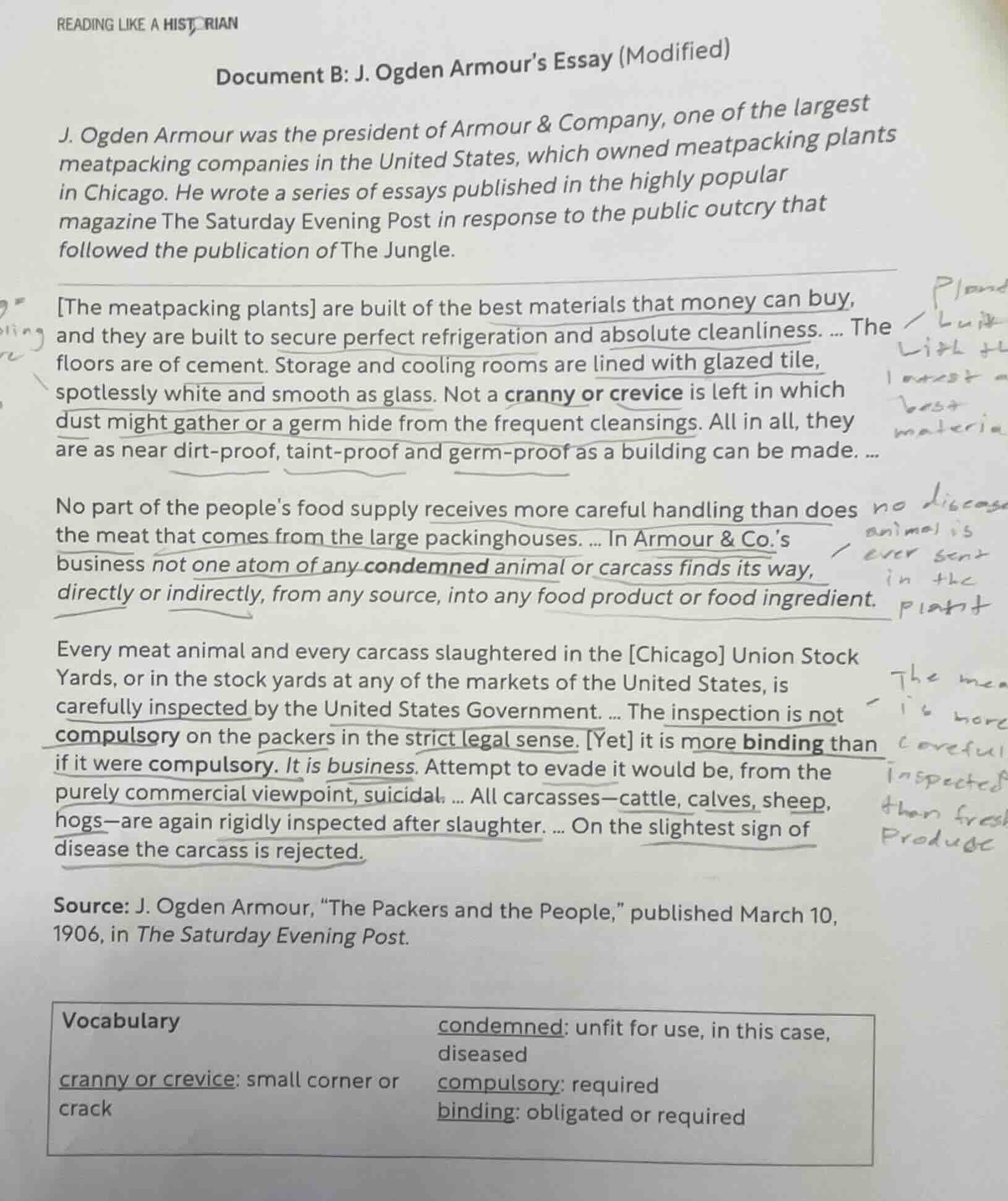
document b: j. ogden armour’s essay (modified)
j. ogden armour was the president of armour & company, one of the largest meatpacking companies in the united states, which owned meatpacking plants in chicago. he wrote a series of essays published in the highly popular magazine the saturday evening post in response to the public outcry that followed the publication of the jungle.
the meatpacking plants are built of the best materials that money can buy, and they are built to secure perfect refrigeration and absolute cleanliness. ... the floors are of cement. storage and cooling rooms are lined with glazed tile, spotlessly white and smooth as glass. not a cranny or crevice is left in which dust might gather or a germ hide from the frequent cleansings. all in all, they are as near dirt - proof, taint - proof and germ - proof as a building can be made. ...
no part of the people’s food supply receives more careful handling than does the meat that comes from the large packinghouses. ... in armour & co.’s business not one atom of any condemned animal or carcass finds its way, directly or indirectly, from any source, into any food product or food ingredient.
every meat animal and every carcass slaughtered in the chicago union stock yards, or in the stock yards at any of the markets of the united states, is carefully inspected by the united states government. ... the inspection is not compulsory on the packers in the strict legal sense. yet it is more binding than if it were compulsory. it is business. attempt to evade it would be, from the purely commercial viewpoint, suicidal. ... all carcasses—cattle, calves, sheep, hogs—are again rigidly inspected after slaughter. ... on the slightest sign of disease the carcass is rejected.
source: j. ogden armour, “the packers and the people,” published march 10, 1906, in the saturday evening post.
vocabulary
cranny or crevice: small corner or crack
condemned: unfit for use, in this case, diseased
compulsory: required
binding: obligated or required
Since no specific question is provided about this document, it's hard to give a targeted answer. If you want to analyze the document (e.g., its historical context, the author's perspective, or the claims made about meatpacking), here's a general breakdown:
(if the question was about the document's content/context):
- Historical Context: The document is a response to Upton Sinclair’s The Jungle (1906), which exposed unsanitary and unethical practices in meatpacking. J. Ogden Armour, a meatpacking industry leader, defends his company’s practices.
- Author’s Perspective: Armour emphasizes the cleanliness of plants, careful handling of meat, and strict inspections to counter public outrage from The Jungle. He argues his company’s operations are hygienic, ethical, and commercially self - regulating (evading inspection would be “suicidal” for business).
- Claims Analysis: He claims plants are “dirt - proof, taint - proof, germ - proof,” no condemned animals enter food products, and inspections (government and post - slaughter) are rigorous (rejecting diseased carcasses). These claims aim to restore public trust in the meatpacking industry.
If you have a specific question (e.g., “What is Armour’s response to public outcry?”, “Analyze the reliability of Armour’s claims.”, etc.), please share it for a more precise answer.

Snap & solve any problem in the app
Get step-by-step solutions on Sovi AI
Photo-based solutions with guided steps
Explore more problems and detailed explanations
(if the question was about the document's content/context):
- Historical Context: The document is a response to Upton Sinclair’s The Jungle (1906), which exposed unsanitary and unethical practices in meatpacking. J. Ogden Armour, a meatpacking industry leader, defends his company’s practices.
- Author’s Perspective: Armour emphasizes the cleanliness of plants, careful handling of meat, and strict inspections to counter public outrage from The Jungle. He argues his company’s operations are hygienic, ethical, and commercially self - regulating (evading inspection would be “suicidal” for business).
- Claims Analysis: He claims plants are “dirt - proof, taint - proof, germ - proof,” no condemned animals enter food products, and inspections (government and post - slaughter) are rigorous (rejecting diseased carcasses). These claims aim to restore public trust in the meatpacking industry.
If you have a specific question (e.g., “What is Armour’s response to public outcry?”, “Analyze the reliability of Armour’s claims.”, etc.), please share it for a more precise answer.