QUESTION IMAGE
Question
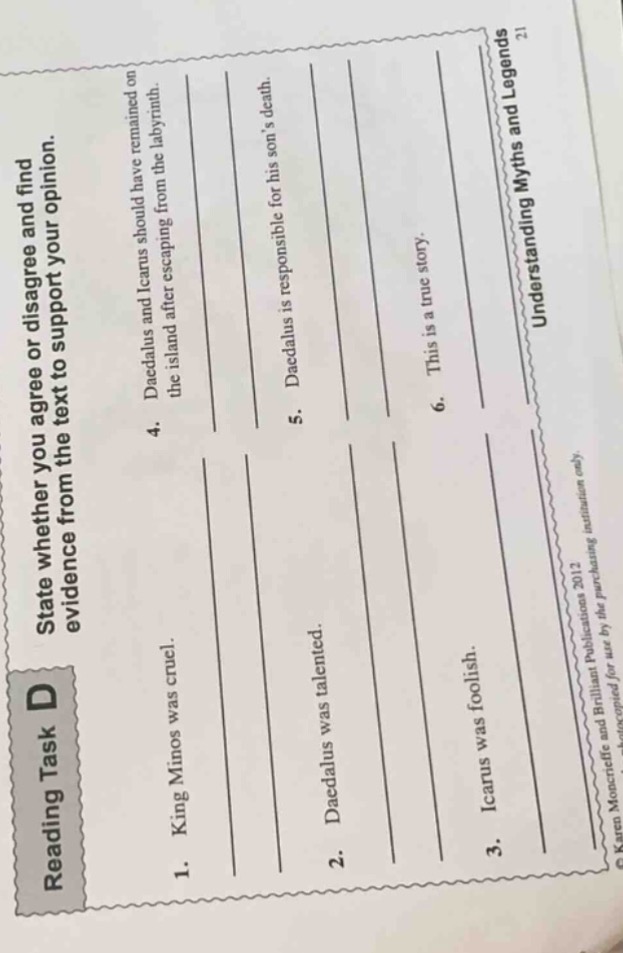
reading task d
state whether you agree or disagree and find
evidence from the text to support your opinion.
- king minos was cruel.
- daedalus was talented.
- icarus was foolish.
- daedalus and icarus should have remained on
the island after escaping from the labyrinth.
- daedalus is responsible for his son’s death.
- this is a true story.
understanding myths and legends
© karen moncrieffe and brilliant publications 2012
photocopied for use by the purchasing institution only
To answer these questions, we analyze each statement based on the myth of Daedalus and Icarus:
1. King Minos was cruel.
- Explanation: King Minos imprisoned Daedalus and Icarus in the labyrinth and intended to keep them there permanently, showing harsh and unjust treatment. From the myth, his actions (imprisonment, seeking to prevent their escape) demonstrate cruelty.
- Answer: Agree. Evidence: He imprisoned Daedalus and Icarus in the labyrinth with no intention of releasing them, showing disregard for their freedom.
2. Daedalus was talented.
- Explanation: Daedalus designed the labyrinth (a complex structure) and created wings for flight using feathers and wax, showcasing ingenuity and skill.
- Answer: Agree. Evidence: He built the labyrinth and invented wings for himself and Icarus to escape, proving his creativity and technical talent.
3. Icarus was foolish.
- Explanation: Icarus ignored Daedalus’ warning not to fly too close to the sun. His recklessness led to the wax on his wings melting, causing him to fall to his death.
- Answer: Agree. Evidence: He disobeyed the rule to avoid the sun, prioritizing excitement over safety, which resulted in his demise.
4. Daedalus and Icarus should have remained on the island after escaping the labyrinth.
- Explanation: Staying on the island would have left them at risk of recapture by King Minos, who was determined to find them. Escaping by sea/air was their only hope for freedom, so remaining was not a safer option.
- Answer: Disagree. Evidence: King Minos would likely have hunted them down; leaving (via flight) was their best chance to avoid punishment.
5. Daedalus is responsible for his son’s death.
- Explanation: While Daedalus warned Icarus, he also provided the wings and allowed Icarus to fly. However, Icarus’ own disobedience was the direct cause. Still, Daedalus’ choice to give Icarus wings (knowing his impulsiveness) could be seen as indirect responsibility, but the primary fault lies with Icarus.
- Answer: Partially agree (or Disagree, depending on interpretation). Evidence: Daedalus warned Icarus, but Icarus’ disobedience caused his death. Daedalus tried to guide him, so full responsibility is not his, but he enabled the flight.
6. This is a true story.
- Explanation: The story of Daedalus and Icarus is a myth (a fictional tale with symbolic or cultural meaning), not a historically verified event. Myths contain supernatural elements (flight with wax wings) that do not align with real-world physics.
- Answer: Disagree. Evidence: The story involves magical elements (wax wings enabling flight) and is classified as a myth, not a factual account.
(Note: Adjust responses based on the specific version of the myth provided in the text, but these align with the traditional Daedalus and Icarus narrative.)

Snap & solve any problem in the app
Get step-by-step solutions on Sovi AI
Photo-based solutions with guided steps
Explore more problems and detailed explanations
To answer these questions, we analyze each statement based on the myth of Daedalus and Icarus:
1. King Minos was cruel.
- Explanation: King Minos imprisoned Daedalus and Icarus in the labyrinth and intended to keep them there permanently, showing harsh and unjust treatment. From the myth, his actions (imprisonment, seeking to prevent their escape) demonstrate cruelty.
- Answer: Agree. Evidence: He imprisoned Daedalus and Icarus in the labyrinth with no intention of releasing them, showing disregard for their freedom.
2. Daedalus was talented.
- Explanation: Daedalus designed the labyrinth (a complex structure) and created wings for flight using feathers and wax, showcasing ingenuity and skill.
- Answer: Agree. Evidence: He built the labyrinth and invented wings for himself and Icarus to escape, proving his creativity and technical talent.
3. Icarus was foolish.
- Explanation: Icarus ignored Daedalus’ warning not to fly too close to the sun. His recklessness led to the wax on his wings melting, causing him to fall to his death.
- Answer: Agree. Evidence: He disobeyed the rule to avoid the sun, prioritizing excitement over safety, which resulted in his demise.
4. Daedalus and Icarus should have remained on the island after escaping the labyrinth.
- Explanation: Staying on the island would have left them at risk of recapture by King Minos, who was determined to find them. Escaping by sea/air was their only hope for freedom, so remaining was not a safer option.
- Answer: Disagree. Evidence: King Minos would likely have hunted them down; leaving (via flight) was their best chance to avoid punishment.
5. Daedalus is responsible for his son’s death.
- Explanation: While Daedalus warned Icarus, he also provided the wings and allowed Icarus to fly. However, Icarus’ own disobedience was the direct cause. Still, Daedalus’ choice to give Icarus wings (knowing his impulsiveness) could be seen as indirect responsibility, but the primary fault lies with Icarus.
- Answer: Partially agree (or Disagree, depending on interpretation). Evidence: Daedalus warned Icarus, but Icarus’ disobedience caused his death. Daedalus tried to guide him, so full responsibility is not his, but he enabled the flight.
6. This is a true story.
- Explanation: The story of Daedalus and Icarus is a myth (a fictional tale with symbolic or cultural meaning), not a historically verified event. Myths contain supernatural elements (flight with wax wings) that do not align with real-world physics.
- Answer: Disagree. Evidence: The story involves magical elements (wax wings enabling flight) and is classified as a myth, not a factual account.
(Note: Adjust responses based on the specific version of the myth provided in the text, but these align with the traditional Daedalus and Icarus narrative.)