QUESTION IMAGE
Question
reasoning about definitions and properties of geometric figures
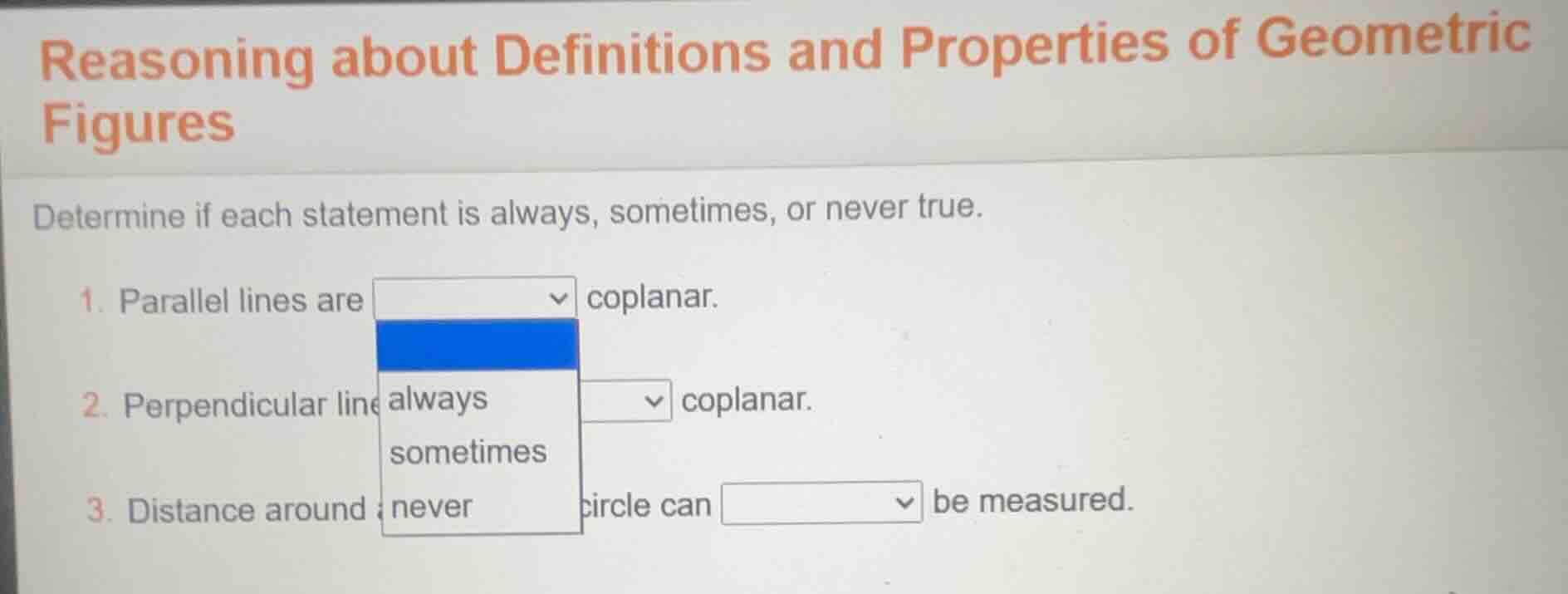
determine if each statement is always, sometimes, or never true.
- parallel lines are coplanar.
- perpendicular line coplanar.
- distance around a circle can be measured.
(the dropdown options are always, sometimes, never)
1. Parallel lines are coplanar.
Step1: Recall the definition of parallel lines
Parallel lines are lines in a plane (or in space) that never meet and are always the same distance apart. By definition, in the context of Euclidean geometry, parallel lines lie in the same plane (coplanar) because the concept of parallelism in standard geometry (for lines) is defined within a plane. There's no case where parallel lines (as per the standard definition) are non - coplanar. So parallel lines are always coplanar.
2. Perpendicular lines are coplanar.
Step1: Recall the definition of perpendicular lines
Perpendicular lines are lines that intersect at a right angle (90 degrees). If two lines are perpendicular, we can always find a plane that contains both of them. Even if we consider lines in space, the two perpendicular lines (that intersect) lie on a common plane. However, if we consider non - intersecting perpendicular lines (skew lines that are perpendicular), but the standard definition of perpendicular lines (in most basic geometric contexts) refers to lines that intersect at 90 degrees. And intersecting lines are always coplanar. So perpendicular lines (that are defined as intersecting at 90 degrees) are always coplanar.
3. Distance around a circle can be measured.
Step1: Recall the concept of the distance around a circle
The distance around a circle is called the circumference. The formula for the circumference of a circle is \(C = 2\pi r\) (where \(r\) is the radius) or \(C=\pi d\) (where \(d\) is the diameter). Since we have a well - defined formula to calculate this distance, the distance around a circle (circumference) can always be measured (either by using the formula with the radius or diameter, or by physical measurement methods like using a string and then measuring the string). So the distance around a circle can always be measured.

Snap & solve any problem in the app
Get step-by-step solutions on Sovi AI
Photo-based solutions with guided steps
Explore more problems and detailed explanations
s:
- always
- always
- always