QUESTION IMAGE
Question
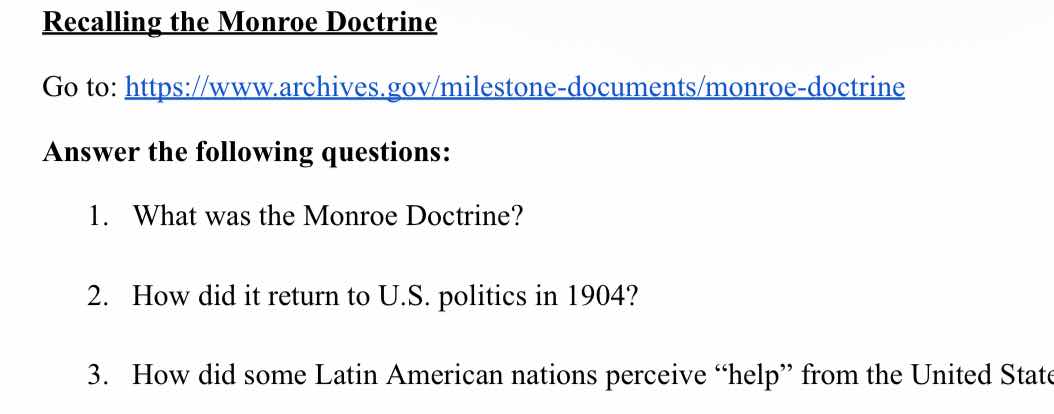
recalling the monroe doctrine
go to: https://www.archives.gov/milestone-documents/monroe-doctrine
answer the following questions:
- what was the monroe doctrine?
- how did it return to u.s. politics in 1904?
- how did some latin american nations perceive “help” from the united state
Brief Explanations
- The Monroe Doctrine was a U.S. foreign policy announcement in 1823. It stated that the Western Hemisphere was closed to further European colonization, that the U.S. would not interfere in existing European colonies or European internal affairs, and that any European interference in the Americas would be seen as a hostile act toward the U.S.
- In 1904, President Theodore Roosevelt added the Roosevelt Corollary to the Monroe Doctrine. This framed the U.S. as an "international police power" in the Western Hemisphere, justifying U.S. intervention in Latin American nations to address alleged fiscal instability or other issues that could invite European intervention, effectively reviving and expanding the doctrine's role in U.S. foreign policy.
- Many Latin American nations viewed U.S. "help" under the Monroe Doctrine (and later the Roosevelt Corollary) with suspicion and resentment. They saw it as a tool for U.S. imperialist intervention, allowing the U.S. to interfere in their internal affairs, undermine their sovereignty, and advance U.S. economic and political interests rather than providing genuine, equitable assistance.

Snap & solve any problem in the app
Get step-by-step solutions on Sovi AI
Photo-based solutions with guided steps
Explore more problems and detailed explanations
- The Monroe Doctrine was an 1823 U.S. foreign policy that declared the Western Hemisphere off-limits to new European colonization, stated the U.S. would not interfere in European affairs, and deemed European interference in the Americas a hostile act.
- In 1904, President Theodore Roosevelt added the Roosevelt Corollary to the Monroe Doctrine, which positioned the U.S. as an "international police power" in the hemisphere, justifying U.S. intervention in Latin American nations to prevent European involvement, thus reviving the doctrine's role in U.S. politics.
- Many Latin American nations perceived U.S. "help" as a cover for imperialist intervention that undermined their national sovereignty and advanced U.S. economic and political interests, rather than legitimate support.