QUESTION IMAGE
Question
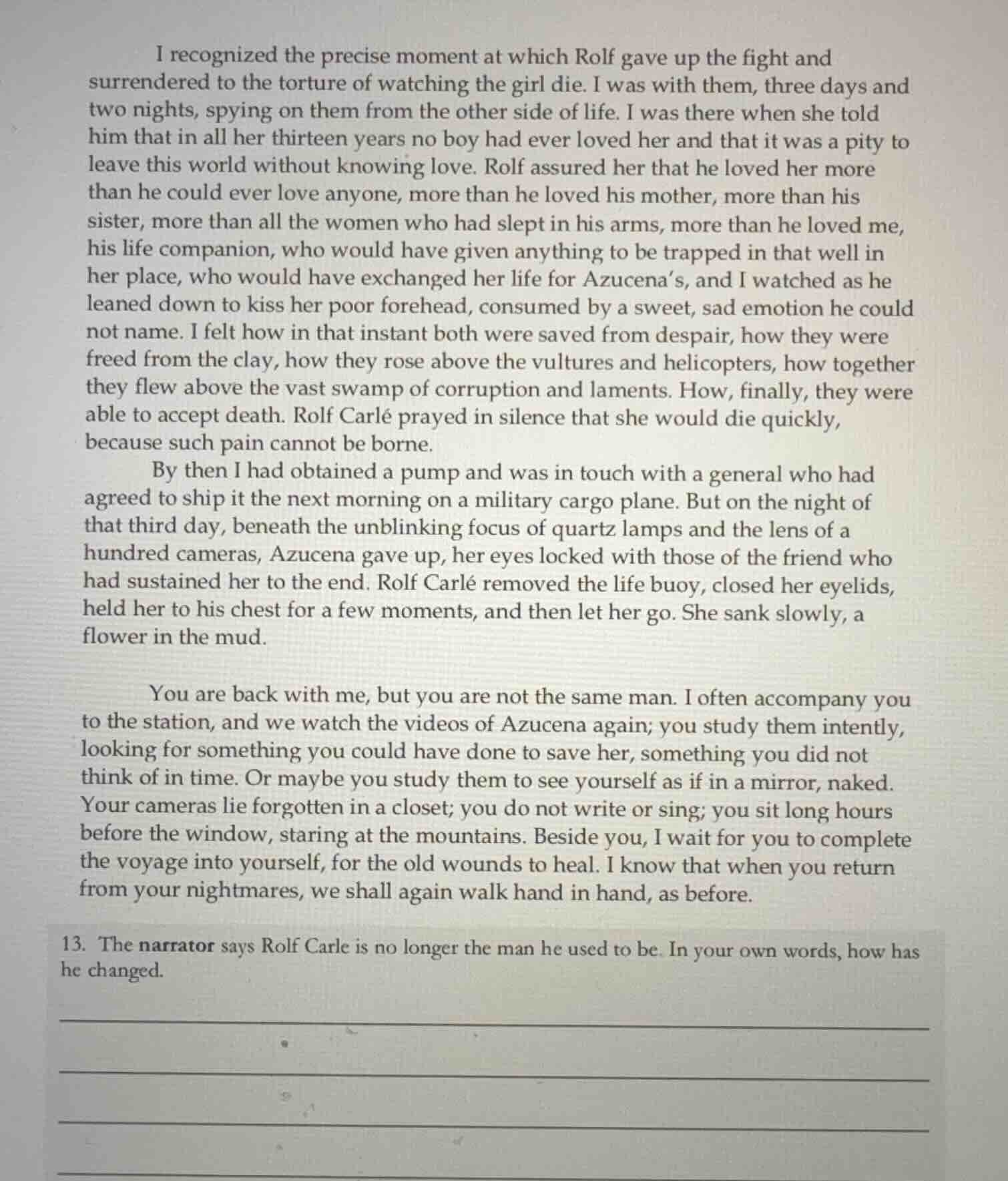
i recognized the precise moment at which rolf gave up the fight and surrendered to the torture of watching the girl die. i was with them, three days and two nights, spying on them from the other side of life. i was there when she told him that in all her thirteen years no boy had ever loved her and that it was a pity to leave this world without knowing love. rolf assured her that he loved her more than he could ever love anyone, more than he loved his mother, more than his sister, more than all the women who had slept in his arms, more than he loved me, his life companion, who would have given anything to be trapped in that well in her place, who would have exchanged her life for azucena’s, and i watched as he leaned down to kiss her poor forehead, consumed by a sweet, sad emotion he could not name. i felt how in that instant both were saved from despair, how they were freed from the clay, how they rose above the vultures and helicopters, how together they flew above the vast swamp of corruption and laments. how, finally, they were able to accept death. rolf carlé prayed in silence that she would die quickly, because such pain cannot be borne.
by then i had obtained a pump and was in touch with a general who had agreed to ship it the next morning on a military cargo plane. but on the night of that third day, beneath the unblinking focus of quartz lamps and the lens of a hundred cameras, azucena gave up, her eyes locked with those of the friend who had sustained her to the end. rolf carlé removed the life buoy, closed her eyelids, held her to his chest for a few moments, and then let her go. she sank slowly, a flower in the mud.
you are back with me, but you are not the same man. i often accompany you to the station, and we watch the videos of azucena again; you study them intently, looking for something you could have done to save her, something you did not think of in time. or maybe you study them to see yourself as if in a mirror, naked. your cameras lie forgotten in a closet; you do not write or sing; you sit long hours before the window, staring at the mountains. beside you, i wait for you to complete the voyage into yourself, for the old wounds to heal. i know that when you return from your nightmares, we shall again walk hand in hand, as before.
- the narrator says rolf carle is no longer the man he used to be. in your own words, how has he changed.
Rolf Carlé has abandoned his previous work and creative pursuits, as seen by his forgotten cameras and lack of writing/singing. He is consumed by guilt and introspection, repeatedly reviewing footage of Azucena to find missed chances to save her. He has become withdrawn, spending long hours staring quietly instead of engaging with his old life, and is haunted by nightmares, showing deep emotional trauma from the experience.

Snap & solve any problem in the app
Get step-by-step solutions on Sovi AI
Photo-based solutions with guided steps
Explore more problems and detailed explanations
Rolf Carlé has become withdrawn, guilt-ridden, and traumatized. He has abandoned his professional and creative activities (his cameras are forgotten, he no longer writes or sings). He is fixated on the loss of Azucena, repeatedly reviewing footage to search for ways he could have saved her, and spends long, quiet hours lost in introspection. He is also plagued by nightmares, indicating deep unresolved pain from the experience.