QUESTION IMAGE
Question
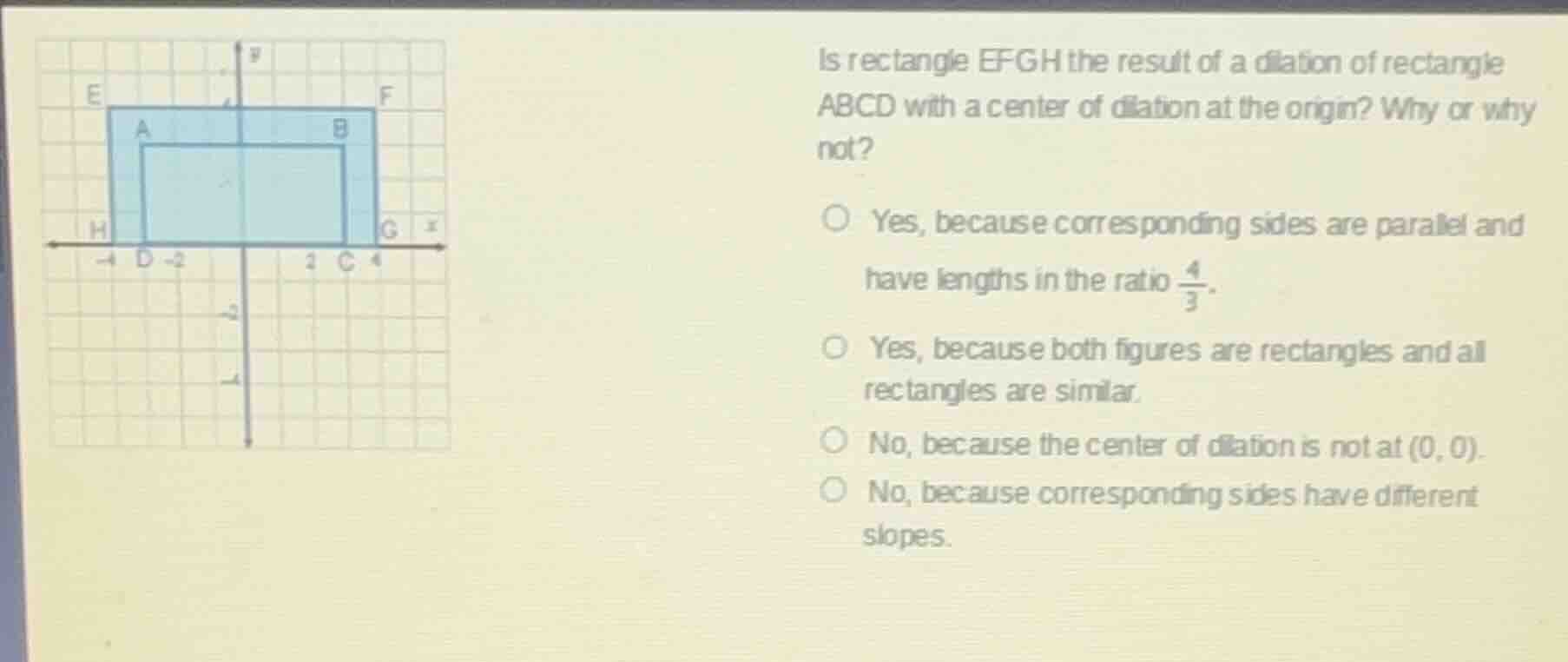
is rectangle efgh the result of a dilation of rectangle abcd with a center of dilation at the origin? why or why not?
yes, because corresponding sides are parallel and have lengths in the ratio \\(\frac{4}{3}\\).
yes, because both figures are rectangles and all rectangles are similar.
no, because the center of dilation is not at (0, 0).
no, because corresponding sides have different slopes.
Step1: Identify side lengths of ABCD
First, find the length and width of rectangle ABCD. From the graph, the length (horizontal side) is from \(x=-3\) to \(x=3\), so length \(= 3 - (-3) = 6\). The width (vertical side) is from \(y=0\) to \(y=2\), so width \(= 2 - 0 = 2\).
Step2: Identify side lengths of EFGH
Next, find the length and width of rectangle EFGH. The length is from \(x=-4\) to \(x=4\), so length \(= 4 - (-4) = 8\). The width is from \(y=0\) to \(y=3\), so width \(= 3 - 0 = 3\).
Step3: Check side length ratio
Calculate the ratio of corresponding sides: \(\frac{\text{Length of EFGH}}{\text{Length of ABCD}} = \frac{8}{6} = \frac{4}{3}\), and \(\frac{\text{Width of EFGH}}{\text{Width of ABCD}} = \frac{3}{2}\). These ratios are not equal.
Step4: Verify dilation properties
For a dilation centered at the origin, all corresponding sides must be parallel (which they are, as both are axis-aligned rectangles) and have a consistent scale factor. Since the side ratios are different, it is not a dilation. Also, eliminate other options: all rectangles are not similar (only those with proportional sides are), the center is given as origin, and sides have the same slope (0 for horizontal, undefined for vertical).

Snap & solve any problem in the app
Get step-by-step solutions on Sovi AI
Photo-based solutions with guided steps
Explore more problems and detailed explanations
No, because corresponding sides have different slopes.