QUESTION IMAGE
Question
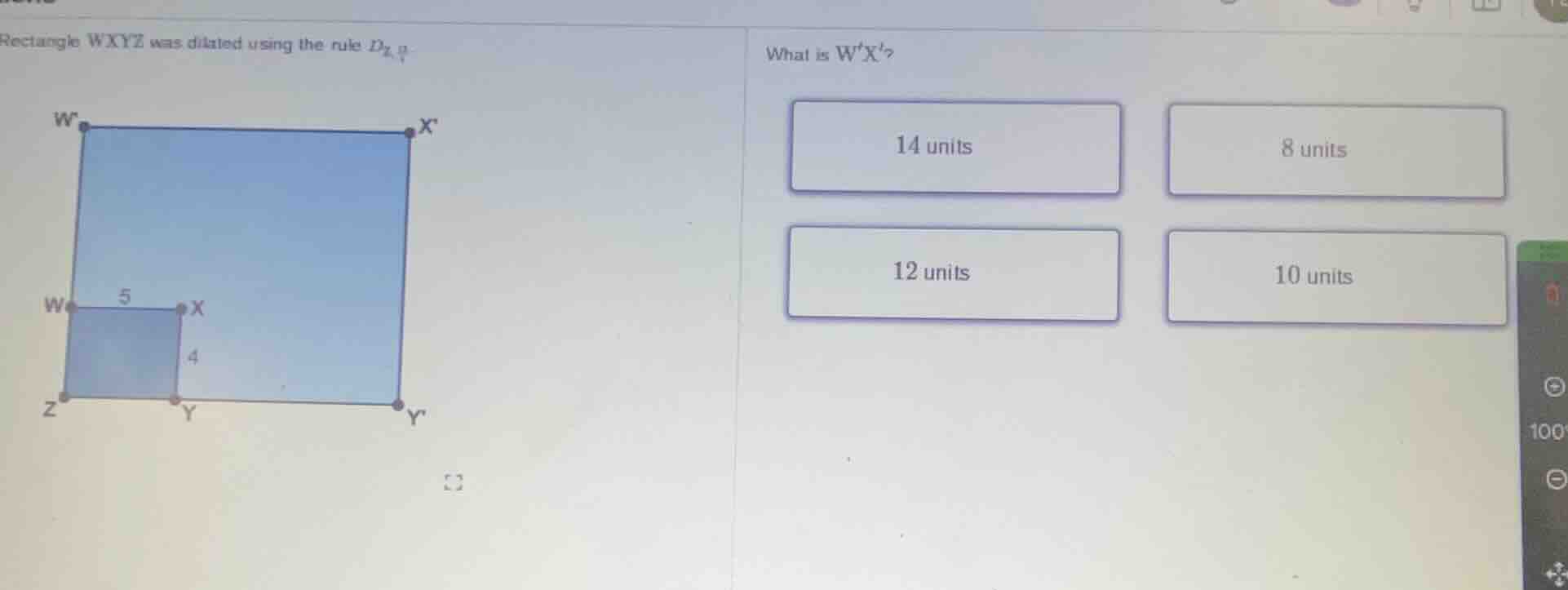
rectangle wxyz was dilated using the rule $d_{k,p}$. what is $wx$? 14 units 8 units 12 units 10 units
Step1: Identify the scale factor
The original length \( WX = 5 \) units, and the dilation rule is \( D_{k,0} \). First, find the scale factor \( k \) using the vertical side. Original vertical side \( WZ = 4 \) units, and the dilated vertical side (from \( W \) to \( W' \)): let's assume the original rectangle has height 4, and the dilated one's height can be related, but actually, since dilation is uniform, the scale factor \( k \) can be found by the ratio of corresponding sides. Wait, maybe the original rectangle \( WXYZ \) has \( WX = 5 \) and \( XY = 4 \), and after dilation, the vertical side (from \( Z \) to \( Y' \)): wait, maybe the scale factor is \( \frac{\text{dilated length}}{\text{original length}} \). Wait, looking at the vertical side: original \( WZ \) is 4, and the dilated \( W'Z \) (the height of the big rectangle) – wait, maybe the original rectangle has \( WX = 5 \), and the dilated \( W'X' \) is \( k \times 5 \). Let's check the vertical side: original \( XY = 4 \), and the dilated \( X'Y' \) – wait, maybe the scale factor is \( \frac{4 + \text{something}}{4} \)? No, wait, the original rectangle \( WXYZ \) has length \( WX = 5 \) and width \( XY = 4 \). After dilation with center at the origin (or (0,0)), the new length \( W'X' = k \times WX \), and new width \( X'Y' = k \times XY \). Wait, looking at the diagram, the original \( WX = 5 \), and the dilated \( W'X' \) – wait, maybe the scale factor is 2? No, wait, maybe the original height is 4, and the dilated height is \( 4 + 4 = 8 \)? No, that's not right. Wait, maybe the original rectangle has \( WX = 5 \), and the dilated \( W'X' \) is calculated by the scale factor. Wait, the problem is about dilation, so the scale factor \( k \) is the ratio of corresponding sides. Let's see, the original vertical side (from \( W \) to \( Z \)) is 4, and the dilated vertical side (from \( W \) to \( W' \)) – wait, maybe the original \( WX = 5 \), and the dilated \( W'X' = 2 \times 5 = 10 \)? No, wait, the options are 14, 8, 12, 10. Wait, maybe the scale factor is \( \frac{10}{5} = 2 \)? No, 52=10, but let's check the vertical side. Original \( XY = 4 \), dilated \( X'Y' = 8 \)? 42=8, but the options for \( W'X' \) are 14,8,12,10. Wait, maybe I made a mistake. Wait, the original \( WX = 5 \), and the dilated \( W'X' \) – wait, maybe the scale factor is \( \frac{10}{5} = 2 \), but 52=10. Wait, but let's re-examine. The original rectangle has \( WX = 5 \) (horizontal) and \( XY = 4 \) (vertical). After dilation, the horizontal side \( W'X' \) should be \( k \times 5 \), and vertical side \( X'Y' = k \times 4 \). Looking at the diagram, the vertical side of the big rectangle (from \( Z \) to \( Y' \)) is \( 4 + 4 = 8 \)? So \( k \times 4 = 8 \), so \( k = 2 \). Then \( W'X' = k \times 5 = 2 \times 5 = 10 \)? Wait, but 52=10, which is one of the options (10 units). Wait, but let's check again. Wait, maybe the original \( WX = 5 \), and the dilated \( W'X' \) is 10? Let's confirm. Dilation scale factor \( k \) is the ratio of dilated length to original length. If original \( WX = 5 \), and dilated \( W'X' = 10 \), then \( k = 2 \). And original \( XY = 4 \), dilated \( X'Y' = 8 \), which matches the diagram (the big rectangle's height is 8, since original is 4, doubled). So yes, scale factor \( k = 2 \), so \( W'X' = 2 \times 5 = 10 \) units. Wait, but let's check the options. 10 units is an option. So that's the answer.
Step1: Determine the scale factor
The original horizontal side \( WX = 5 \) units. For the vertical side, original \( XY = 4 \) units, and the dilate…

Snap & solve any problem in the app
Get step-by-step solutions on Sovi AI
Photo-based solutions with guided steps
Explore more problems and detailed explanations
10 units