QUESTION IMAGE
Question
2/2 rectangles, rhombus, squares practice day
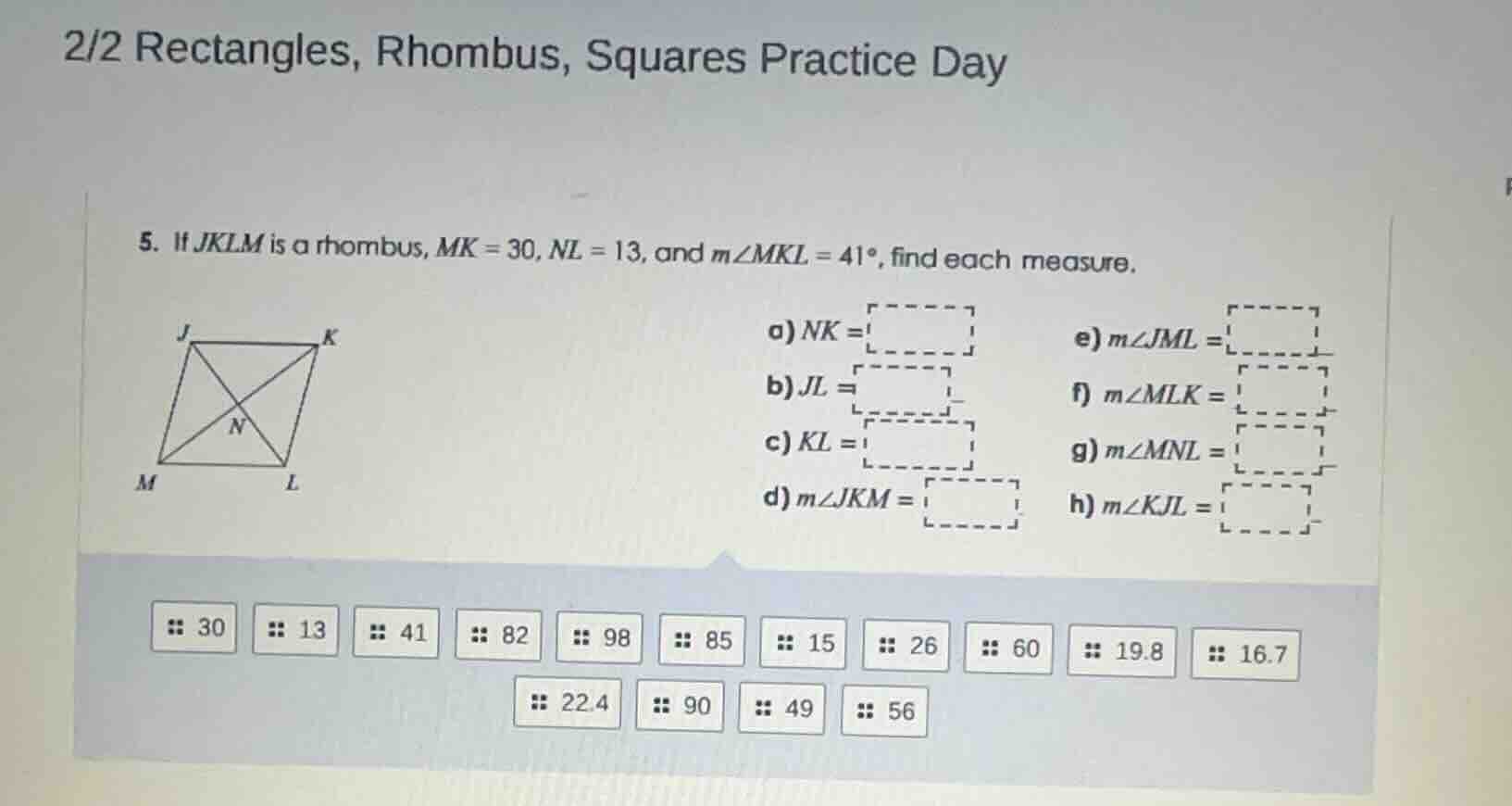
- if jklm is a rhombus, mk = 30, nl = 13, and m∠mkl = 41°, find each measure.
a) nk =
b) jl =
c) kl =
d) m∠jkm =
e) m∠jml =
f) m∠mlk =
g) m∠mnl =
h) m∠kjl =
Step1: Find NK (diagonal bisect)
In a rhombus, diagonals bisect each other. $MK = 30$, so $NK = \frac{MK}{2} = \frac{30}{2} = 15$
Step2: Find JL (diagonal bisect)
In a rhombus, diagonals bisect each other. $NL = 13$, so $JL = 2 \times NL = 2 \times 13 = 26$
Step3: Find KL (right triangle hypotenuse)
Diagonals of a rhombus are perpendicular, so $\triangle KNL$ is right-angled at $N$. Use Pythagorean theorem:
$KL = \sqrt{NK^2 + NL^2} = \sqrt{15^2 + 13^2} = \sqrt{225 + 169} = \sqrt{394} \approx 19.8$
Step4: Find $m\angle JKM$ (rhombus sides parallel)
$JK \parallel ML$, so alternate interior angles are equal. $m\angle JKM = m\angle MKL = 41^\circ$
Step5: Find $m\angle JML$ (opposite angles of rhombus)
First find $m\angle JKL$: in $\triangle KNL$, $m\angle NKL = 41^\circ$, $m\angle KNL = 90^\circ$, so $m\angle KLN = 180^\circ - 90^\circ - 41^\circ = 49^\circ$. $m\angle JKL = 2 \times 41^\circ = 82^\circ$. Opposite angles of rhombus are equal, so $m\angle JML = m\angle JKL = 82^\circ$
Step6: Find $m\angle MLK$ (consecutive angles supplementary)
Consecutive angles of rhombus are supplementary. $m\angle MLK = 180^\circ - m\angle JKL = 180^\circ - 82^\circ = 98^\circ$
Step7: Find $m\angle MNL$ (diagonals perpendicular)
Diagonals of a rhombus are perpendicular, so $m\angle MNL = 90^\circ$
Step8: Find $m\angle KJL$ (alternate interior angles)
$JK \parallel ML$, so $m\angle KJL = m\angle MLJ = 49^\circ$

Snap & solve any problem in the app
Get step-by-step solutions on Sovi AI
Photo-based solutions with guided steps
Explore more problems and detailed explanations
a) $NK = 15$
b) $JL = 26$
c) $KL \approx 19.8$
d) $m\angle JKM = 41^\circ$
e) $m\angle JML = 82^\circ$
f) $m\angle MLK = 98^\circ$
g) $m\angle MNL = 90^\circ$
h) $m\angle KJL = 49^\circ$