QUESTION IMAGE
Question
relating geometric definitions
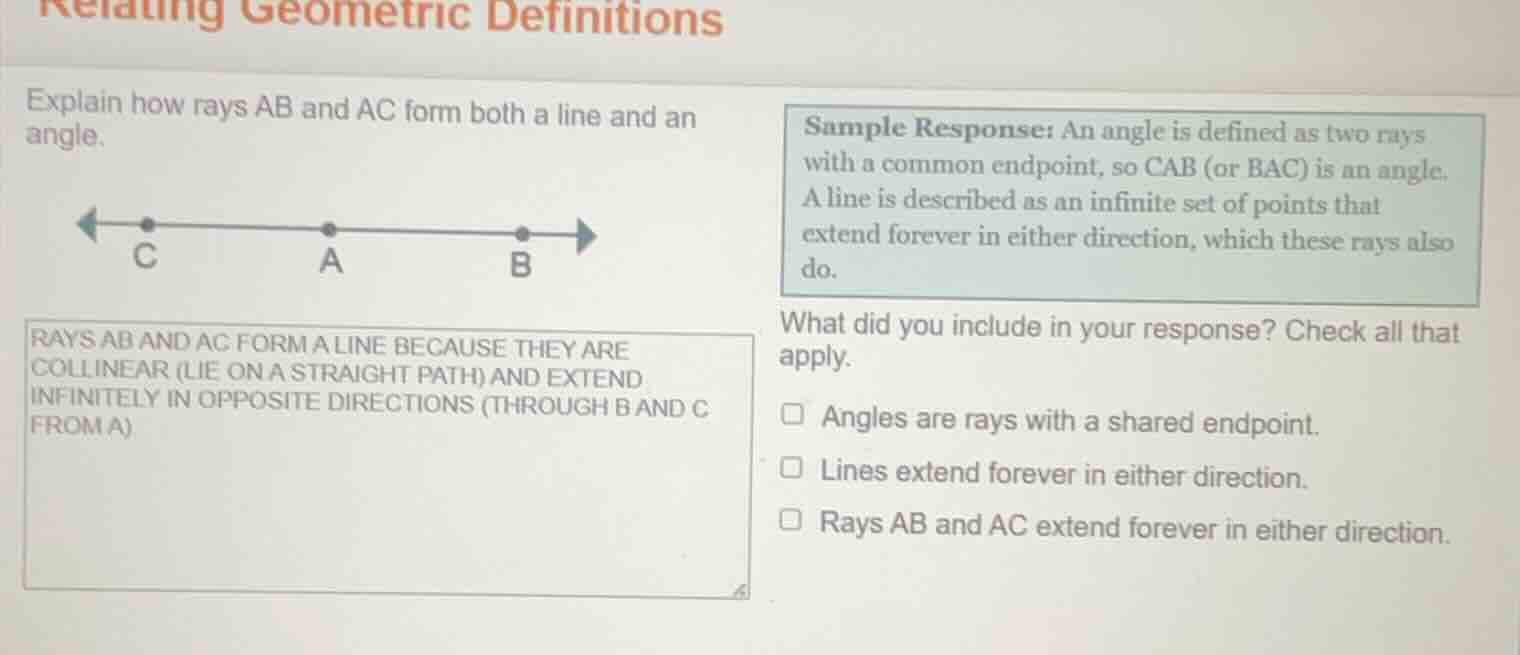
explain how rays ab and ac form both a line and an angle.
image of a line with points c, a, b in that order, arrows at both ends
rays ab and ac form a line because they are collinear (lie on a straight path) and extend infinitely in opposite directions (through b and c from a)
sample response: an angle is defined as two rays with a common endpoint, so cab (or bac) is an angle. a line is described as an infinite set of points that extend forever in either direction, which these rays also do.
what did you include in your response? check all that apply.
- angles are rays with a shared endpoint.
- lines extend forever in either direction.
- rays ab and ac extend forever in either direction.
Brief Explanations
- For the first option: An angle is defined as two rays with a common endpoint (vertex), so this is a correct description related to the angle formed by rays AB and AC (with common endpoint A).
- For the second option: A line is a geometric figure that extends infinitely in both directions, which is relevant to explaining how the rays form a line.
- For the third option: Ray AB extends from A through B infinitely in one direction, and ray AC extends from A through C infinitely in the opposite direction. Together, they extend infinitely in either direction (since one goes one way and the other the opposite, covering both directions overall), so this is correct.

Snap & solve any problem in the app
Get step-by-step solutions on Sovi AI
Photo-based solutions with guided steps
Explore more problems and detailed explanations
- Angles are rays with a shared endpoint.
- Lines extend forever in either direction.
- Rays AB and AC extend forever in either direction.