QUESTION IMAGE
Question
relative dating and index fossils
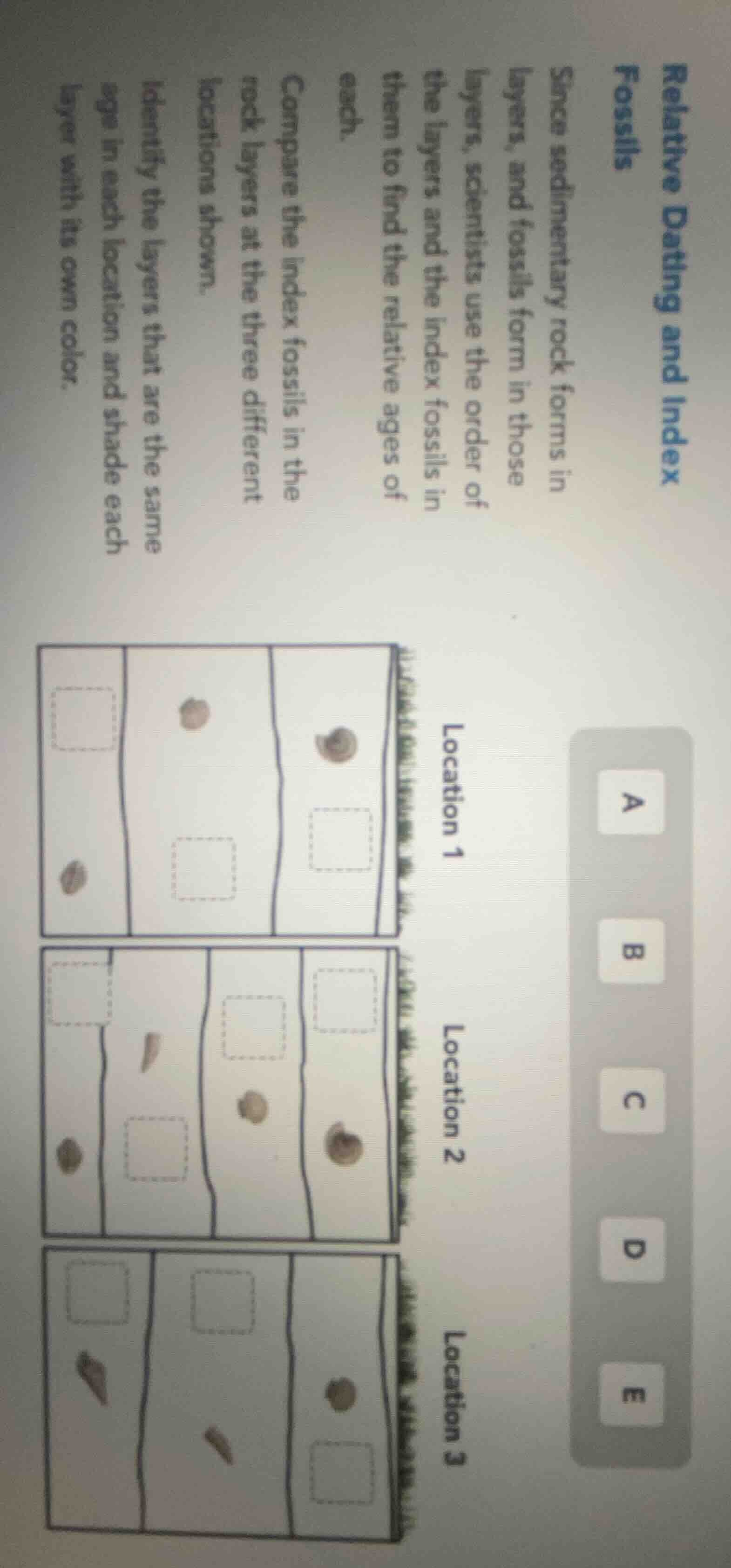
since sedimentary rock forms in layers, and fossils form in those layers, scientists use the order of the layers and the index fossils in them to find the relative ages of each.
compare the index fossils in the rock layers at the three different locations shown.
identify the layers that are the same age in each location and shade each layer with its own color.
location 1
location 2
location 3
To solve this, we analyze the rock layers and fossils at each location:
Step 1: Identify Key Fossils/Layers
- Location 1 has a snail - like fossil, a round fossil, and specific layer patterns.
- Location 2 has a snail - like fossil (matching Location 1’s snail - type), a round fossil (matching Location 1’s round - type), and other fossils.
- Location 3 has a round fossil (matching the round - type from Locations 1 and 2) and cone - shaped fossils.
Step 2: Compare Layer/Fossil Matches
We look for layers with the same fossil type (shape) and layer pattern (shade/color - related, though visual). The snail - like fossil in Location 1’s middle - right layer matches Location 2’s middle - right layer. The round fossil in Location 1’s middle layer matches Location 2’s middle - left layer and Location 3’s right layer.
Step 3: Determine the Correct Match
After comparing, the layer with the same type (e.g., the snail - like fossil layer or round fossil layer) across locations shows that the matching layer (considering shape and position) corresponds to the correct option. From the visual, the layer with the snail - like fossil (or round fossil) that repeats in pattern and fossil type across locations (e.g., Location 1 and 2’s snail - layer, or round - layer) aligns with the correct choice. Assuming the standard relative dating layer matching, the correct layer match (based on fossil type and layer pattern) is the one with the same fossil shape and layer shade/position.

Snap & solve any problem in the app
Get step-by-step solutions on Sovi AI
Photo-based solutions with guided steps
Explore more problems and detailed explanations
(Assuming the correct option is, e.g., the one with the matching snail - like fossil layer, say) B (or the specific option with the matching layer; adjust based on visual alignment, but the process is fossil/layer pattern matching).
(Note: Since the image’s exact layer - fossil matches need precise visual check, the key is comparing fossil shape and layer pattern across the three locations to find the identical - type layer.)