QUESTION IMAGE
Question
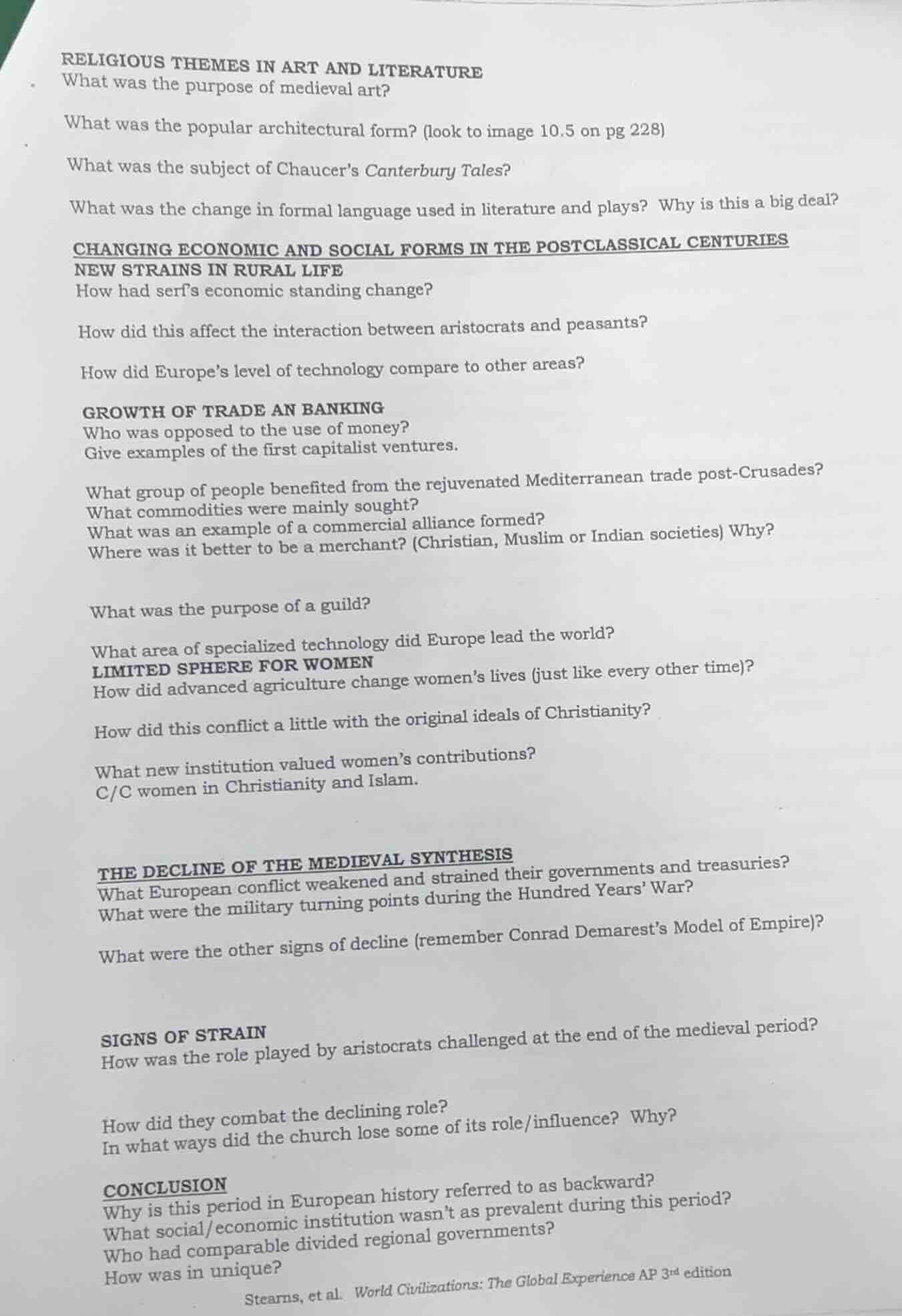
religious themes in art and literature
what was the purpose of medieval art?
what was the popular architectural form? (look to image 10.5 on pg 228)
what was the subject of chaucers canterbury tales?
what was the change in formal language used in literature and plays? why is this a big deal?
changing economic and social forms in the postclassical centuries
new strains in rural life
how had serfs economic standing change?
how did this affect the interaction between aristocrats and peasants?
how did europes level of technology compare to other areas?
growth of trade an banking
who was opposed to the use of money?
give examples of the first capitalist ventures.
what group of people benefited from the rejuvenated mediterranean trade post-crusades?
what commodities were mainly sought?
what was an example of a commercial alliance formed?
where was it better to be a merchant? (christian, muslim or indian societies) why?
what was the purpose of a guild?
what area of specialized technology did europe lead the world?
limited sphere for women
how did advanced agriculture change womens lives (just like every other time)?
how did this conflict a little with the original ideals of christianity?
what new institution valued womens contributions?
c/c women in christianity and islam.
the decline of the medieval synthesis
what european conflict weakened and strained their governments and treasuries?
what were the military turning points during the hundred years war?
what were the other signs of decline (remember conrad demarests model of empire)?
signs of strain
how was the role played by aristocrats challenged at the end of the medieval period?
how did they combat the declining role?
in what ways did the church lose some of its role/influence? why?
conclusion
why is this period in european history referred to as backward?
what social/economic institution wasnt as prevalent during this period?
who had comparable divided regional governments?
how was in unique?
stearns, et al. world civilizations: the global experience ap 3rd edition
RELIGIOUS THEMES IN ART AND LITERATURE
- Medieval art's core purpose was to teach religious doctrine to illiterate populations, as most people could not read sacred texts.
- The popular medieval architectural form was Gothic architecture, characterized by pointed arches, flying buttresses, and stained glass.
- Chaucer's Canterbury Tales focuses on a diverse group of pilgrims sharing stories as they travel to Canterbury Cathedral, satirizing medieval social classes and religious life.
- Formal language shifted from Latin (used for religious/scholarly works) to vernacular (local spoken languages like English, French, Italian). This was transformative because it made literature accessible to the general public, expanded literary audiences, and helped develop national cultural identities.
CHANGING ECONOMIC AND SOCIAL FORMS IN THE POSTCLASSICAL CENTURIES: NEW STRAINS IN RURAL LIFE
- Serfs gained more economic autonomy: many were able to pay rent instead of providing labor services, some bought their freedom, and others moved to towns.
- This weakened aristocrats' traditional control over peasants; as serfs gained independence, the feudal labor system eroded, and aristocrats lost a reliable source of forced labor and income.
- Europe's technology lagged behind the Islamic world and East Asia in areas like papermaking, gunpowder, and advanced navigation, but excelled in agricultural innovations like the three-field system.
GROWTH OF TRADE AND BANKING
- The Catholic Church initially opposed the use of money, particularly usury (charging interest on loans), viewing it as morally wrong.
- Early capitalist ventures included Italian city-state merchant partnerships (like the Medici banking network), long-distance trade caravans, and wool manufacturing guilds in Flanders.
- Italian city-states (e.g., Venice, Genoa) benefited most from post-Crusade Mediterranean trade, as they controlled key trade routes.
- Commodities sought included spices, silk, sugar, and precious metals from Asia and the Middle East.
- The Hanseatic League, a commercial alliance of Northern European trading cities, was a major example; it controlled trade in the Baltic and North Seas.
- It was better to be a merchant in Islamic societies, as Islamic law and culture were more accepting of trade and banking, and merchants held higher social status compared to Christian Europe, where merchants were often viewed with suspicion by the Church and aristocracy.
- Guilds regulated trade, set quality standards, trained apprentices, and protected the economic interests of their members (artisans and merchants).
- Europe led the world in metallurgy, particularly in the production of high-quality iron and steel for tools, weapons, and agricultural equipment.
LIMITED SPHERE FOR WOMEN
- Advanced agriculture (like the three-field system) shifted women's work from field labor to domestic tasks, confining them to the home and reducing their economic independence.
- This conflicted with early Christian ideals, which emphasized spiritual equality between men and women; medieval practice restricted women's roles in the Church and society, contradicting this early emphasis.
- Beguine communities, lay religious groups of women, valued women's contributions to charity and spiritual life outside traditional convent structures.
- In Christianity, women were largely confined to domestic roles or convents, with limited access to religious authority. In Islam, women had some property rights and could participate in trade, but still faced gender restrictions; both r…

Snap & solve any problem in the app
Get step-by-step solutions on Sovi AI
Photo-based solutions with guided steps
Explore more problems and detailed explanations
RELIGIOUS THEMES IN ART AND LITERATURE
- To teach religious doctrine to illiterate people
- Gothic architecture
- Pilgrims sharing stories, satirizing medieval society
- Shift from Latin to vernacular; expanded literary access and built national identities
CHANGING ECONOMIC AND SOCIAL FORMS IN THE POSTCLASSICAL CENTURIES: NEW STRAINS IN RURAL LIFE
- Gained more autonomy, could pay rent or buy freedom
- Weakened aristocrats' feudal control over peasants
- Lagged in tech like papermaking; led in agricultural innovations
GROWTH OF TRADE AND BANKING
- The Catholic Church (opposed usury)
- Medici banking, Flanders wool guilds, Italian trade partnerships
- Italian city-states (Venice, Genoa)
- Spices, silk, sugar, precious metals
- The Hanseatic League (Baltic/North Sea alliance)
- Islamic societies; merchants had higher status and legal protections
- Regulate trade, set standards, train workers
- Metallurgy (iron/steel production)
LIMITED SPHERE FOR WOMEN
- Confined women to domestic work, reduced economic independence
- Contradicted early Christian ideals of spiritual equality
- Beguine communities
- Christianity: limited to homes/convents; Islam: some property/trade rights, both had gender restrictions
THE DECLINE OF THE MEDIEVAL SYNTHESIS
- The Hundred Years' War
- Crécy, Agincourt (English wins); Orléans (French turning point)
- Black Death, Great Schism, peasant revolts
SIGNS OF STRAIN
- Rise of merchants, centralized monarchies, decline of feudal labor
- Enforced social hierarchies, increased rents, served in royal armies
- Great Schism, clergy corruption, secular monarch challenges
CONCLUSION
- Political fragmentation, slow tech progress, limited urbanization
- Slavery (replaced by serfdom)
- Feudal Japan
- Unified Catholic Church influence, feudal hierarchy, early parliamentary development