QUESTION IMAGE
Question
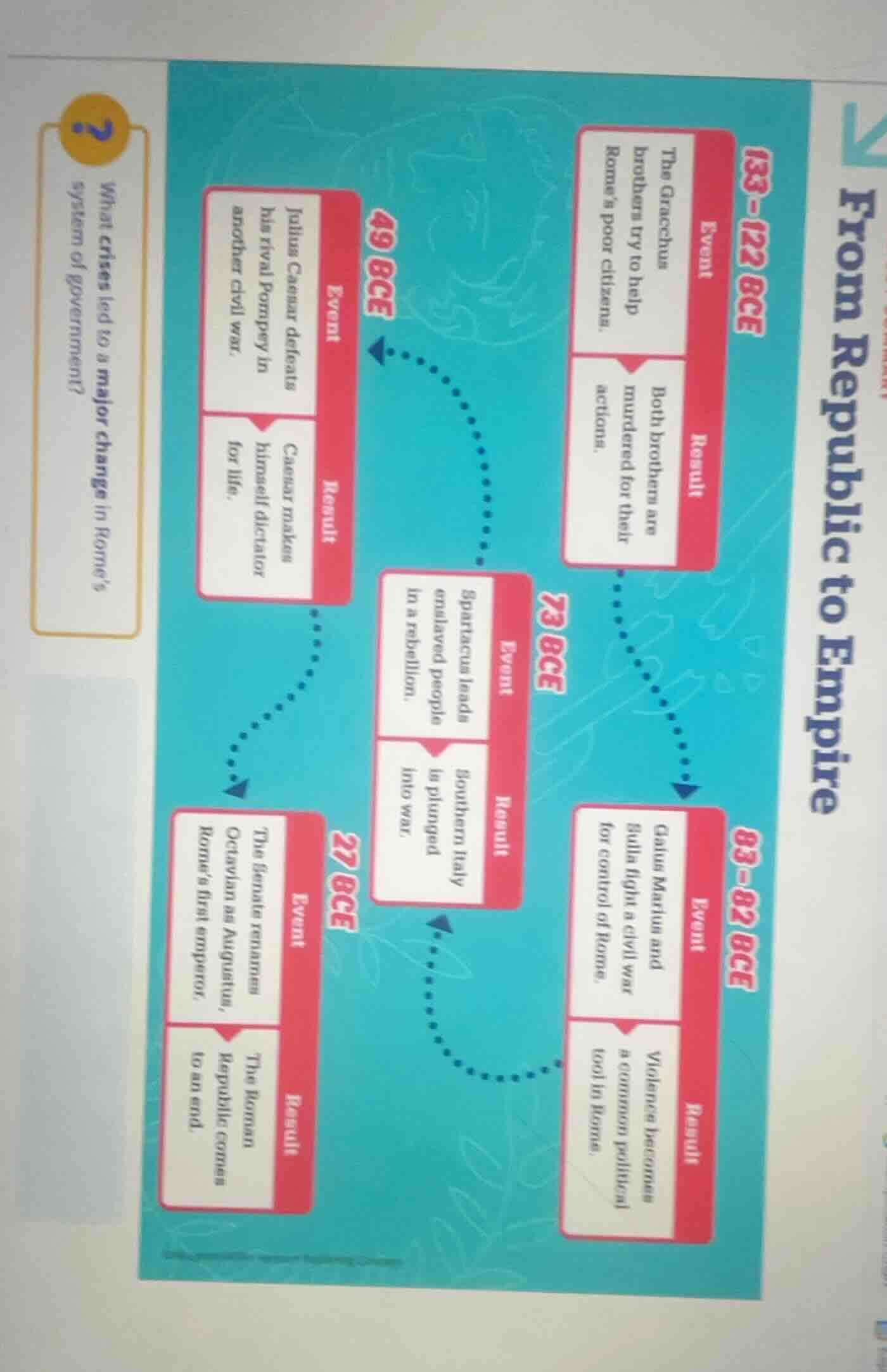
from republic to empire
133–122 bce
event: the gracchus brothers try to help rome’s poor citizens.
result: both brothers are murdered for their actions.
83–82 bce
event: gaius marius and sulla fight a civil war for control of rome.
result: violence becomes a common political tool in rome.
73 bce
event: spartacus leads enslaved people in a rebellion.
result: southern italy is plunged into war.
49 bce
event: julius caesar defeats his rival pompey in another civil war.
result: caesar makes himself dictator for life.
27 bce
event: the senate renames octavian as augustus, rome’s first emperor.
result: the roman republic comes to an end.
what crises led to a major change in rome’s system of government?
A series of interconnected crises destabilized Rome's Republic:
- Populist political reformers (the Gracchus brothers) were murdered for advocating for the poor, breaking norms of political discourse.
- Civil war between Marius and Sulla normalized violence as a political tool.
- A large slave rebellion led by Spartacus showed weaknesses in Roman control and resource management.
- Civil war between Caesar and Pompey led to Caesar taking sole dictatorial power, ending traditional republican shared governance.
- The formal establishment of Augustus as Rome's first emperor finalized the shift from a republican system to an imperial one.

Snap & solve any problem in the app
Get step-by-step solutions on Sovi AI
Photo-based solutions with guided steps
Explore more problems and detailed explanations
The crises that led to Rome's government shifting from a Republic to an Empire were:
- The murder of the Gracchus brothers (133-122 BCE) after they tried to aid poor citizens, which eroded non-violent political norms.
- The civil war between Marius and Sulla (83-82 BCE), which turned political violence into an accepted practice.
- The slave rebellion led by Spartacus (73 BCE), which exposed internal instability in the Republic.
- The civil war between Julius Caesar and Pompey (49 BCE), which led Caesar to declare himself dictator for life, concentrating power in one leader.
- The Senate naming Octavian "Augustus" as Rome's first emperor (27 BCE), which formally ended the Roman Republic and established the imperial system.