QUESTION IMAGE
Question
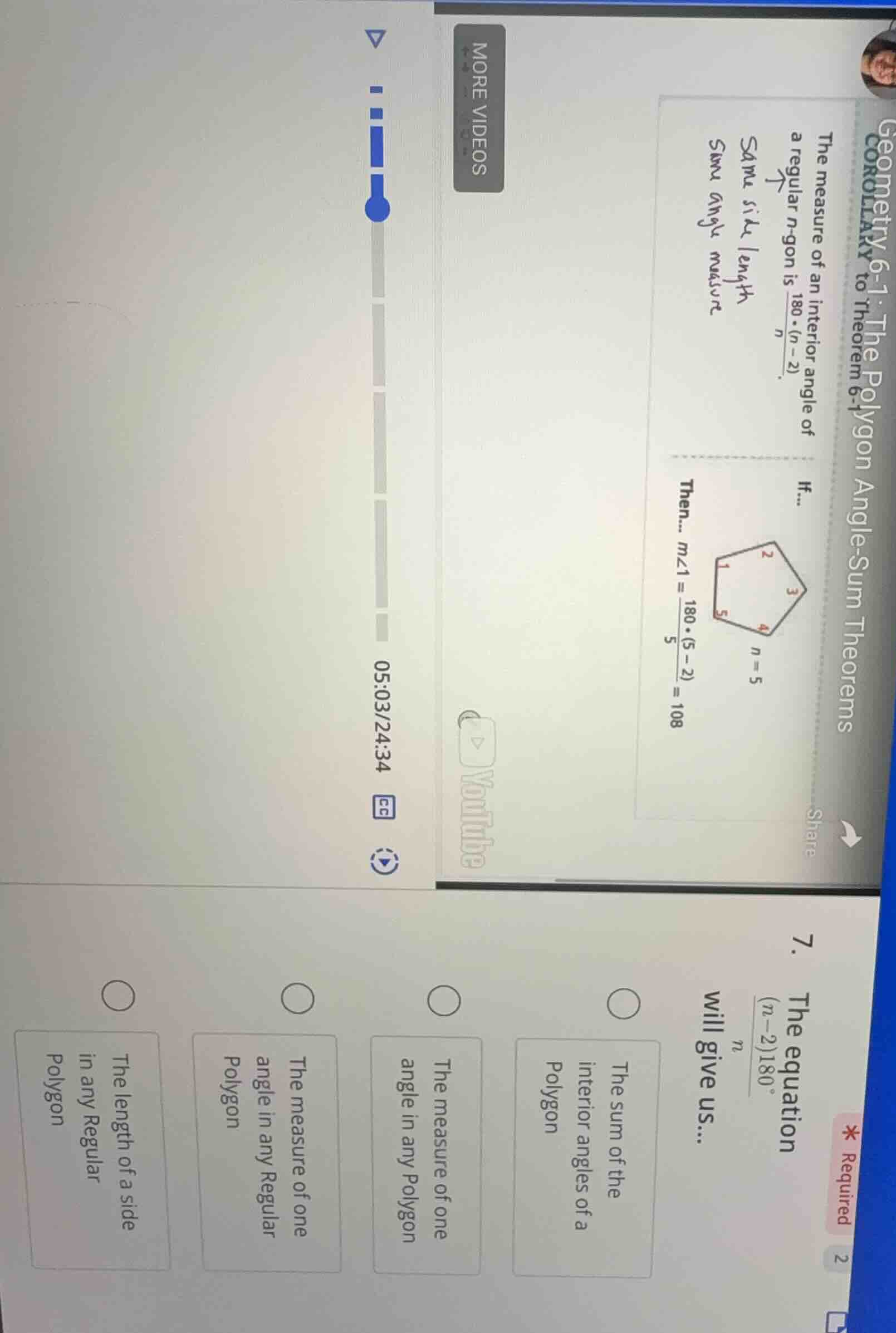
- * required the equation \\(\frac{(n-2)180^{\circ}}{n}\\) will give us... the sum of the interior angles of a polygon the measure of one angle in any polygon the measure of one angle in any regular polygon the length of a side in any regular polygon
Brief Explanations
The formula \(\frac{(n - 2)180^{\circ}}{n}\) is used to find the measure of one interior angle in a regular polygon. Let's analyze each option:
- Option 1: The sum of interior angles of a polygon is given by \((n - 2)180^{\circ}\), not \(\frac{(n - 2)180^{\circ}}{n}\), so this is incorrect.
- Option 2: The measure of one angle in any polygon is not given by this formula (it's for regular polygons), and also the formula \(\frac{(n - 2)180^{\circ}}{n}\) is for regular polygons' interior angles, not any polygon, so this is incorrect.
- Option 3: The formula \(\frac{(n - 2)180^{\circ}}{n}\) calculates the measure of one interior angle in a regular polygon (since regular polygons have equal interior angles), so this is correct.
- Option 4: The formula has nothing to do with the length of a side in a regular polygon, so this is incorrect.

Snap & solve any problem in the app
Get step-by-step solutions on Sovi AI
Photo-based solutions with guided steps
Explore more problems and detailed explanations
The measure of one angle in any Regular Polygon (the third option, assuming the options are ordered as: 1. The sum of the interior angles of a Polygon; 2. The measure of one angle in any Polygon; 3. The measure of one angle in any Regular Polygon; 4. The length of a side in any Regular Polygon)