QUESTION IMAGE
Question
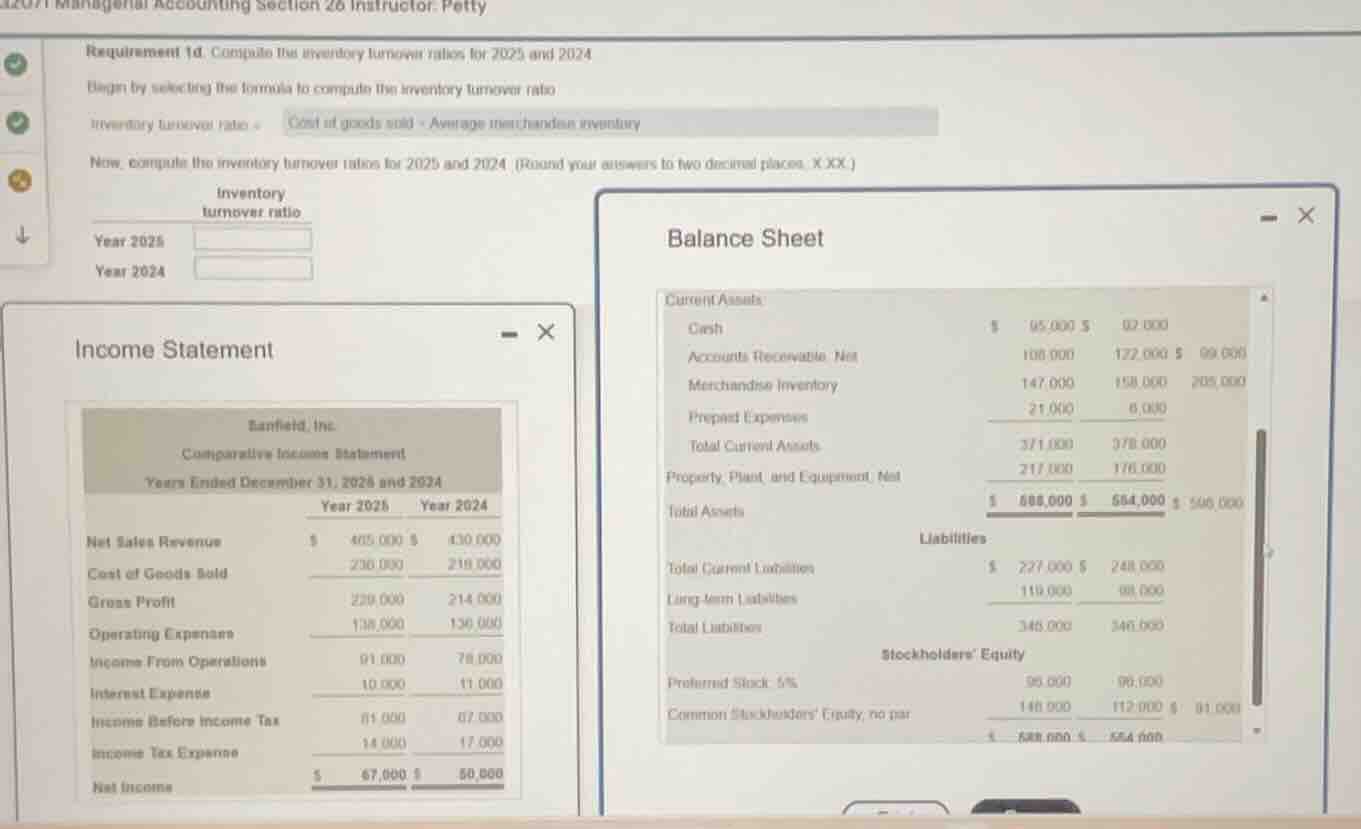
requirement 1d. compute the inventory turnover ratios for 2025 and 2024
begin by selecting the formula to compute the inventory turnover ratio.
inventory turnover ratio = cost of goods sold \div average merchandise inventory
now, compute the inventory turnover ratios for 2025 and 2024 (round your answers to two decimal places. x.xx.)
income statement
banfield, inc.
comparative income statement
years ended december 31, 2025 and 2024
| year 2025 | year 2024 | |
|---|---|---|
| cost of goods sold | 220,000 | 218,000 |
| gross profit | 230,000 | 214,000 |
| operating expense | 138,000 | 136,000 |
| income from operations | 91,000 | 78,000 |
| interest expense | 10,000 | 11,000 |
| income before income tax | 81,000 | 67,000 |
| income tax expense | 14,000 | 17,000 |
| net income | $ 67,000 | $ 50,000 |
balance sheet
current assets:
| accounts receivable, net | 100,000 | 172,000 | $ 99,000 |
| merchandise inventory | 147,000 | 158,000 | 205,000 |
| prepaid expenses | 21,000 | 6,000 | |
| total current assets | 371,000 | 378,000 | |
| property, plant, and equipment, net | 217,000 | 176,000 | |
| total assets | $ 808,000 | $ 584,000 | $ 540,000 |
liabilities
| long - term liabilities | 119,000 | 98,000 |
| total liabilities | 346,000 | 346,000 |
stockholders equity
| common stockholders equity, no par | 148,000 | 112,000 | $ 91,000 |
Step1: Recall the formula for inventory turnover ratio
The formula for inventory turnover ratio is $\text{Inventory Turnover Ratio} = \frac{\text{Cost of Goods Sold}}{\text{Average Merchandise Inventory}}$, where $\text{Average Merchandise Inventory} = \frac{\text{Beginning Inventory} + \text{Ending Inventory}}{2}$.
Step2: Calculate average merchandise inventory for 2025
For 2025, the beginning inventory is the ending inventory of 2024, which is $158,000$, and the ending inventory of 2025 is $147,000$. So, $\text{Average Merchandise Inventory (2025)} = \frac{158000 + 147000}{2} = \frac{305000}{2} = 152500$.
Step3: Calculate inventory turnover ratio for 2025
The cost of goods sold for 2025 is $220,000$. Using the formula, $\text{Inventory Turnover Ratio (2025)} = \frac{220000}{152500} \approx 1.44$ (rounded to two decimal places).
Step4: Calculate average merchandise inventory for 2024
For 2024, the beginning inventory is the ending inventory of 2023, which is $205,000$ (from the balance sheet, assuming the previous year's inventory is $205,000$), and the ending inventory of 2024 is $158,000$. Wait, no, looking at the balance sheet, the merchandise inventory for 2024 is $158,000$ and for 2023 (previous year) is $205,000$? Wait, the balance sheet shows merchandise inventory for different years? Wait, the balance sheet has columns with amounts, maybe the first column is 2025, second 2024, third 2023? Let's recheck. The income statement has 2025 and 2024. The balance sheet: Current Assets - Merchandise Inventory: first amount (2025) is $147,000$, second (2024) is $158,000$, third (2023) is $205,000$. So for 2024, the beginning inventory is 2023's ending inventory, which is $205,000$, and ending inventory of 2024 is $158,000$. So $\text{Average Merchandise Inventory (2024)} = \frac{205000 + 158000}{2} = \frac{363000}{2} = 181500$.
Step5: Calculate inventory turnover ratio for 2024
The cost of goods sold for 2024 is $218,000$. Using the formula, $\text{Inventory Turnover Ratio (2024)} = \frac{218000}{181500} \approx 1.20$ (rounded to two decimal places). Wait, but let's check again. Wait, maybe the balance sheet's merchandise inventory: the first column is 2025, second 2024, third 2023. So for 2024, the beginning inventory is 2023's inventory ($205,000$) and ending inventory is 2024's inventory ($158,000$). But let's confirm the cost of goods sold for 2024 is $218,000$ (from income statement). So average inventory for 2024: (205000 + 158000)/2 = 181500. Then 218000 / 181500 ≈ 1.20. Wait, but maybe I made a mistake in the beginning inventory for 2024. Wait, the income statement is for years ended December 31, 2025 and 2024. So for 2024, the inventory at the beginning of 2024 is the inventory at December 31, 2023, which is $205,000$ (from balance sheet, third column), and inventory at December 31, 2024 is $158,000$ (second column). So that's correct.
Wait, but let's recheck the average inventory for 2025: beginning inventory (Dec 31, 2024) is $158,000$, ending inventory (Dec 31, 2025) is $147,000$. So average is (158000 + 147000)/2 = 152500. Cost of goods sold 2025 is 220000. 220000 / 152500 ≈ 1.44.
For 2024: beginning inventory (Dec 31, 2023) is $205,000$, ending inventory (Dec 31, 2024) is $158,000$. Average is (205000 + 158000)/2 = 181500. Cost of goods sold 2024 is 218000. 218000 / 181500 ≈ 1.20.
Wait, but maybe the balance sheet's merchandise inventory for 2024 is $158,000$ and for 2023 is $205,000$, so that's correct.

Snap & solve any problem in the app
Get step-by-step solutions on Sovi AI
Photo-based solutions with guided steps
Explore more problems and detailed explanations
Inventory turnover ratio for 2025: $\approx 1.44$
Inventory turnover ratio for 2024: $\approx 1.20$