QUESTION IMAGE
Question
review
move the correct answer to each box in the table.
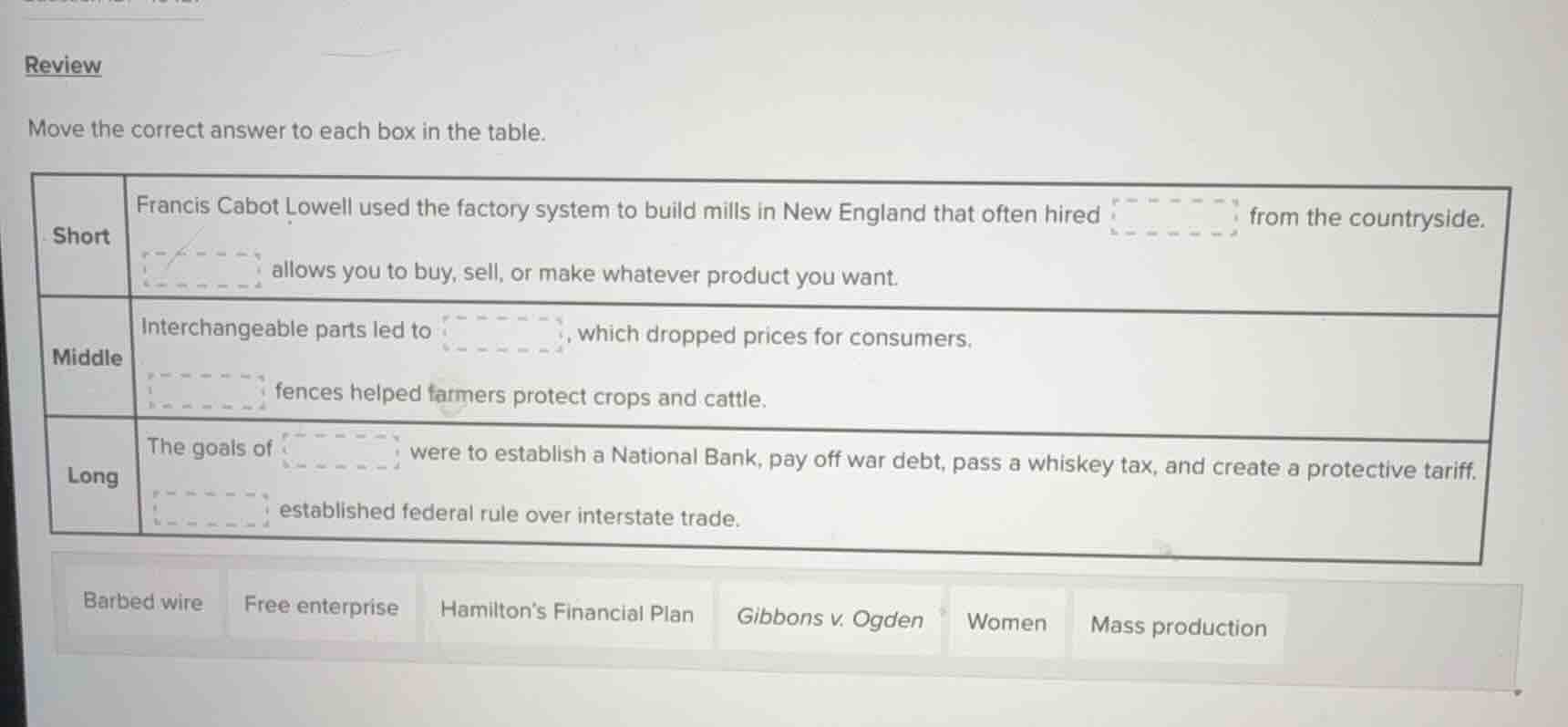
| | francis cabot lowell used the factory system to build mills in new england that often hired from the countryside.
allows you to buy, sell, or make whatever product you want.
| middle | interchangeable parts led to , which dropped prices for consumers.
fences helped farmers protect crops and cattle.
| long | the goals of were to establish a national bank, pay off war debt, pass a whiskey tax, and create a protective tariff.
established federal rule over interstate trade.
barbed wire free enterprise hamilton’s financial plan gibbons v. ogden women mass production
- Francis Cabot Lowell's mills in New England were known for hiring young women from rural areas as factory workers.
- Free enterprise is an economic system that allows individuals to buy, sell, or produce desired products with minimal restriction.
- Interchangeable parts enabled mass production, which streamlined manufacturing and reduced consumer prices.
- Barbed wire was a key invention that let farmers cheaply and effectively fence off land to protect crops and livestock.
- Hamilton's Financial Plan, proposed by Alexander Hamilton, included establishing a national bank, repaying war debts, implementing a whiskey tax, and enacting a protective tariff.
- The Supreme Court case Gibbons v. Ogden established that the federal government has authority over interstate commerce.

Snap & solve any problem in the app
Get step-by-step solutions on Sovi AI
Photo-based solutions with guided steps
Explore more problems and detailed explanations
Short
- Francis Cabot Lowell used the factory system to build mills in New England that often hired Women from the countryside.
- Free enterprise allows you to buy, sell, or make whatever product you want.
Middle
- Interchangeable parts led to Mass production, which dropped prices for consumers.
- Barbed wire fences helped farmers protect crops and cattle.
Long
- The goals of Hamilton's Financial Plan were to establish a National Bank, pay off war debt, pass a whiskey tax, and create a protective tariff.
- Gibbons v. Ogden established federal rule over interstate trade.