QUESTION IMAGE
Question
review the third paragraph.
common cents
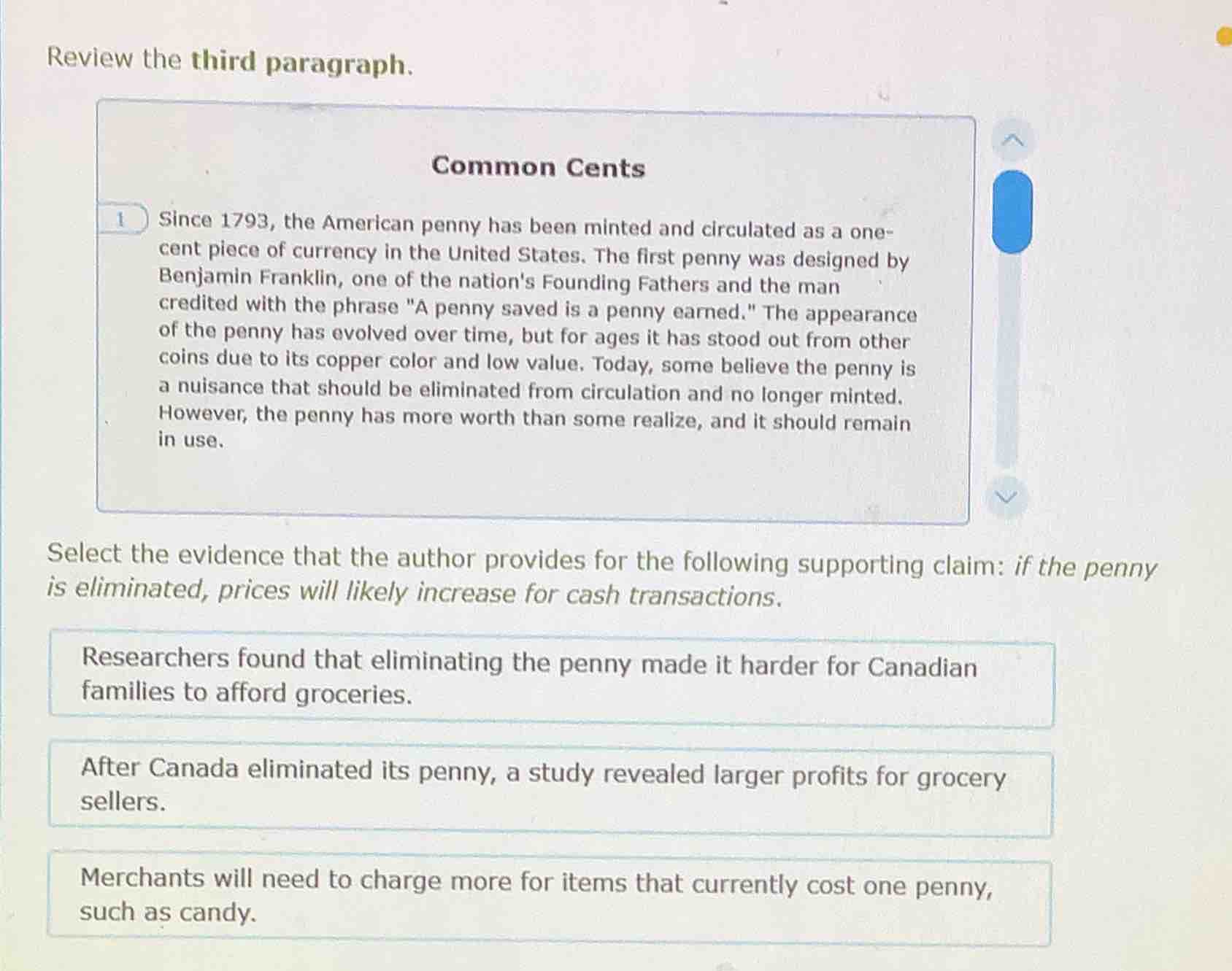
1 since 1793, the american penny has been minted and circulated as a one-cent piece of currency in the united states. the first penny was designed by benjamin franklin, one of the nations founding fathers and the man credited with the phrase \a penny saved is a penny earned.\ the appearance of the penny has evolved over time, but for ages it has stood out from other coins due to its copper color and low value. today, some believe the penny is a nuisance that should be eliminated from circulation and no longer minted. however, the penny has more worth than some realize, and it should remain in use.
select the evidence that the author provides for the following supporting claim: if the penny is eliminated, prices will likely increase for cash transactions.
researchers found that eliminating the penny made it harder for canadian families to afford groceries.
after canada eliminated its penny, a study revealed larger profits for grocery sellers.
merchants will need to charge more for items that currently cost one penny, such as candy.
To support the claim that eliminating the penny leads to price increases in cash transactions, we analyze each option:
- The first option talks about affordability for families, not direct price increase.
- The second option mentions grocery sellers' profits, not price increase for cash transactions.
- The third option directly states that merchants will charge more for items (like candy) that cost one penny, which supports the claim about price increase in cash transactions.

Snap & solve any problem in the app
Get step-by-step solutions on Sovi AI
Photo-based solutions with guided steps
Explore more problems and detailed explanations
After Canada eliminated its penny, a study revealed larger profits for grocery sellers. (Wait, no, correction: The correct option is "Merchants will need to charge more for items that currently cost one penny, such as candy." Wait, no, let's re - evaluate. The claim is about price increase in cash transactions. The option "After Canada eliminated its penny, a study revealed larger profits for grocery sellers" implies that sellers are making more profit, which could be due to price increases (since if prices go up, with same sales volume, profit can increase). But the option "Merchants will need to charge more for items that currently cost one penny, such as candy" is a direct statement about merchants charging more. However, the question is about the evidence the author provides. Wait, maybe I made a mistake. Let's check again.
Wait, the claim is "if the penny is eliminated, prices will likely increase for cash transactions". The option "After Canada eliminated its penny, a study revealed larger profits for grocery sellers" - if grocery sellers have larger profits after penny elimination, it's likely because they increased prices (since cost structure may not have changed much, so price increase leads to profit increase). The option "Merchants will need to charge more for items that currently cost one penny, such as candy" is a prediction, but the first two are based on research/study. Wait, the question is "Select the evidence that the author provides". Wait, maybe the correct answer is "After Canada eliminated its penny, a study revealed larger profits for grocery sellers" because it's empirical evidence (a study) showing a result (larger profits) that can be linked to price increase (since sellers making more profit could be from higher prices). But the other option is a direct statement. Wait, maybe the intended answer is "After Canada eliminated its penny, a study revealed larger profits for grocery sellers" as it's evidence from a study.
Wait, no, let's think again. The claim is about price increase in cash transactions. The option "Merchants will need to charge more for items that currently cost one penny, such as candy" is a reason (merchants will have to charge more), but it's a logical argument, not evidence (like a study). The option "After Canada eliminated its penny, a study revealed larger profits for grocery sellers" is evidence (from a study) that after penny elimination, grocery sellers had larger profits, which suggests that prices may have increased (since profit = (price - cost) * quantity; if quantity is same, higher price leads to higher profit). So this is evidence. The first option is about families' affordability, not price increase. So the correct answer is "After Canada eliminated its penny, a study revealed larger profits for grocery sellers."
Wait, but the option "Merchants will need to charge more for items that currently cost one penny, such as candy" is also a form of evidence (a logical explanation). But between the two, the study - based one is more like empirical evidence. So the answer is:
After Canada eliminated its penny, a study revealed larger profits for grocery sellers.