QUESTION IMAGE
Question
review it
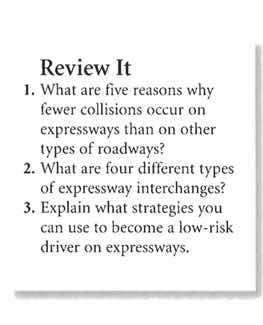
- what are five reasons why fewer collisions occur on expressways than on other types of roadways?
- what are four different types of expressway interchanges?
- explain what strategies you can use to become a low - risk driver on expressways.
Brief Explanations
- For the first question, the reasons relate to expressway design, traffic control, and user behavior that reduce collision risks.
- For the second question, interchanges are categorized by their structure and traffic flow handling.
- For the third question, low-risk driving strategies focus on proactive, safe behaviors tailored to expressway conditions.

Snap & solve any problem in the app
Get step-by-step solutions on Sovi AI
Photo-based solutions with guided steps
Explore more problems and detailed explanations
- Five reasons fewer collisions occur on expressways:
- Controlled access limits entry/exit points, reducing cross-traffic conflicts.
- Higher, consistent speed limits minimize speed differentials between vehicles.
- Divided roadways separate opposing traffic, eliminating head-on collisions.
- No intersections, stop signs, or traffic lights remove conflict points.
- Drivers on expressways are typically more alert and focused on high-speed travel.
- Four different types of expressway interchanges:
- Diamond interchange: Uses ramps in a diamond shape to connect a highway to a cross road.
- Cloverleaf interchange: Uses loop ramps for left turns, allowing continuous flow between two highways.
- Trumpet interchange: A three-way interchange with a trumpet-shaped ramp, often used for freeway-to-artery connections.
- Stack interchange: A multi-level interchange where ramps cross over/under each other, used in high-traffic urban areas.
- Strategies to become a low-risk expressway driver:
- Maintain a safe following distance (at least 3-4 seconds behind the vehicle ahead, increased in poor weather).
- Scan the road 10-15 seconds ahead to anticipate hazards and traffic changes.
- Use turn signals consistently for lane changes and exits to communicate intentions.
- Adjust speed to match traffic flow and weather/road conditions, avoiding sudden accelerations or decelerations.
- Stay in the middle lane when possible to avoid frequent lane changes and conflicts with entering/exiting traffic.