QUESTION IMAGE
Question
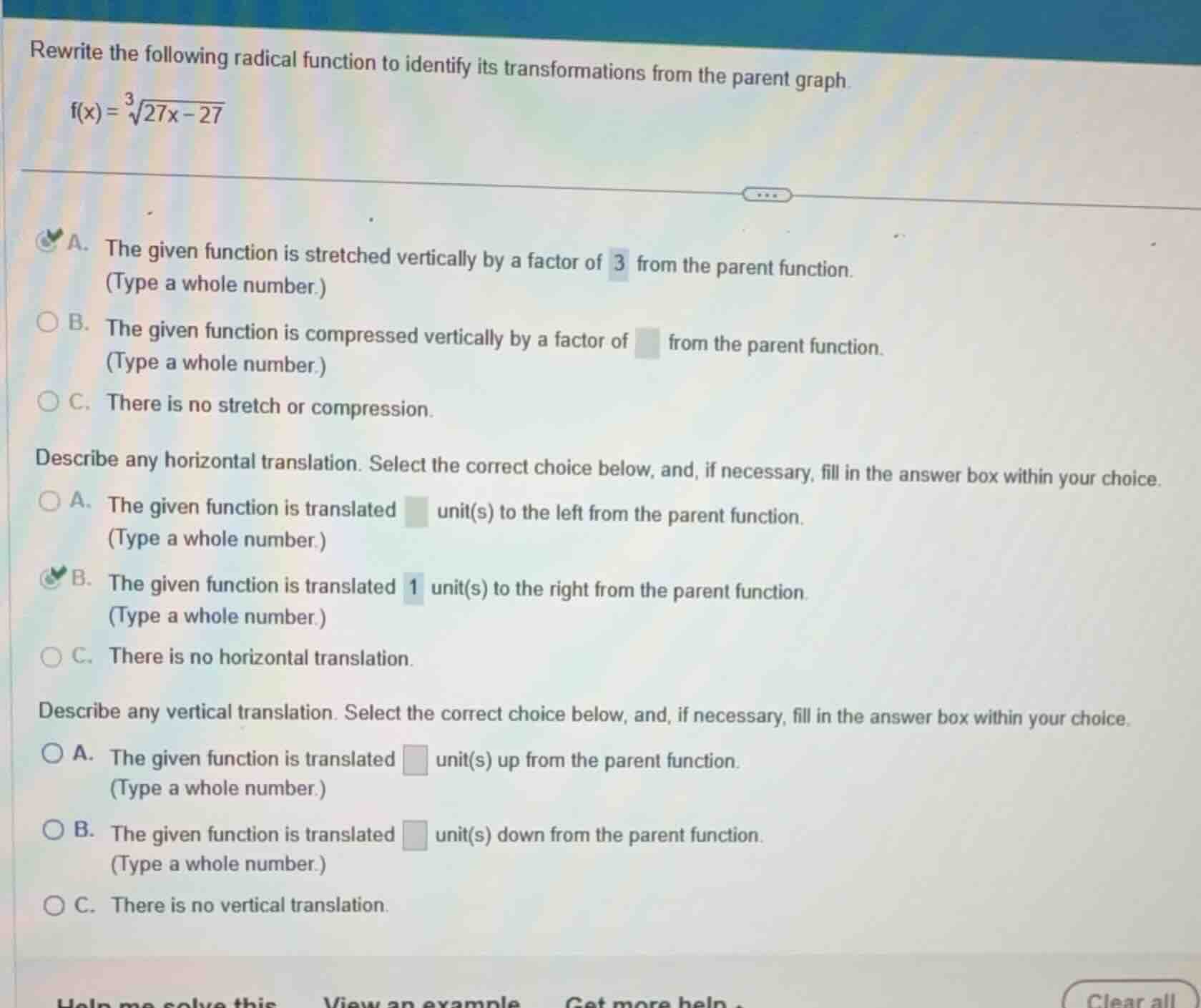
rewrite the following radical function to identify its transformations from the parent graph.
$f(x)=\sqrt3{27x - 27}$
a. the given function is stretched vertically by a factor of 3 from the parent function.
(type a whole number.)
b. the given function is compressed vertically by a factor of \square from the parent function.
(type a whole number.)
c. there is no stretch or compression.
describe any horizontal translation. select the correct choice below, and, if necessary, fill in the answer box within your choice.
a. the given function is translated \square unit(s) to the left from the parent function.
(type a whole number.)
b. the given function is translated 1 unit(s) to the right from the parent function.
(type a whole number.)
c. there is no horizontal translation.
describe any vertical translation. select the correct choice below, and, if necessary, fill in the answer box within your choice.
a. the given function is translated \square unit(s) up from the parent function.
(type a whole number.)
b. the given function is translated \square unit(s) down from the parent function.
(type a whole number.)
c. there is no vertical translation.
Step1: Factor out 27 from radicand
$f(x)=\sqrt[3]{27(x-1)}$
Step2: Simplify the radical
$f(x)=\sqrt[3]{27} \cdot \sqrt[3]{x-1} = 3\sqrt[3]{x-1}$
Step3: Compare to parent function $g(x)=\sqrt[3]{x}$
The transformed form $3\sqrt[3]{x-1}$ matches the structure $a\sqrt[3]{x-h}+k$, where $a=3$, $h=1$, $k=0$.

Snap & solve any problem in the app
Get step-by-step solutions on Sovi AI
Photo-based solutions with guided steps
Explore more problems and detailed explanations
For stretch/compression:
A. The given function is stretched vertically by a factor of 3 from the parent function.
For horizontal translation:
B. The given function is translated 1 unit(s) to the right from the parent function.
For vertical translation:
C. There is no vertical translation.