QUESTION IMAGE
Question
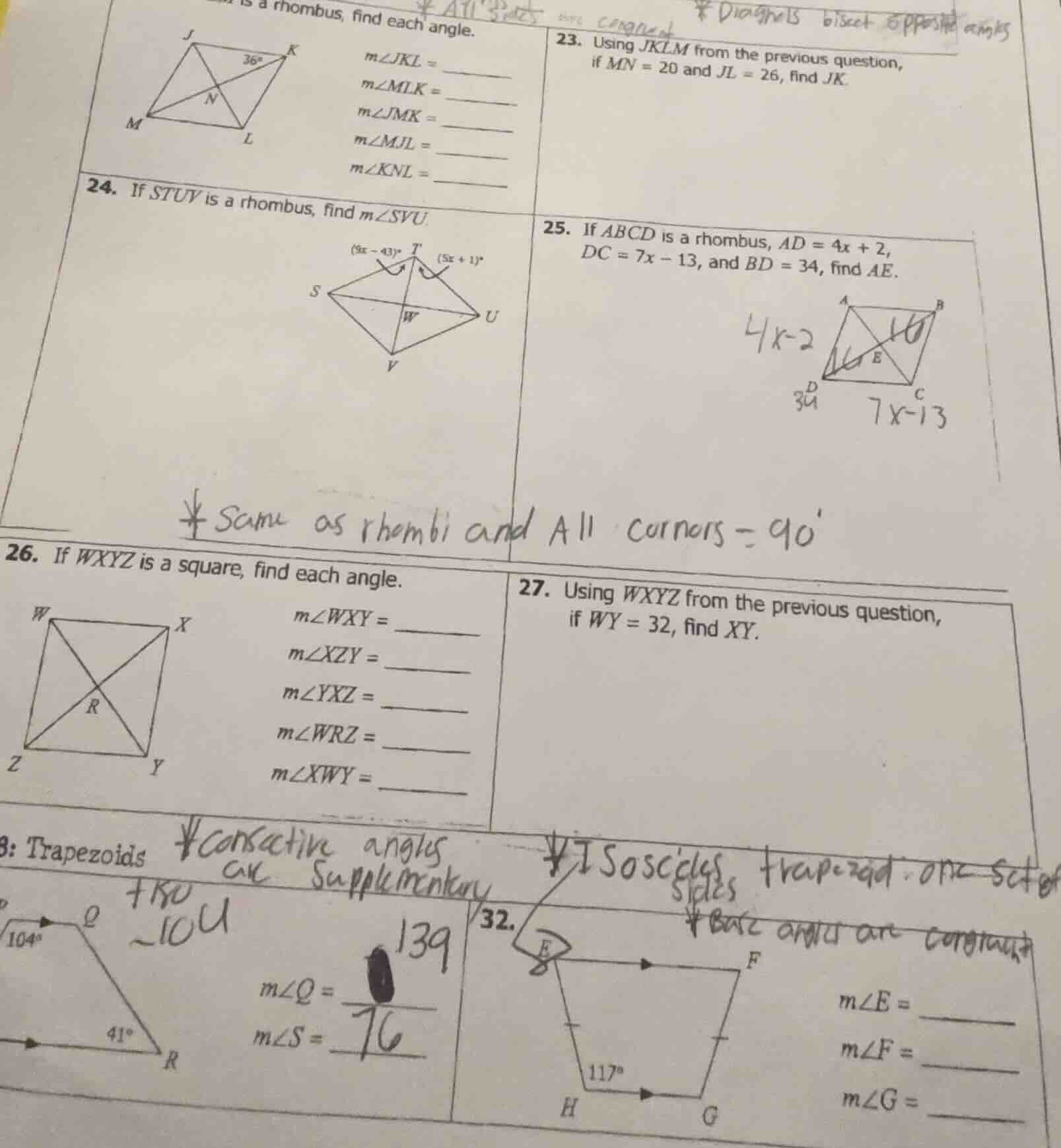
a rhombus, find each angle.
- using jklm from the previous question,
if mn = 20 and jl = 26, find jk.
- if stuv is a rhombus, find m∠svu.
- if abcd is a rhombus, ad = 4x + 2,
dc = 7x - 13, and bd = 34, find ae.
- if wxyz is a square, find each angle.
- using wxyz from the previous question,
if wy = 32, find xy.
trapezoids
Let's solve question 25: If \(ABCD\) is a rhombus, \(AD = 4x + 2\), \(DC = 7x - 13\), and \(BD = 34\), find \(AE\).
Step 1: Recall properties of a rhombus
In a rhombus, all sides are equal. So, \(AD = DC\).
Step 2: Set up the equation
Since \(AD = DC\), we have:
\[
4x + 2 = 7x - 13
\]
Step 3: Solve for \(x\)
Subtract \(4x\) from both sides:
\[
2 = 3x - 13
\]
Add 13 to both sides:
\[
15 = 3x
\]
Divide both sides by 3:
\[
x = 5
\]
Step 4: Find the length of \(AD\) (and \(DC\))
Substitute \(x = 5\) into \(AD = 4x + 2\):
\[
AD = 4(5) + 2 = 20 + 2 = 22
\]
So, each side of the rhombus is 22.
Step 5: Recall the diagonals of a rhombus
In a rhombus, the diagonals bisect each other at right angles. Also, the diagonals bisect the angles of the rhombus. The diagonals of a rhombus are perpendicular bisectors of each other. So, \(BD = 34\) means \(BE = ED = \frac{34}{2} = 17\). Let \(AE = y\). Then, in right triangle \(AED\), we can use the Pythagorean theorem:
\[
AD^2 = AE^2 + ED^2
\]
We know \(AD = 22\) and \(ED = 17\), so:
\[
22^2 = y^2 + 17^2
\]
\[
484 = y^2 + 289
\]
Subtract 289 from both sides:
\[
y^2 = 484 - 289 = 195
\]
Wait, that can't be right. Wait, maybe I made a mistake. Wait, no, the diagonals of a rhombus bisect each other, but they are not necessarily equal. Wait, maybe the other diagonal? Wait, no, the problem is to find \(AE\). Wait, maybe I misread the diagram. Wait, in the diagram, \(BD = 34\), so \(BE = ED = 17\). And \(AC\) is the other diagonal, with \(AE = EC\). Wait, but in the rhombus, the diagonals satisfy \(d_1^2 + d_2^2 = 4s^2\), where \(d_1\) and \(d_2\) are the diagonals, and \(s\) is the side length. Wait, maybe I made a mistake in the side length. Wait, \(AD = 4x + 2\), \(x = 5\), so \(AD = 22\). Then, if \(BD = 34\), then half of \(BD\) is 17. Then, in the right triangle formed by \(AE\), \(ED\), and \(AD\), we have:
\[
AE = \sqrt{AD^2 - ED^2} = \sqrt{22^2 - 17^2} = \sqrt{(22 - 17)(22 + 17)} = \sqrt{5 \times 39} = \sqrt{195} \approx 13.96
\]
But that seems odd. Wait, maybe the problem is that the diagonals are \(AC\) and \(BD\), and \(E\) is the intersection point. So, \(AE\) is half of \(AC\). Wait, maybe I made a mistake in the side length. Wait, let's check the side length again. \(AD = 4x + 2\), \(DC = 7x - 13\). So, \(4x + 2 = 7x - 13\). So, \(2 + 13 = 7x - 4x\), \(15 = 3x\), \(x = 5\). So, \(AD = 4*5 + 2 = 22\), \(DC = 7*5 - 13 = 35 - 13 = 22\). So that's correct. Then, \(BD = 34\), so \(ED = 17\). Then, in triangle \(AED\), which is right-angled at \(E\), \(AE = \sqrt{AD^2 - ED^2} = \sqrt{22^2 - 17^2} = \sqrt{484 - 289} = \sqrt{195} \approx 13.96\). But maybe the problem is that the diagonals are \(AC\) and \(BD\), and \(E\) is the midpoint. Wait, maybe the diagram shows \(BD = 34\) and \(AC\) is the other diagonal. Wait, maybe I misread the problem. Wait, the problem says "find \(AE\)". Maybe \(AE\) is half of \(AC\), and we need to find \(AC\) first. Wait, in a rhombus, the diagonals satisfy \(d_1^2 + d_2^2 = 4s^2\), where \(d_1 = BD = 34\), \(d_2 = AC\), and \(s = 22\). So:
\[
34^2 + AC^2 = 4*(22)^2
\]
\[
1156 + AC^2 = 4*484 = 1936
\]
\[
AC^2 = 1936 - 1156 = 780
\]
\[
AC = \sqrt{780} = 2\sqrt{195} \approx 27.93
\]
Then, \(AE = \frac{AC}{2} = \sqrt{195} \approx 13.96\). But that seems messy. Wait, maybe I made a mistake in the side length. Wait, let's check again. \(AD = 4x + 2\), \(DC = 7x - 13\). So, \(4x + 2 = 7x - 13\). So, \(2 + 13 = 3x\), \(15 = 3x\), \(x = 5\). So, \(AD = 22\), \(DC = 22\). That's correct. Then, \(BD = 34\), so \(ED = 17\). Then, \(AE = \sqrt{22^2 - 17^2} =…

Snap & solve any problem in the app
Get step-by-step solutions on Sovi AI
Photo-based solutions with guided steps
Explore more problems and detailed explanations
Let's solve question 25: If \(ABCD\) is a rhombus, \(AD = 4x + 2\), \(DC = 7x - 13\), and \(BD = 34\), find \(AE\).
Step 1: Recall properties of a rhombus
In a rhombus, all sides are equal. So, \(AD = DC\).
Step 2: Set up the equation
Since \(AD = DC\), we have:
\[
4x + 2 = 7x - 13
\]
Step 3: Solve for \(x\)
Subtract \(4x\) from both sides:
\[
2 = 3x - 13
\]
Add 13 to both sides:
\[
15 = 3x
\]
Divide both sides by 3:
\[
x = 5
\]
Step 4: Find the length of \(AD\) (and \(DC\))
Substitute \(x = 5\) into \(AD = 4x + 2\):
\[
AD = 4(5) + 2 = 20 + 2 = 22
\]
So, each side of the rhombus is 22.
Step 5: Recall the diagonals of a rhombus
In a rhombus, the diagonals bisect each other at right angles. Also, the diagonals bisect the angles of the rhombus. The diagonals of a rhombus are perpendicular bisectors of each other. So, \(BD = 34\) means \(BE = ED = \frac{34}{2} = 17\). Let \(AE = y\). Then, in right triangle \(AED\), we can use the Pythagorean theorem:
\[
AD^2 = AE^2 + ED^2
\]
We know \(AD = 22\) and \(ED = 17\), so:
\[
22^2 = y^2 + 17^2
\]
\[
484 = y^2 + 289
\]
Subtract 289 from both sides:
\[
y^2 = 484 - 289 = 195
\]
Wait, that can't be right. Wait, maybe I made a mistake. Wait, no, the diagonals of a rhombus bisect each other, but they are not necessarily equal. Wait, maybe the other diagonal? Wait, no, the problem is to find \(AE\). Wait, maybe I misread the diagram. Wait, in the diagram, \(BD = 34\), so \(BE = ED = 17\). And \(AC\) is the other diagonal, with \(AE = EC\). Wait, but in the rhombus, the diagonals satisfy \(d_1^2 + d_2^2 = 4s^2\), where \(d_1\) and \(d_2\) are the diagonals, and \(s\) is the side length. Wait, maybe I made a mistake in the side length. Wait, \(AD = 4x + 2\), \(x = 5\), so \(AD = 22\). Then, if \(BD = 34\), then half of \(BD\) is 17. Then, in the right triangle formed by \(AE\), \(ED\), and \(AD\), we have:
\[
AE = \sqrt{AD^2 - ED^2} = \sqrt{22^2 - 17^2} = \sqrt{(22 - 17)(22 + 17)} = \sqrt{5 \times 39} = \sqrt{195} \approx 13.96
\]
But that seems odd. Wait, maybe the problem is that the diagonals are \(AC\) and \(BD\), and \(E\) is the intersection point. So, \(AE\) is half of \(AC\). Wait, maybe I made a mistake in the side length. Wait, let's check the side length again. \(AD = 4x + 2\), \(DC = 7x - 13\). So, \(4x + 2 = 7x - 13\). So, \(2 + 13 = 7x - 4x\), \(15 = 3x\), \(x = 5\). So, \(AD = 4*5 + 2 = 22\), \(DC = 7*5 - 13 = 35 - 13 = 22\). So that's correct. Then, \(BD = 34\), so \(ED = 17\). Then, in triangle \(AED\), which is right-angled at \(E\), \(AE = \sqrt{AD^2 - ED^2} = \sqrt{22^2 - 17^2} = \sqrt{484 - 289} = \sqrt{195} \approx 13.96\). But maybe the problem is that the diagonals are \(AC\) and \(BD\), and \(E\) is the midpoint. Wait, maybe the diagram shows \(BD = 34\) and \(AC\) is the other diagonal. Wait, maybe I misread the problem. Wait, the problem says "find \(AE\)". Maybe \(AE\) is half of \(AC\), and we need to find \(AC\) first. Wait, in a rhombus, the diagonals satisfy \(d_1^2 + d_2^2 = 4s^2\), where \(d_1 = BD = 34\), \(d_2 = AC\), and \(s = 22\). So:
\[
34^2 + AC^2 = 4*(22)^2
\]
\[
1156 + AC^2 = 4*484 = 1936
\]
\[
AC^2 = 1936 - 1156 = 780
\]
\[
AC = \sqrt{780} = 2\sqrt{195} \approx 27.93
\]
Then, \(AE = \frac{AC}{2} = \sqrt{195} \approx 13.96\). But that seems messy. Wait, maybe I made a mistake in the side length. Wait, let's check again. \(AD = 4x + 2\), \(DC = 7x - 13\). So, \(4x + 2 = 7x - 13\). So, \(2 + 13 = 3x\), \(15 = 3x\), \(x = 5\). So, \(AD = 22\), \(DC = 22\). That's correct. Then, \(BD = 34\), so \(ED = 17\). Then, \(AE = \sqrt{22^2 - 17^2} = \sqrt{484 - 289} = \sqrt{195} \approx 13.96\). But maybe the problem is that the diagonals are perpendicular bisectors, so \(AE\) is half of \(AC\), and we need to find \(AC\). Wait, maybe the diagram is different. Wait, maybe \(BD = 34\) is one diagonal, and \(AC\) is the other. Wait, maybe the problem is simpler. Wait, maybe \(AE\) is a segment related to the side. Wait, no, in a rhombus, the diagonals bisect each other at right angles. So, if \(BD = 34\), then \(BE = ED = 17\). Then, if \(AD = 22\), then \(AE = \sqrt{AD^2 - ED^2} = \sqrt{22^2 - 17^2} = \sqrt{484 - 289} = \sqrt{195} \approx 13.96\). But maybe the problem has a typo, or I misread it. Wait, maybe \(AD = 4x - 2\) instead of \(4x + 2\)? Let's check. If \(AD = 4x - 2\) and \(DC = 7x - 13\), then \(4x - 2 = 7x - 13\), so \(13 - 2 = 3x\), \(11 = 3x\), which is not an integer. No. Wait, maybe \(BD = 30\) instead of 34? No, the problem says 34. Wait, maybe I made a mistake in the property. Wait, in a rhombus, the diagonals bisect each other, but they are not necessarily equal. Wait, maybe the answer is \(\sqrt{195}\), but that's approximately 13.96. Alternatively, maybe the problem is that \(AE\) is a side, but no. Wait, maybe the diagram shows \(BD = 34\) and \(AC = 26\) (from question 23, \(JL = 26\)). Wait, question 23 is about \(JKLM\) with \(MN = 20\) and \(JL = 26\). Maybe \(JL\) is a diagonal, so \(JL = 26\), so \(JN = NL = 13\), and \(MN = 20\), so \(MK = 40\). Then, \(JK = \sqrt{13^2 + 20^2} = \sqrt{169 + 400} = \sqrt{569} \approx 23.85\). But that's question 23. For question 25, maybe the diagram has \(BD = 34\) and \(AC = 26\) (from question 23's \(JL = 26\)). Wait, maybe the problem is using the same rhombus? No, question 25 is about \(ABCD\). Wait, maybe I made a mistake in the side length. Wait, let's re-express the problem.
Wait, the problem says: "If \(ABCD\) is a rhombus, \(AD = 4x + 2\), \(DC = 7x - 13\), and \(BD = 34\), find \(AE\)."
In a rhombus, \(AD = DC\), so \(4x + 2 = 7x - 13\) => \(x = 5\), so \(AD = 22\). The diagonals of a rhombus bisect each other at right angles. So, let \(E\) be the intersection of the diagonals \(AC\) and \(BD\). Then, \(BE = ED = 17\) (since \(BD = 34\)). Then, in right triangle \(AED\), \(AE^2 + ED^2 = AD^2\) => \(AE^2 + 17^2 = 22^2\) => \(AE^2 = 484 - 289 = 195\) => \(AE = \sqrt{195} \approx 13.96\). But maybe the problem expects an integer, so maybe there's a mistake in my calculation. Wait, maybe \(AD = 4x - 2\) instead of \(4x + 2\). Let's try that. If \(AD = 4x - 2\) and \(DC = 7x - 13\), then \(4x - 2 = 7x - 13\) => \(11 = 3x\) => \(x = \frac{11}{3}\), which is not an integer. No. Alternatively, maybe \(BD = 30\) instead of 34. Then \(ED = 15\), and \(AE = \sqrt{22^2 - 15^2} = \sqrt{484 - 225} = \sqrt{259} \approx 16.09\). Still not integer. Wait, maybe the side length is 25? Let's see, if \(4x + 2 = 25\), then \(4x = 23\), \(x = 5.75\), not integer. If \(7x - 13 = 25\), \(7x = 38\), \(x = 5.428\), not integer. Wait, maybe the problem is that \(AE\) is half of \(AC\), and \(AC\) is calculated as \(2\sqrt{s^2 - (\frac{BD}{2})^2}\). So, \(AC = 2\sqrt{22^2 - 17^2} = 2\sqrt{195} \approx 27.93\), so \(AE = \sqrt{195} \approx 13.96\). So, the answer is \(\sqrt{195}\) or approximately 14.
But maybe I made a mistake. Let's check again.
- \(AD = DC\) (rhombus sides are equal)
- \(4x + 2 = 7x - 13\)
- \(3x = 15\) => \(x = 5\)
- \(AD = 4*5 + 2 = 22\)
- Diagonals bisect each other: \(ED = \frac{BD}{2} = \frac{34}{2} = 17\)
- In right triangle \(AED\), \(AE = \sqrt{AD^2 - ED^2} = \sqrt{22^2 - 17^2} = \sqrt{484 - 289} = \sqrt{195} \approx 13.96\)
So, the length of \(AE\) is \(\sqrt{195}\) or approximately 14.
Final Answer
\(\boxed{\sqrt{195}}\) (or approximately 14)