QUESTION IMAGE
Question
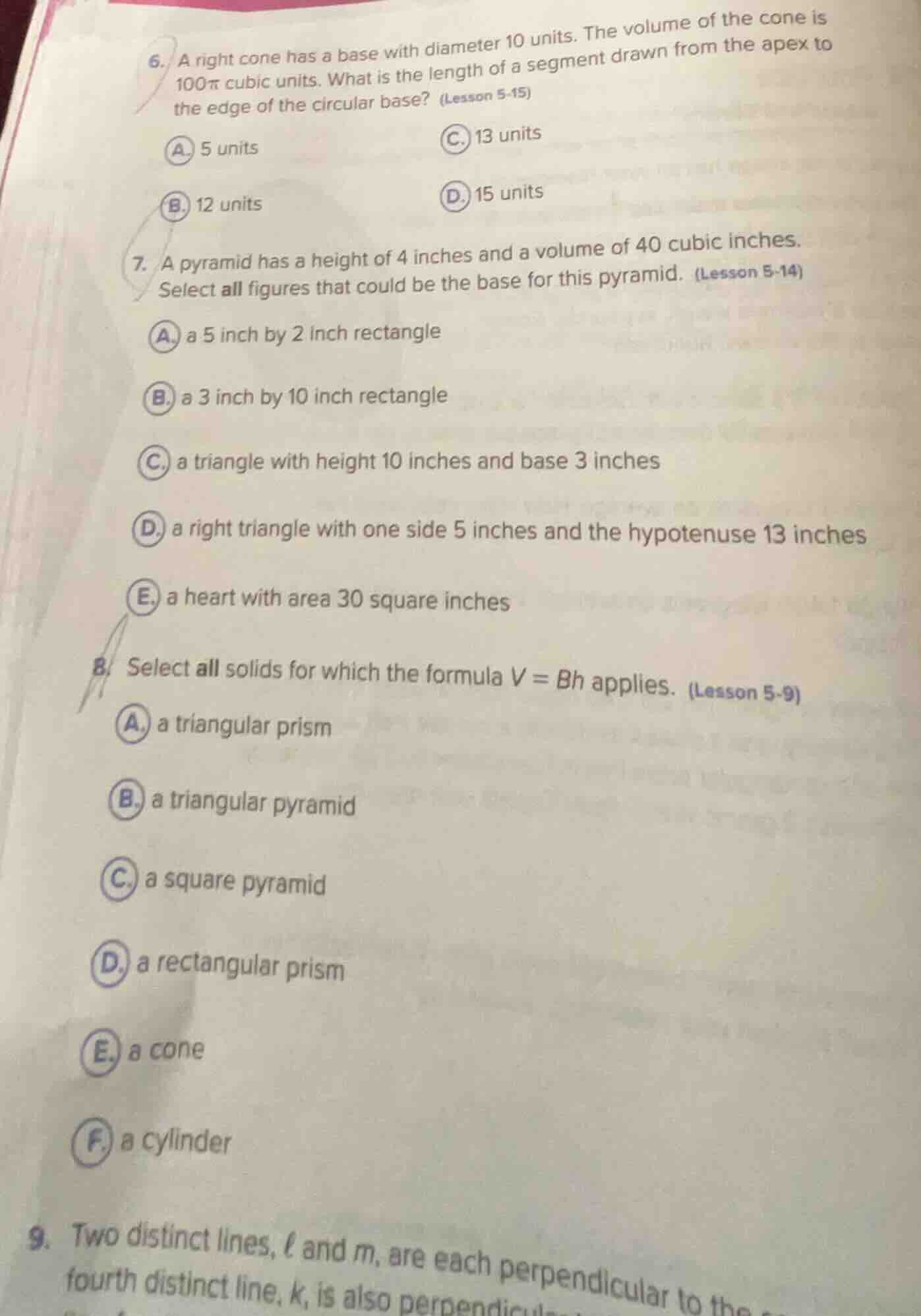
- a right cone has a base with diameter 10 units. the volume of the cone is $100\pi$ cubic units. what is the length of a segment drawn from the apex to the edge of the circular base? (lesson 5-15)a. 5 unitsc. 13 unitsb. 12 unitsd. 15 units7. a pyramid has a height of 4 inches and a volume of 40 cubic inches. select all figures that could be the base for this pyramid. (lesson 5-14)a. a 5 inch by 2 inch rectangleb. a 3 inch by 10 inch rectanglec. a triangle with height 10 inches and base 3 inchesd. a right triangle with one side 5 inches and the hypotenuse 13 inchese. a heart with area 30 square inches8. select all solids for which the formula $v = bh$ applies. (lesson 5-9)a. a triangular prismb. a triangular pyramidc. a square pyramidd. a rectangular prisme. a conef. a cylinder9. two distinct lines, $\ell$ and $m$, are each perpendicular to the fourth distinct line, $k$, is also perpendicular
(Question 6):
Step1: Find base radius
Diameter = 10, so radius $r = \frac{10}{2} = 5$ units.
Step2: Solve for cone height
Volume formula $V = \frac{1}{3}\pi r^2 h$. Substitute $V=100\pi, r=5$:
$$100\pi = \frac{1}{3}\pi (5)^2 h$$
Cancel $\pi$, solve for $h$:
$$100 = \frac{25}{3}h \implies h = \frac{100 \times 3}{25} = 12$$
Step3: Calculate slant length
Use Pythagorean theorem: $l = \sqrt{r^2 + h^2}$
$$l = \sqrt{5^2 + 12^2} = \sqrt{25 + 144} = \sqrt{169} = 13$$
(Question 7):
Step1: Find required base area
Pyramid volume $V = \frac{1}{3}Bh$. Substitute $V=40, h=4$:
$$40 = \frac{1}{3}B(4) \implies B = \frac{40 \times 3}{4} = 30 \text{ square inches}$$
Step2: Check each option's area
- A: $5 \times 2 = 10
eq 30$
- B: $3 \times 10 = 30$
- C: $\frac{1}{2} \times 3 \times 10 = 15
eq 30$
- D: Find other leg: $\sqrt{13^2 - 5^2} = 12$, area $\frac{1}{2} \times 5 \times 12 = 30$
- E: Area = 30
(Question 8):
Step1: Identify solids for $V=Bh$
The formula $V=Bh$ applies to prisms and cylinders, where $B$ is base area, $h$ is height. Pyramids/cones use $V=\frac{1}{3}Bh$.
- A: Triangular prism (prism, valid)
- B: Triangular pyramid (uses $\frac{1}{3}Bh$, invalid)
- C: Square pyramid (uses $\frac{1}{3}Bh$, invalid)
- D: Rectangular prism (prism, valid)
- E: Cone (uses $\frac{1}{3}Bh$, invalid)
- F: Cylinder (valid)

Snap & solve any problem in the app
Get step-by-step solutions on Sovi AI
Photo-based solutions with guided steps
Explore more problems and detailed explanations
(Question 6):
C. 13 units
---