QUESTION IMAGE
Question
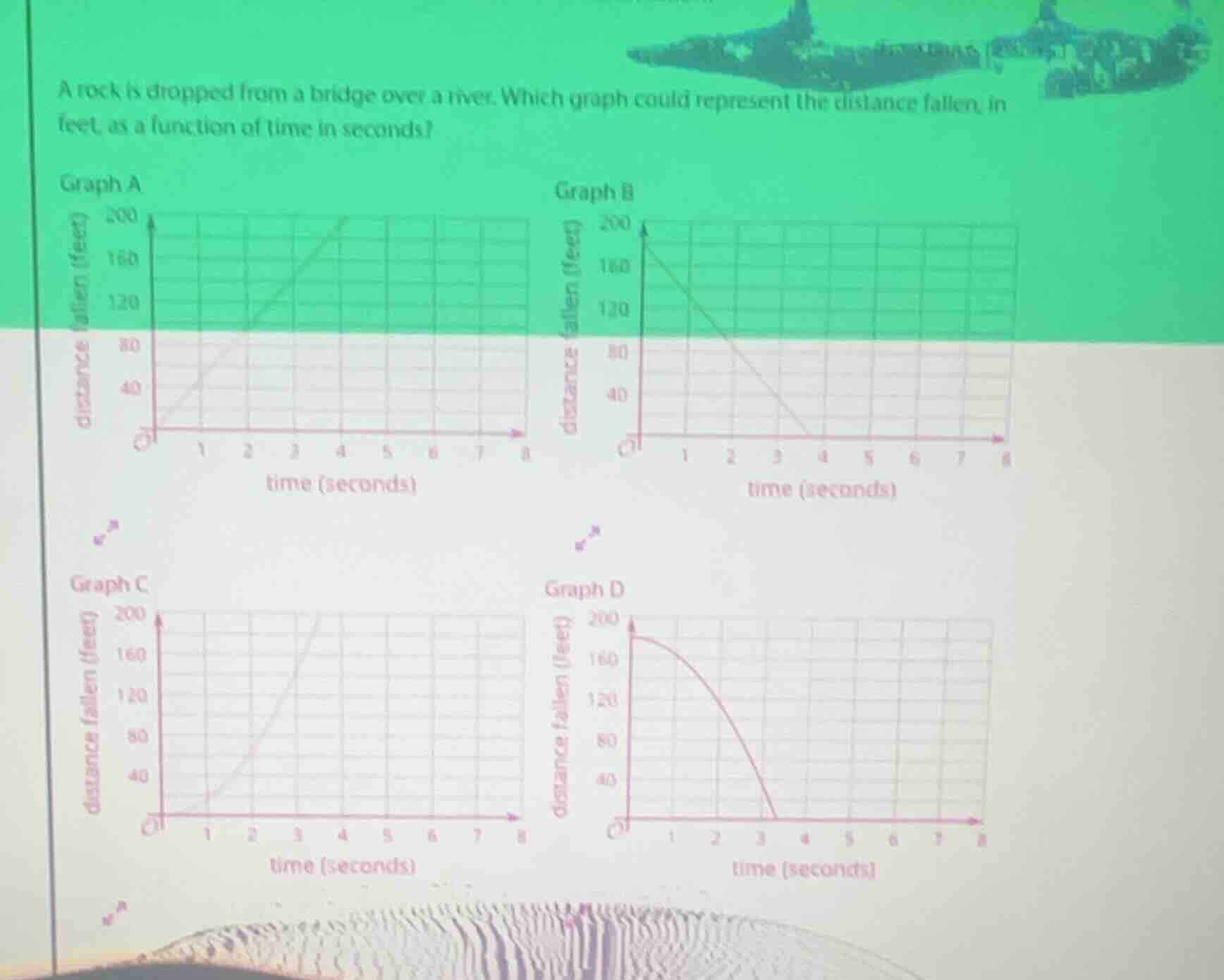
a rock is dropped from a bridge over a river. which graph could represent the distance fallen, in feet, as a function of time in seconds? graph a graph b graph c graph d
Step1: Recall free - fall motion formula
The distance \(d\) an object falls in free - fall (neglecting air resistance) is given by the formula \(d = \frac{1}{2}gt^{2}\) (where \(g\) is the acceleration due to gravity, approximately \(32\space ft/s^{2}\) near the Earth's surface). This is a quadratic function of the form \(y = ax^{2}+bx + c\) (in this case, \(b = 0\) and \(c = 0\)), and its graph is a parabola opening upwards. But we can also analyze the relationship between distance and time in terms of the rate of change of distance (speed). The speed of a freely falling object is \(v=gt\), which means the speed increases with time. So the distance fallen should increase at an increasing rate (the graph should be a curve that gets steeper as time increases, or a line with a positive slope that is getting steeper, but among the given linear - looking or curved graphs, we can also think about the nature of the function).
Step2: Analyze each graph
- Graph A: It is a straight line with a constant positive slope. This would represent a constant speed (uniform motion), but in free - fall, the speed increases, so the distance - time graph should not be a straight line with constant slope.
- Graph B: It is a straight line with a negative slope, which would imply that the distance fallen is decreasing with time, which is impossible for a dropped object (the object should be falling down, so distance fallen should increase with time).
- Graph C: Wait, no, let's re - examine. Wait, the formula for free - fall distance is \(d=\frac{1}{2}gt^{2}\), which is a quadratic function. But if we look at the graphs, Graph C: Wait, maybe I misread. Wait, the key is that the distance fallen should increase, and the rate of increase (speed) should increase. So the graph should be a curve that is concave up (since the second derivative of \(d=\frac{1}{2}gt^{2}\) is positive, \(d'' = g>0\)). But among the given graphs, Graph C: Wait, no, let's check the options again. Wait, the formula \(d=\frac{1}{2}gt^{2}\) is a quadratic function, so its graph is a parabola. But if we consider the difference in distance over equal time intervals:
- For a quadratic function \(d(t)=\frac{1}{2}gt^{2}\), if we take \(t = 1\), \(d(1)=\frac{1}{2}g(1)^{2}=\frac{g}{2}\); \(t = 2\), \(d(2)=\frac{1}{2}g(4) = 2g\); \(t = 3\), \(d(3)=\frac{1}{2}g(9)=\frac{9g}{2}\). The differences between consecutive distances: \(d(2)-d(1)=2g-\frac{g}{2}=\frac{3g}{2}\), \(d(3)-d(2)=\frac{9g}{2}-2g=\frac{5g}{2}\), so the distance between consecutive points (for equal time intervals) is increasing. This means that the graph should be getting steeper as time increases.
- Graph A: The slope is constant (equal distance increase per unit time), which is uniform motion, not free - fall.
- Graph B: Distance decreases with time, impossible.
- Graph C: Wait, maybe the user made a typo, but looking at the graphs, Graph C (if we assume that the lines are such that the slope is increasing) or wait, maybe I mislabeled. Wait, the correct graph for free - fall distance as a function of time (since \(d\propto t^{2}\)) should be a parabola opening upwards. But among the given graphs, Graph C: Wait, no, let's look at the options again. Wait, the formula \(d=\frac{1}{2}gt^{2}\) is a quadratic function, so its graph is a parabola. But if we consider the graphs, Graph C (the one with the steeper line as time increases) or wait, maybe the intended graph is Graph C? Wait, no, let's think again. Wait, the distance fallen by a dropped object (initial velocity \(u = 0\)) is given by \(d=ut+\fr…

Snap & solve any problem in the app
Get step-by-step solutions on Sovi AI
Photo-based solutions with guided steps
Explore more problems and detailed explanations
Graph C (assuming the labels are as per the image: the bottom - left graph with the distance fallen increasing at an increasing rate, i.e., the line getting steeper as time increases)