QUESTION IMAGE
Question
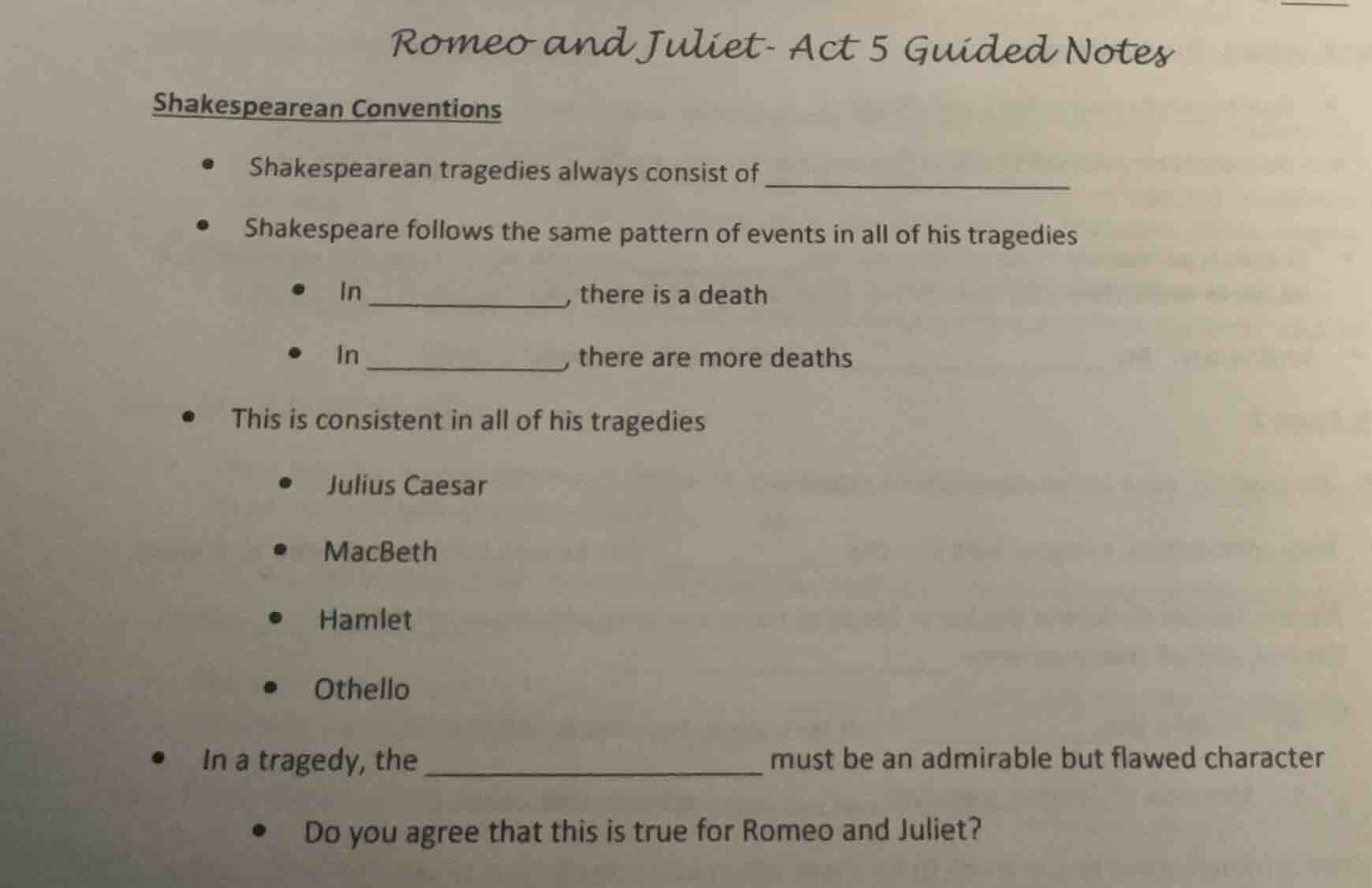
romeo and juliet- act 5 guided notesshakespearean conventions• shakespearean tragedies always consist of • shakespeare follows the same pattern of events in all of his tragedies • in , there is a death • in , there are more deaths• this is consistent in all of his tragedies • julius caesar • macbeth • hamlet • othello• in a tragedy, the must be an admirable but flawed character • do you agree that this is true for romeo and juliet?
Brief Explanations
- Shakespearean tragedies adhere to a core structure centered around a tragic hero and escalating death tolls, with a single key death mid-play and multiple fatalities in the final act.
- The tragic hero is defined as an admirable figure with a fatal flaw that drives their downfall, a standard across Shakespeare's tragic works.
- For Romeo and Juliet, both title characters fit the tragic hero mold: they are noble-hearted but impulsive, a flaw that leads to their deaths.

Snap & solve any problem in the app
Get step-by-step solutions on Sovi AI
Photo-based solutions with guided steps
Explore more problems and detailed explanations
- Shakespearean tragedies always consist of a tragic hero and a series of escalating, unavoidable deaths
- In the middle (Act 3), there is a death
- In the final act (Act 5), there are more deaths
- In a tragedy, the tragic hero must be an admirable but flawed character
- Do you agree that this is true for Romeo and Juliet? Yes. Both Romeo and Juliet are admirable (they are loyal, passionate, and sympathetic to audiences) but have a tragic flaw: impulsive, reckless decision-making (Romeo killing Tybalt, both rushing to suicide without verifying information) that leads to their downfall.