QUESTION IMAGE
Question
rotation of 180 clockwise translation 4 units down reflection over x - axis dilation with scale factor of 2 reflection over y - axis rotation of 90 clockwise
Brief Explanations
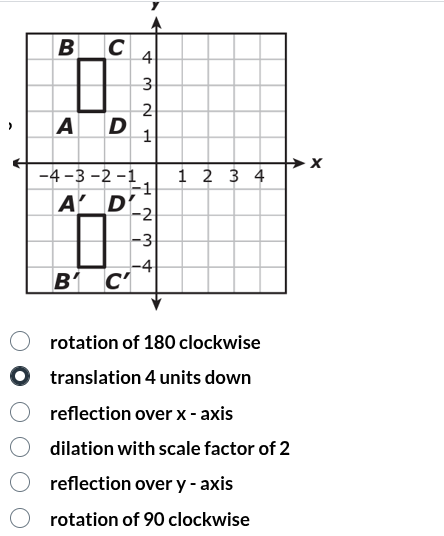
To determine the transformation from the original rectangle (with vertices A, B, C, D) to the image rectangle (with vertices \(A'\), \(B'\), \(C'\), \(D'\)):
- Check the y - coordinates of corresponding points. For example, point A (let's assume A is at \((-3,1)\)) and \(A'\) is at \((-3, - 3)\). The change in the y - coordinate is \(-3-1=-4\), meaning it moved 4 units down.
- A 180 - degree rotation would change both x and y signs, but here x - coordinates remain the same.
- Reflection over the x - axis would change the sign of the y - coordinate, but the vertical distance here is 4 units (from y = 1 to y=-3, the distance is \(1-(-3) = 4\) units down, not a reflection which would map \((x,y)\) to \((x, - y)\) (e.g., \((-3,1)\) would go to \((-3,-1)\) for reflection over x - axis, not \((-3,-3)\)).
- Dilation would change the size, but the size of the rectangle remains the same.
- Reflection over y - axis changes x - sign, which is not the case here.
- 90 - degree clockwise rotation would change the coordinates in a different way (e.g., \((x,y)\) to \((y, - x)\)), which is not observed.
So the transformation is a translation 4 units down.

Snap & solve any problem in the app
Get step-by-step solutions on Sovi AI
Photo-based solutions with guided steps
Explore more problems and detailed explanations
translation 4 units down