QUESTION IMAGE
Question
round 1: unit 3
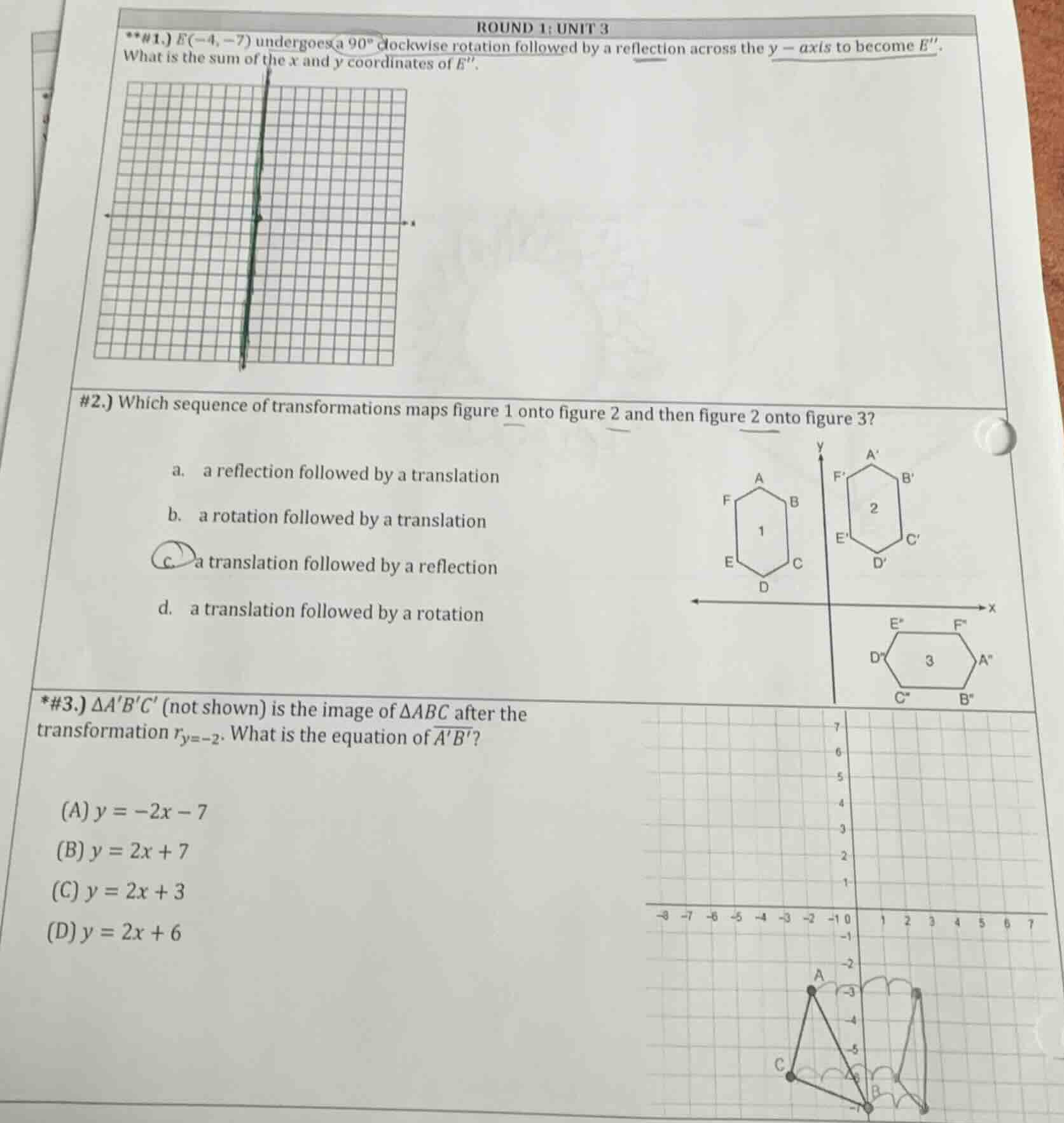
**#1.) e(-4, -7) undergoes a 90° clockwise rotation followed by a reflection across the y - axis to become e. what is the sum of the x and y coordinates of e.
#2.) which sequence of transformations maps figure 1 onto figure 2 and then figure 2 onto figure 3?
a. a reflection followed by a translation
b. a rotation followed by a translation
c. a translation followed by a reflection
d. a translation followed by a rotation
*#3.) δabc (not shown) is the image of δabc after the transformation ( r_{y = -2} ). what is the equation of ( overline{ab} )?
(a) ( y = -2x - 7 )
(b) ( y = 2x + 7 )
(c) ( y = 2x + 3 )
(d) ( y = 2x + 6 )
Question #1
Step 1: 90° Clockwise Rotation
The rule for a 90° clockwise rotation about the origin is \((x, y) \to (y, -x)\). For point \(E(-4, -7)\), applying this rule:
\(x = -4\), \(y = -7\)
New coordinates after rotation: \((-7, 4)\) (since \(y = -7\) becomes the new \(x\), and \(-x = -(-4) = 4\) becomes the new \(y\))
Step 2: Reflection Across the \(y\)-axis
The rule for reflection across the \(y\)-axis is \((x, y) \to (-x, y)\). For the point \((-7, 4)\) from Step 1:
\(x = -7\), so \(-x = 7\); \(y = 4\) remains.
New coordinates after reflection: \((7, 4)\)
Step 3: Sum of \(x\) and \(y\) Coordinates
For \(E''(7, 4)\), sum \(x + y = 7 + 4 = 11\)
- To map figure 1 to figure 2: Figure 1 (left of \(y\)-axis) and figure 2 (right of \(y\)-axis) are mirror images across the \(y\)-axis? No, wait—figure 1 and 2 are aligned vertically but shifted? Wait, no, looking at the orientation: Figure 1 to 2: first, a translation (movement) to align horizontally? Wait, no, actually, figure 1 to 2: if we translate figure 1 to the right (along \(x\)-axis) to get near figure 2? No, wait the options: Let's analyze each transformation.
- Option c: "a translation followed by a reflection"
- First, translate figure 1 (move it) to the position of figure 2 (since figure 1 and 2 have the same shape/orientation, just shifted). Then, to map figure 2 to figure 3: figure 2 is upright, figure 3 is flipped (reflected) over a horizontal line? Wait, no—figure 2 and 3: figure 2 is vertical, figure 3 is horizontal? Wait, no, the hexagons: figure 1 (left), figure 2 (right, same vertical orientation), figure 3 (below, horizontal). Wait, maybe first translate figure 1 to figure 2 (same orientation, so translation), then reflect figure 2 over a horizontal line (or \(x\)-axis) to get figure 3. So the sequence is translation followed by reflection, which is option c.
First, we need the coordinates of \(A\) and \(B\) from the graph (assuming from the grid):
- From the grid, let's identify \(A\) and \(B\):
- \(A\) appears to be at \((-3, -3)\) (wait, looking at the grid: \(y = -3\) for \(A\)? Wait, the grid has \(y\)-axis with -7 at the bottom. Wait, let's re-examine:
- Point \(A\): Let's see the coordinates. From the graph, \(A\) is at \((-3, -3)\)? Wait, no, the \(y\)-axis has -2 as the reflection line \(r_{y=-2}\).
- The reflection over \(y = k\) (horizontal line) has the rule: For a point \((x, y)\), its reflection over \(y = k\) is \((x, 2k - y)\).
- Let's find coordinates of \(A\) and \(B\):
- From the grid, \(B\) is at \((-1, -7)\) (since it's at \(y = -7\), \(x = -1\))
- \(A\) is at \((-3, -3)\) ( \(x = -3\), \(y = -3\))
- Reflection over \(y = -2\):
- For \(A(-3, -3)\): \(2k - y = 2(-2) - (-3) = -4 + 3 = -1\). So \(A'(-3, -1)\)
- For \(B(-1, -7)\): \(2k - y = 2(-2) - (-7) = -4 + 7 = 3\). So \(B'(-1, 3)\)
- Now, find the slope of \(A'B'\):
- Slope \(m = \frac{y_2 - y_1}{x_2 - x_1} = \frac{3 - (-1)}{-1 - (-3)} = \frac{4}{2} = 2\)
- Now, use point-slope form for \(A'(-3, -1)\):
- \(y - y_1 = m(x - x_1)\)
- \(y - (-1) = 2(x - (-3))\)
- \(y + 1 = 2(x + 3)\)
- \(y + 1 = 2x + 6\)
- \(y = 2x + 5\)? Wait, no—wait maybe my coordinates are wrong. Wait, maybe \(A\) is at \((-3, -3)\), \(B\) at \((-1, -7)\). Wait, let's recalculate reflection:
- Reflection over \(y = -2\): the distance from \(y = -3\) to \(y = -2\) is \(1\) unit above, so \(A'\) is \(1\) unit above \(y = -2\), so \(y = -2 + 1 = -1\), so \(A'(-3, -1)\)
- Distance from \(y = -7\) to \(y = -2\) is \(5\) units above, so \(B'\) is \(5\) units above \(y = -2\), so \(y = -2 + 5 = 3\), so \(B'(-1, 3)\)
- Now, equation of line \(A'B'\):
- Slope \(m = \frac{3 - (-1)}{-1 - (-3)} = \frac{4}{2} = 2\)
- Using point \(A'(-3, -1)\): \(y = 2(x + 3) - 1 = 2x + 6 - 1 = 2x + 5\). Wait, but the options are \(y = -2x -7\), \(y = 2x +7\), \(y = 2x +3\), \(y = 2x +6\). Hmm, maybe my coordinates are incorrect. Wait, maybe \(A\) is at \((-3, -3)\), \(B\) at \((-1, -7)\). Wait, let's check the options. Let's assume the correct reflection gives a line with slope \(2\). Let's check option C: \(y = 2x + 3\). No, wait maybe I made a mistake. Wait, the reflection over \(y = -2\): the formula is \((x, y) \to (x, -4 - y)\) (since \(2k - y = 2(-2) - y = -4 - y\)). So for \(A(-3, -3)\): \(y' = -4 - (-3) = -1\), so \(A'(-3, -1)\). For \(B(-1, -7)\): \(y' = -4 - (-7) = 3\), so \(B'(-1, 3)\). Now, equation of line through \((-3, -1)\) and \((-1, 3)\):
- Slope \(m = (3 - (-1))/(-1 - (-3)) = 4/2 = 2\)
- Using point \((-3, -1)\): \(y = 2(x + 3) - 1 = 2x + 6 - 1 = 2x + 5\). Not in options. Wait, maybe \(A\) is at \((-3, -3)\), \(B\) at \((-1, -7)\) is wrong. Wait, maybe \(B\) is at \((-1, -7)\), \(A\) at \((-3, -3)\). Wait, let's check the options again. Option C: \(y = 2x + 3\). Wait, maybe my reflection is wrong. Wait, the reflection over \(y = -2\): if a point is at \(y = a\), its reflection is at \(y = -4 - a\) (since \(2*(-2) - a = -4 -a\)). So if \(A\) is at \((-3, -3)\), reflection is \(y = -4 - (-3) = -1\), so \(A'(-3, -1)\). If \(B\) is at \((-1, -7)\), reflection is \(y = -4 - (-7) = 3\), so \(B'(-1, 3)\). Then the line through these points: slope 2, equation \(y = 2x + 5\). Not in options. Wait, maybe the coordinates are different. Wait, maybe \(A\) is at \((-3, -3)\), \(B\) at \((-1, -7)\) is incorrect. Let's look at the grid again: the \(y\)-axis has -7 at the bottom, and the…

Snap & solve any problem in the app
Get step-by-step solutions on Sovi AI
Photo-based solutions with guided steps
Explore more problems and detailed explanations
11