QUESTION IMAGE
Question
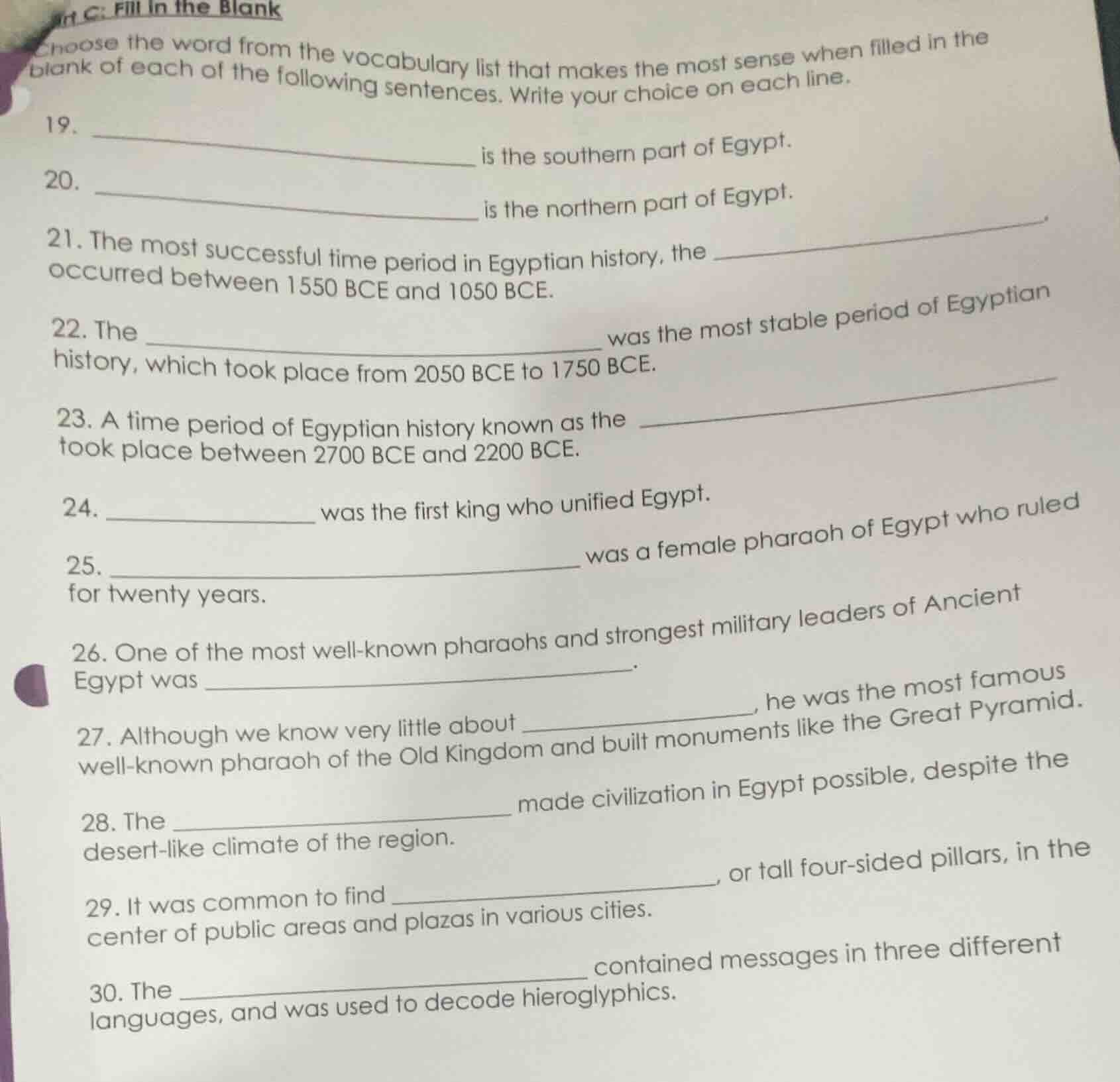
rt c: fill in the blank
choose the word from the vocabulary list that makes the most sense when filled in the blank of each of the following sentences. write your choice on each line.
- ____________________________ is the southern part of egypt.
- ____________________________ is the northern part of egypt.
- the most successful time period in egyptian history, the ____________________________, occurred between 1550 bce and 1050 bce.
- the ____________________________ was the most stable period of egyptian history, which took place from 2050 bce to 1750 bce.
- a time period of egyptian history known as the ____________________________ took place between 2700 bce and 2200 bce.
- _____________ was the first king who unified egypt.
- ____________________________ was a female pharaoh of egypt who ruled for twenty years.
- one of the most well - known pharaohs and strongest military leaders of ancient egypt was ____________________________.
- although we know very little about ______________________, he was the most famous well - known pharaoh of the old kingdom and built monuments like the great pyramid.
- the ______________________ made civilization in egypt possible, despite the desert - like climate of the region.
- it was common to find ______________________, or tall four - sided pillars, in the center of public areas and plazas in various cities.
- the ______________________ contained messages in three different languages, and was used to decode hieroglyphics.
To solve these fill - in - the - blank questions, we rely on our knowledge of Ancient Egyptian history, geography, and culture. Here are the answers:
Question 19
The southern part of Egypt is known as Upper Egypt. This is a basic geographical division of ancient Egypt, where Upper Egypt is in the south and Lower Egypt is in the north (due to the flow of the Nile River).
So the answer is: Upper Egypt
Question 20
The northern part of Egypt is Lower Egypt. The naming is related to the direction of the Nile's flow; as the Nile flows northward, the lower (northern) part of the Nile Valley is called Lower Egypt.
So the answer is: Lower Egypt
Question 21
The New Kingdom of Egypt was the most successful time period, lasting from 1550 BCE to 1050 BCE. During this period, Egypt reached great heights in terms of military conquests, trade, and cultural achievements.
So the answer is: New Kingdom
Question 22
The Middle Kingdom, which lasted from 2050 BCE to 1750 BCE, was the most stable period of Egyptian history. It was a time of political stability, economic growth, and cultural development.
So the answer is: Middle Kingdom
Question 23
The Old Kingdom of Egypt took place between 2700 BCE and 2200 BCE. This was the period when the great pyramids were built and a strong central government was established.
So the answer is: Old Kingdom
Question 24
Menes (also known as Narmer) was the first king to unify Egypt, bringing together Upper and Lower Egypt under one rule.
So the answer is: Menes (Narmer)
Question 25
Hatshepsut was a female pharaoh of Egypt who ruled for about twenty years. She is known for her successful reign and building projects.
So the answer is: Hatshepsut
Question 26
Ramesses II (also known as Ramses the Great) was one of the most well - known pharaohs and a strong military leader of Ancient Egypt. He had many military campaigns and building projects.
So the answer is: Ramesses II (Ramses the Great)
Question 27
Khufu (also known as Cheops) is the most famous pharaoh of the Old Kingdom who built the Great Pyramid. We know relatively little about his personal life, but his pyramid is one of the most iconic structures of ancient Egypt.
So the answer is: Khufu (Cheops)
Question 28
The Nile River made civilization in Egypt possible. The annual flooding of the Nile provided fertile soil for agriculture, which was the basis of Egyptian civilization, even though the surrounding area has a desert - like climate.
So the answer is: Nile River
Question 29
Obelisks, or tall four - sided pillars, were commonly found in the center of public areas and plazas in various Egyptian cities. They were often used for religious and commemorative purposes.
So the answer is: obelisks
Question 30
The Rosetta Stone contained messages in three different languages (Egyptian hieroglyphics, Demotic script, and Ancient Greek) and was used to decode hieroglyphics.
So the answer is: Rosetta Stone

Snap & solve any problem in the app
Get step-by-step solutions on Sovi AI
Photo-based solutions with guided steps
Explore more problems and detailed explanations
To solve these fill - in - the - blank questions, we rely on our knowledge of Ancient Egyptian history, geography, and culture. Here are the answers:
Question 19
The southern part of Egypt is known as Upper Egypt. This is a basic geographical division of ancient Egypt, where Upper Egypt is in the south and Lower Egypt is in the north (due to the flow of the Nile River).
So the answer is: Upper Egypt
Question 20
The northern part of Egypt is Lower Egypt. The naming is related to the direction of the Nile's flow; as the Nile flows northward, the lower (northern) part of the Nile Valley is called Lower Egypt.
So the answer is: Lower Egypt
Question 21
The New Kingdom of Egypt was the most successful time period, lasting from 1550 BCE to 1050 BCE. During this period, Egypt reached great heights in terms of military conquests, trade, and cultural achievements.
So the answer is: New Kingdom
Question 22
The Middle Kingdom, which lasted from 2050 BCE to 1750 BCE, was the most stable period of Egyptian history. It was a time of political stability, economic growth, and cultural development.
So the answer is: Middle Kingdom
Question 23
The Old Kingdom of Egypt took place between 2700 BCE and 2200 BCE. This was the period when the great pyramids were built and a strong central government was established.
So the answer is: Old Kingdom
Question 24
Menes (also known as Narmer) was the first king to unify Egypt, bringing together Upper and Lower Egypt under one rule.
So the answer is: Menes (Narmer)
Question 25
Hatshepsut was a female pharaoh of Egypt who ruled for about twenty years. She is known for her successful reign and building projects.
So the answer is: Hatshepsut
Question 26
Ramesses II (also known as Ramses the Great) was one of the most well - known pharaohs and a strong military leader of Ancient Egypt. He had many military campaigns and building projects.
So the answer is: Ramesses II (Ramses the Great)
Question 27
Khufu (also known as Cheops) is the most famous pharaoh of the Old Kingdom who built the Great Pyramid. We know relatively little about his personal life, but his pyramid is one of the most iconic structures of ancient Egypt.
So the answer is: Khufu (Cheops)
Question 28
The Nile River made civilization in Egypt possible. The annual flooding of the Nile provided fertile soil for agriculture, which was the basis of Egyptian civilization, even though the surrounding area has a desert - like climate.
So the answer is: Nile River
Question 29
Obelisks, or tall four - sided pillars, were commonly found in the center of public areas and plazas in various Egyptian cities. They were often used for religious and commemorative purposes.
So the answer is: obelisks
Question 30
The Rosetta Stone contained messages in three different languages (Egyptian hieroglyphics, Demotic script, and Ancient Greek) and was used to decode hieroglyphics.
So the answer is: Rosetta Stone