QUESTION IMAGE
Question
sat question
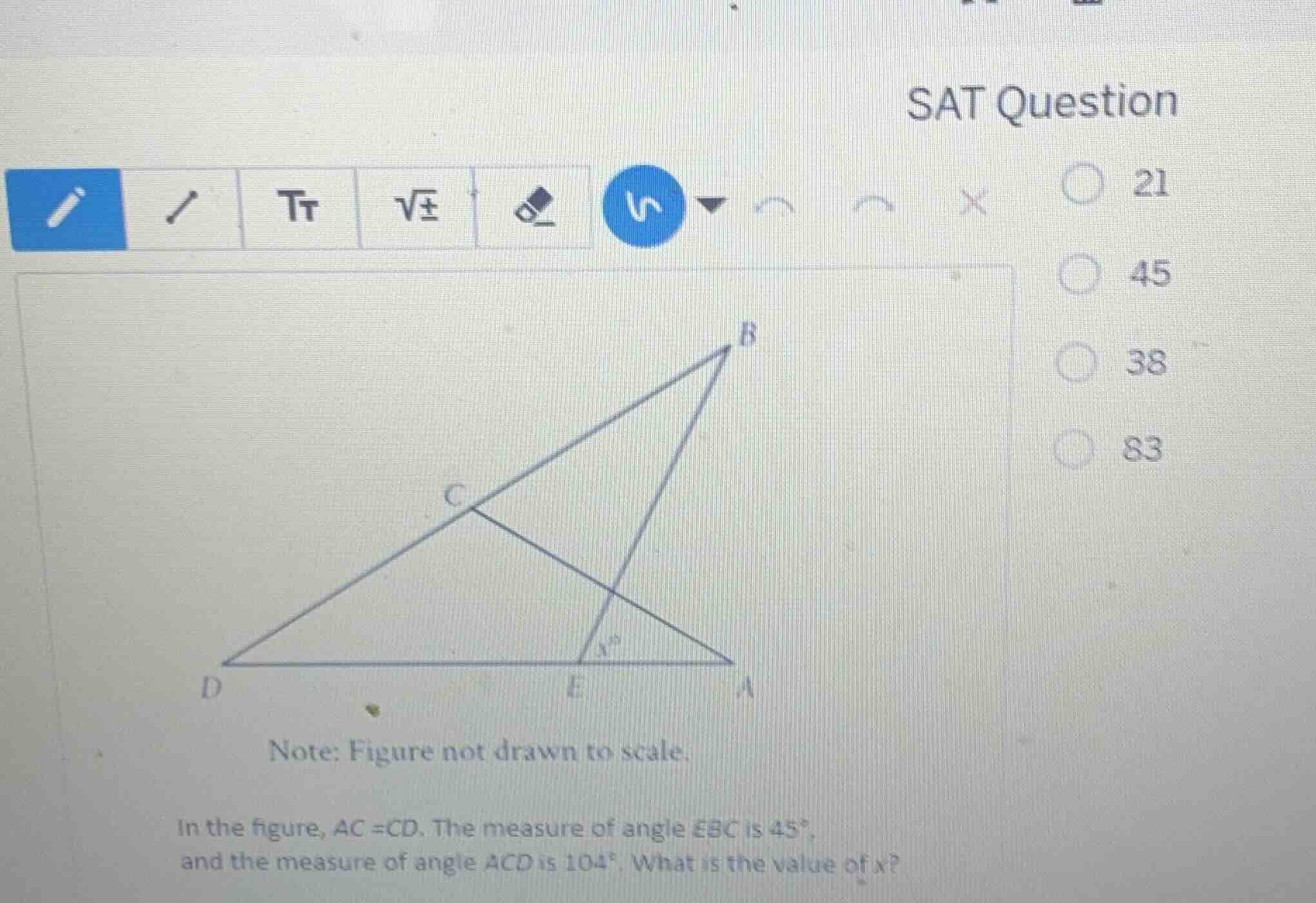
note: figure not drawn to scale.
in the figure, ac = cd. the measure of angle ebc is 45°, and the measure of angle acd is 104°. what is the value of x?
21
45
38
83
Step1: Find angle at A in triangle ACD
Since \( AC = CD \), triangle \( ACD \) is isosceles. The sum of angles in a triangle is \( 180^\circ \). Given \( \angle ACD = 104^\circ \), let \( \angle CAD=\angle CDA = y \). Then \( 2y + 104^\circ=180^\circ \). Solving for \( y \): \( 2y=180 - 104=76^\circ \), so \( y = \frac{76^\circ}{2}=38^\circ \). So \( \angle CAD = 38^\circ \).
Step2: Analyze triangle involving angle EBC
We know \( \angle EBC = 45^\circ \). Let's consider the triangle where we can use the angle sum or exterior angle. Wait, actually, we can use the fact that in the triangle, we can find the angle \( x \) by considering the angles. Wait, maybe another approach. Wait, \( \angle ACD = 104^\circ \), so the adjacent angle (linear pair) would be \( 180 - 104 = 76^\circ \), but no, let's go back. Wait, in triangle \( ACD \), we found \( \angle A = 38^\circ \). Now, looking at the triangle with angle \( EBC = 45^\circ \), maybe we can use the fact that \( x = 180^\circ - 45^\circ - 92^\circ \)? Wait, no, maybe I made a mistake. Wait, let's re - examine.
Wait, \( AC = CD \), so triangle \( ACD \) is isosceles with \( \angle ACD = 104^\circ \). So base angles \( \angle D=\angle A=\frac{180 - 104}{2}=38^\circ \). Now, let's look at the other triangle. Wait, angle \( EBC = 45^\circ \), and we need to find \( x \). Wait, maybe the triangle has angles \( 45^\circ \), \( 38^\circ \), and \( x \)? Wait, no, maybe the sum of angles in a triangle. Wait, perhaps the triangle with angle \( x \), angle \( 45^\circ \), and angle equal to \( \angle A = 38^\circ \)? Wait, no, let's think again.
Wait, the key is: In triangle \( ACD \), \( AC = CD \), so \( \angle CAD=\angle CDA=\frac{180 - 104}{2}=38^\circ \). Now, consider the triangle where angle at \( B \) is \( 45^\circ \), angle at \( A \) is \( 38^\circ \), and angle \( x \). Wait, maybe the sum of angles in a triangle is \( 180^\circ \), so \( x=180-(45 + 92) \)? No, that's not right. Wait, maybe I missed a step. Wait, \( \angle ACD = 104^\circ \), so the angle adjacent to it (vertical or something) is not. Wait, maybe the triangle with angle \( x \) is formed such that \( x = 180 - 45 - (180 - 104 - 38) \)? No, this is getting confusing. Wait, let's start over.
- Triangle \( ACD \): \( AC = CD \), so it's isosceles. \( \angle ACD = 104^\circ \). So the two equal angles: \( \angle CAD \) and \( \angle CDA \). The sum of angles in a triangle is \( 180^\circ \), so \( \angle CAD+\angle CDA+\angle ACD = 180^\circ \). Since \( \angle CAD=\angle CDA \), let each be \( \alpha \). Then \( 2\alpha+104^\circ = 180^\circ \), so \( 2\alpha=76^\circ \), so \( \alpha = 38^\circ \). So \( \angle CAD = 38^\circ \).
- Now, look at the triangle with angle \( \angle EBC = 45^\circ \), angle \( \angle CAD = 38^\circ \), and angle \( x \). Wait, maybe the sum of angles in this triangle is \( 180^\circ \), but we need to check if there's a right angle? No, the problem doesn't say. Wait, maybe the triangle is a triangle where we have angles \( 45^\circ \), \( 38^\circ \), and \( x \), and also, maybe the angle at \( E \) is related. Wait, no, perhaps the correct approach is:
We know that in triangle \( ACD \), \( \angle CAD = 38^\circ \). Now, consider the triangle with angle \( \angle EBC = 45^\circ \). Let's assume that the triangle has angles \( 45^\circ \), \( 38^\circ \), and \( x \), and since the sum of angles in a triangle is \( 180^\circ \), but wait, that would be \( x = 180-(45 + 38)=97 \), which is not an option. So I must have made a mistake.
Wait, wait, \( \angle ACD = 104^\circ \…

Snap & solve any problem in the app
Get step-by-step solutions on Sovi AI
Photo-based solutions with guided steps
Explore more problems and detailed explanations
\( 83 \)