QUESTION IMAGE
Question
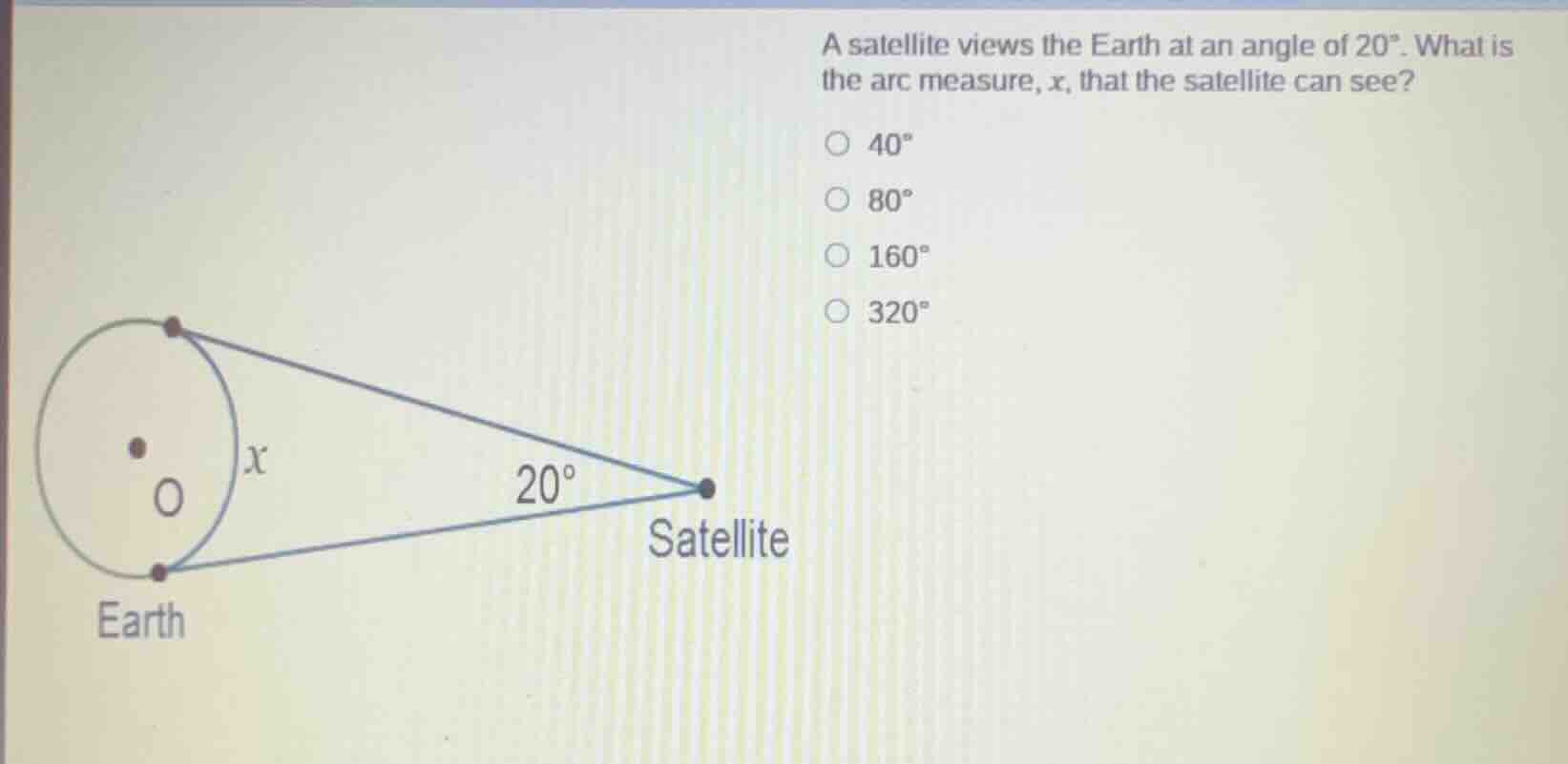
a satellite views the earth at an angle of 20°. what is the arc measure, x, that the satellite can see? 40° 80° 160° 320°
Step1: Recall the property of tangents and circles
The lines from the satellite to the Earth are tangents to the Earth (a circle). The radius to a tangent is perpendicular to the tangent, so we have two right angles at the points of tangency.
Step2: Use the sum of angles in a quadrilateral
The sum of the interior angles of a quadrilateral is \(360^\circ\). We have two right angles (\(90^\circ\) each) and the angle at the satellite (\(20^\circ\)). Let the central angle (arc \(x\)) be \(C\). So, \(90^\circ + 90^\circ + 20^\circ + C = 360^\circ\)? Wait, no, actually, the central angle and the angle at the satellite are related by the formula: the measure of the central angle is \(180^\circ - \) the angle at the external point (satellite) when we consider the triangle formed? Wait, no, more accurately, the angle between two tangents from an external point is equal to \(180^\circ - \) the measure of the intercepted arc. Wait, let's correct that. The formula is: if two tangents are drawn from an external point to a circle, the measure of the angle between the tangents is equal to \(180^\circ - \) the measure of the intercepted arc. Wait, no, actually, the measure of the angle formed by two tangents drawn from an external point to a circle is equal to half the difference of the measures of the intercepted arcs. But since one arc is the major arc and the other is the minor arc (arc \(x\)), and the total circumference is \(360^\circ\), the two arcs add up to \(360^\circ\). The angle between the tangents (\(20^\circ\)) is equal to \(\frac{1}{2}(\text{major arc} - \text{minor arc})\). But also, the triangle formed by the center and the two points of tangency is isoceles, and the angle at the center (arc \(x\)) and the angle at the satellite: since the tangents are perpendicular to the radii, we have a quadrilateral with two right angles, so the sum of the angle at the satellite and the central angle is \(180^\circ\)? Wait, no, let's think again. The two radii to the points of tangency are perpendicular to the tangents, so we have two right angles. So the quadrilateral has angles: \(90^\circ\) (at first tangent point), \(90^\circ\) (at second tangent point), \(20^\circ\) (at satellite), and \(x\) (at center). The sum of interior angles of a quadrilateral is \(360^\circ\), so \(90 + 90 + 20 + x = 360\)? Wait, that would give \(x = 360 - 200 = 160^\circ\). Wait, that makes sense. Because \(90 + 90 = 180\), \(180 + 20 = 200\), \(360 - 200 = 160\). So the arc measure \(x\) is \(160^\circ\).
Wait, let's verify with the formula for the angle between two tangents: the measure of the angle between two tangents drawn from an external point to a circle is equal to \(180^\circ - \) the measure of the intercepted arc. Wait, no, the correct formula is that the measure of the angle formed by two tangents is equal to half the difference of the measures of the intercepted arcs. The two intercepted arcs are the minor arc (x) and the major arc (360 - x). So the angle at the external point (20°) is equal to \(\frac{1}{2}[(360 - x) - x]\). Let's solve that:
\(20 = \frac{1}{2}(360 - 2x)\)
Multiply both sides by 2: \(40 = 360 - 2x\)
Subtract 360: \(40 - 360 = -2x\)
\(-320 = -2x\)
Divide by -2: \(x = 160^\circ\). Yes, that matches. So the arc measure \(x\) is \(160^\circ\).

Snap & solve any problem in the app
Get step-by-step solutions on Sovi AI
Photo-based solutions with guided steps
Explore more problems and detailed explanations
\(160^\circ\) (corresponding to the option: 160°)