QUESTION IMAGE
Question
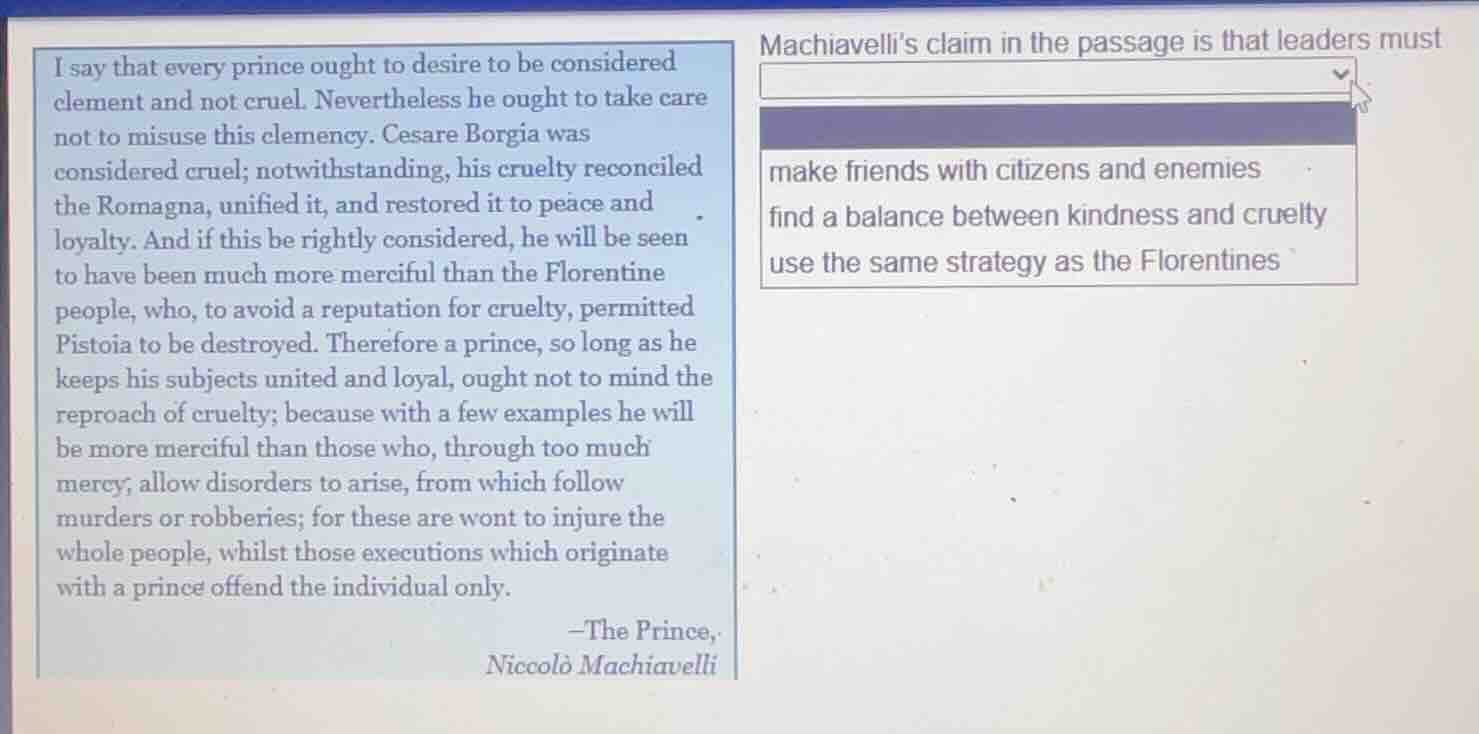
i say that every prince ought to desire to be considered clement and not cruel. nevertheless he ought to take care not to misuse this clemency. cesare borgia was considered cruel; notwithstanding, his cruelty reconciled the romagna, unified it, and restored it to peace and loyalty. and if this be rightly considered, he will be seen to have been much more merciful than the florentine people, who, to avoid a reputation for cruelty, permitted pistoia to be destroyed. therefore a prince, so long as he keeps his subjects united and loyal, ought not to mind the reproach of cruelty; because with a few examples he will be more merciful than those who, through too much mercy, allow disorders to arise, from which follow murders or robberies; for these are wont to injure the whole people, whilst those executions which originate with a prince offend the individual only.
—the prince,
niccolò machiavelli
machiavelli’s claim in the passage is that leaders must
make friends with citizens and enemies
find a balance between kindness and cruelty
use the same strategy as the florentines
The passage states leaders should be seen as clement but not misuse mercy. It contrasts Cesare Borgia's controlled cruelty (which brought peace) with Florentines' excessive mercy (which caused chaos), arguing leaders need to balance these two traits to keep subjects loyal and unified.

Snap & solve any problem in the app
Get step-by-step solutions on Sovi AI
Photo-based solutions with guided steps
Explore more problems and detailed explanations
find a balance between kindness and cruelty