QUESTION IMAGE
Question
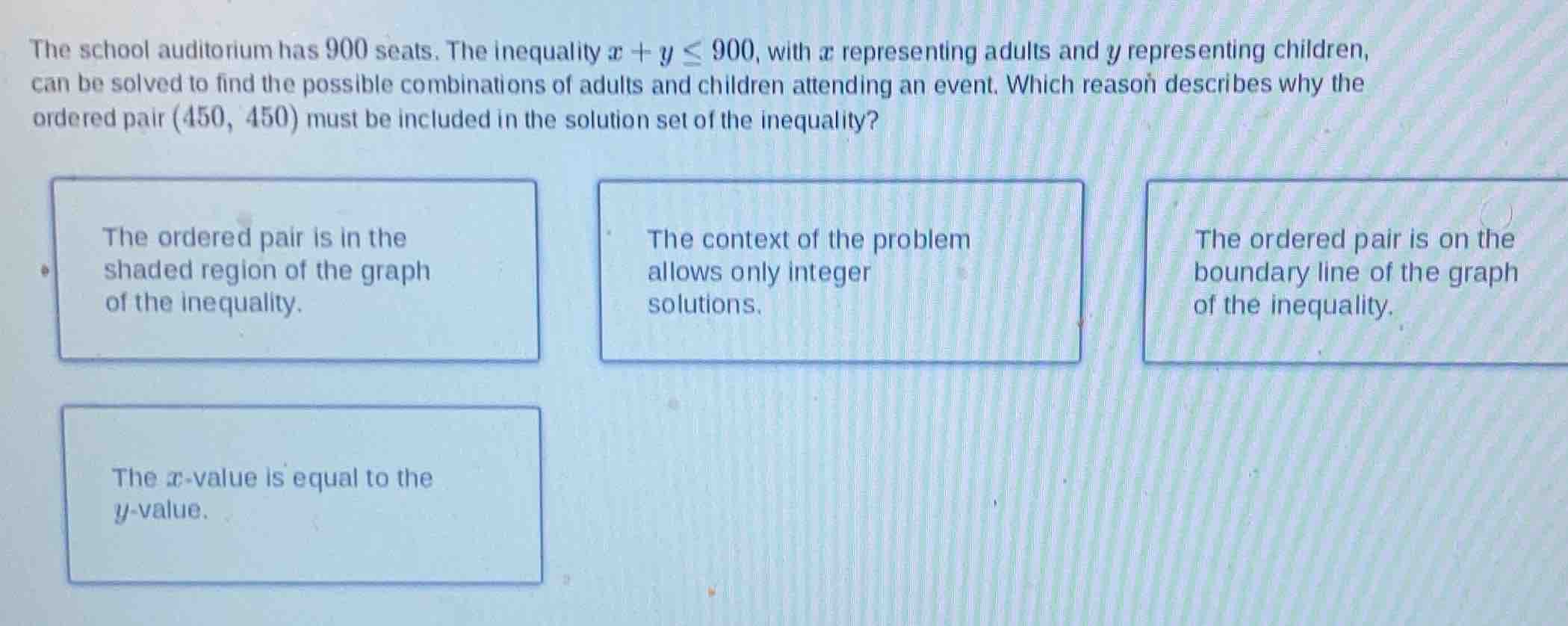
the school auditorium has 900 seats. the inequality $x + y \leq 900$, with $x$ representing adults and $y$ representing children, can be solved to find the possible combinations of adults and children attending an event. which reason describes why the ordered pair $(450, 450)$ must be included in the solution set of the inequality? \
- the ordered pair is in the shaded region of the graph of the inequality. \
- the context of the problem allows only integer solutions. \
- the ordered pair is on the boundary line of the graph of the inequality. \
- the $x$-value is equal to the $y$-value.
First, substitute the ordered pair $(450, 450)$ into the inequality $x + y \leq 900$. Calculate $450 + 450 = 900$, which satisfies the inequality (since $900 \leq 900$ is true). This point lies on the boundary line $x + y = 900$, and inequalities with $\leq$ include points on the boundary line in their solution set. The other options are incorrect: the shaded region reason is too vague, integer solutions don't explain why this specific pair is included, and equal x/y values are irrelevant to the inequality's solution set rule.

Snap & solve any problem in the app
Get step-by-step solutions on Sovi AI
Photo-based solutions with guided steps
Explore more problems and detailed explanations
The ordered pair is on the boundary line of the graph of the inequality.