QUESTION IMAGE
Question
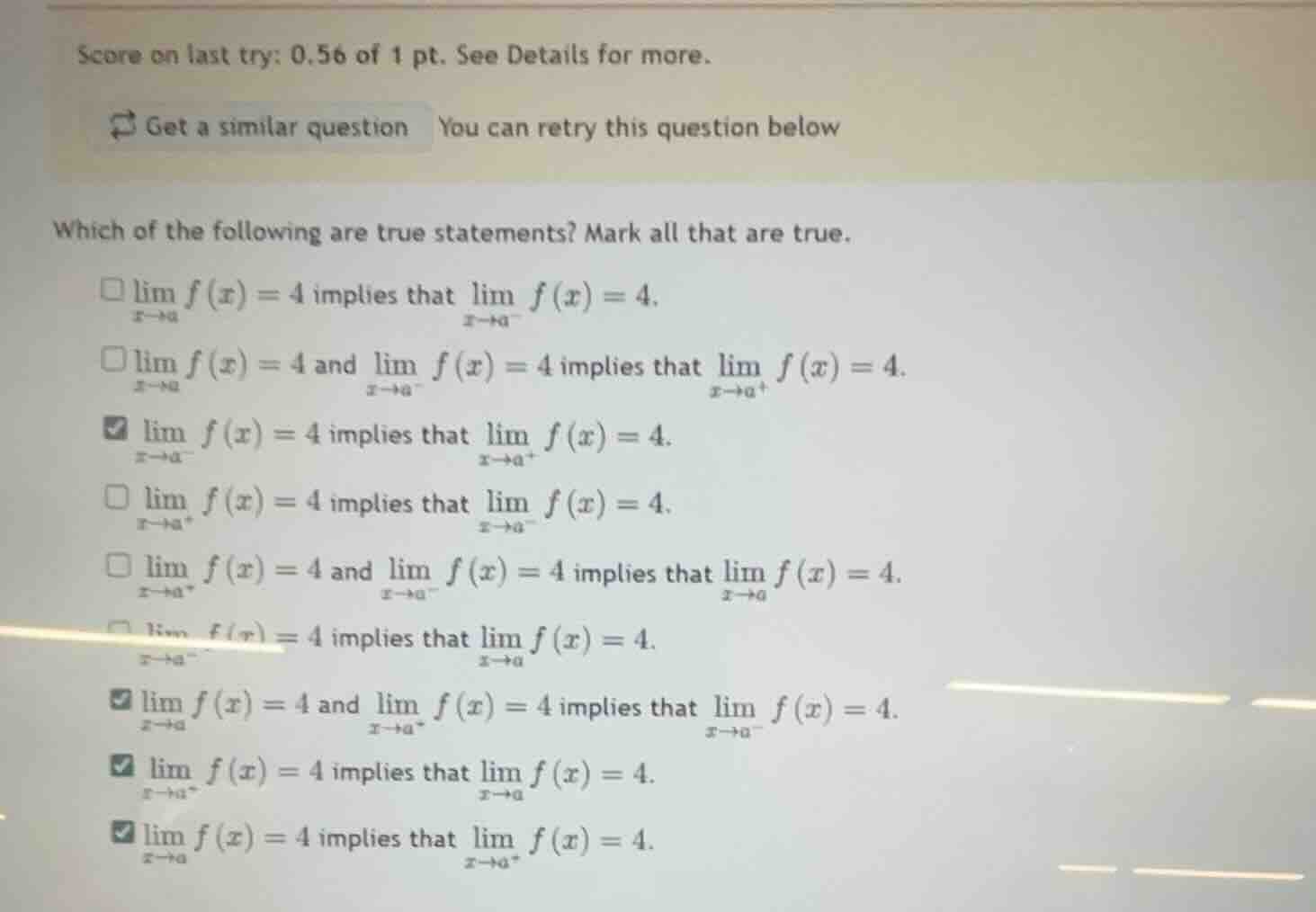
score on last try: 0.56 of 1 pt. see details for more. get a similar question you can retry this question below which of the following are true statements? mark all that are true. $\lim\limits_{x\to a} f(x) = 4$ implies that $\lim\limits_{x\to a^-} f(x) = 4$. $\lim\limits_{x\to a} f(x) = 4$ and $\lim\limits_{x\to a^-} f(x) = 4$ implies that $\lim\limits_{x\to a^+} f(x) = 4$. $\lim\limits_{x\to a^-} f(x) = 4$ implies that $\lim\limits_{x\to a^+} f(x) = 4$. $\lim\limits_{x\to a^+} f(x) = 4$ implies that $\lim\limits_{x\to a^-} f(x) = 4$. $\lim\limits_{x\to a^+} f(x) = 4$ and $\lim\limits_{x\to a^-} f(x) = 4$ implies that $\lim\limits_{x\to a} f(x) = 4$. $\lim\limits_{x\to a^-} f(x) = 4$ implies that $\lim\limits_{x\to a} f(x) = 4$. $\lim\limits_{x\to a} f(x) = 4$ and $\lim\limits_{x\to a^+} f(x) = 4$ implies that $\lim\limits_{x\to a^-} f(x) = 4$. $\lim\limits_{x\to a^+} f(x) = 4$ implies that $\lim\limits_{x\to a} f(x) = 4$. $\lim\limits_{x\to a} f(x) = 4$ implies that $\lim\limits_{x\to a^+} f(x) = 4$.
To determine the true statements, we use the definition of the limit of a function: the two - sided limit $\lim_{x
ightarrow a}f(x)$ exists and is equal to $L$ if and only if the left - hand limit $\lim_{x
ightarrow a^{-}}f(x)$ and the right - hand limit $\lim_{x
ightarrow a^{+}}f(x)$ both exist and are equal to $L$.
1. Analyze the statement $\boldsymbol{\lim_{x
ightarrow a}f(x) = 4\text{ implies that }\lim_{x
ightarrow a^{-}}f(x)=4}$
By the definition of the two - sided limit, if $\lim_{x
ightarrow a}f(x)=L$, then the left - hand limit $\lim_{x
ightarrow a^{-}}f(x)$ and the right - hand limit $\lim_{x
ightarrow a^{+}}f(x)$ must both equal $L$. So if $\lim_{x
ightarrow a}f(x) = 4$, then $\lim_{x
ightarrow a^{-}}f(x)=4$. This statement is true.
2. Analyze the statement $\boldsymbol{\lim_{x
ightarrow a}f(x) = 4\text{ and }\lim_{x
ightarrow a^{-}}f(x)=4\text{ implies that }\lim_{x
ightarrow a^{+}}f(x)=4}$
We know that $\lim_{x
ightarrow a}f(x) = 4$ means $\lim_{x
ightarrow a^{-}}f(x)=\lim_{x
ightarrow a^{+}}f(x) = 4$. But just knowing that $\lim_{x
ightarrow a}f(x) = 4$ and $\lim_{x
ightarrow a^{-}}f(x)=4$ does not give us new information about the right - hand limit (since from $\lim_{x
ightarrow a}f(x) = 4$, we already know $\lim_{x
ightarrow a^{-}}f(x)=\lim_{x
ightarrow a^{+}}f(x) = 4$). However, the logic here is a bit off. The correct implication for the existence of the two - sided limit is that $\lim_{x
ightarrow a^{-}}f(x)=\lim_{x
ightarrow a^{+}}f(x)$ implies $\lim_{x
ightarrow a}f(x)$ exists. But this statement is trying to imply the right - hand limit from the two - sided limit and the left - hand limit. Since $\lim_{x
ightarrow a}f(x) = 4$ already tells us that $\lim_{x
ightarrow a^{+}}f(x)=4$, but the way the statement is structured is not a correct "implication" in the sense of deriving new information. This statement is false.
3. Analyze the statement $\boldsymbol{\lim_{x
ightarrow a^{-}}f(x) = 4\text{ implies that }\lim_{x
ightarrow a^{+}}f(x)=4}$
The left - hand limit and the right - hand limit are independent in the sense that the value of the left - hand limit does not determine the value of the right - hand limit. For example, consider the function $f(x)=
$. Here, $\lim_{x
ightarrow a^{-}}f(x) = 4$, but $\lim_{x
ightarrow a^{+}}f(x)=5
eq4$. So this statement is false.
4. Analyze the statement $\boldsymbol{\lim_{x
ightarrow a^{+}}f(x) = 4\text{ implies that }\lim_{x
ightarrow a^{-}}f(x)=4}$
The right - hand limit and the left - hand limit are independent. For example, consider the function $f(x)=
$. Here, $\lim_{x
ightarrow a^{+}}f(x) = 4$, but $\lim_{x
ightarrow a^{-}}f(x)=5
eq4$. So this statement is false.
5. Analyze the statement $\boldsymbol{\lim_{x
ightarrow a^{+}}f(x) = 4\text{ and }\lim_{x
ightarrow a^{-}}f(x)=4\text{ implies that }\lim_{x
ightarrow a}f(x)=4}$
By the definition of the two - sided limit, if $\lim_{x
ightarrow a^{-}}f(x)=L$ and $\lim_{x
ightarrow a^{+}}f(x)=L$, then $\lim_{x
ightarrow a}f(x)=L$. Here $L = 4$, so if $\lim_{x
ightarrow a^{+}}f(x)=4$ and $\lim_{x
ightarrow a^{-}}f(x)=4$, then $\lim_{x
ightarrow a}f(x)=4$. This statement is true.
6. Analyze the statement $\boldsymbol{\lim_{x
ightarrow a^{-}}f(x) = 4\text{ implies that }\lim_{x
ightarrow a}f(x)=4}$
The left - hand limit being equal to 4 does not guarantee that the right - hand limit is also equal to 4. For example, if $f(x)=
$, $\lim_{x
ightarrow a^{-}}f(x) = 4$, but $\…

Snap & solve any problem in the app
Get step-by-step solutions on Sovi AI
Photo-based solutions with guided steps
Explore more problems and detailed explanations
To determine the true statements, we use the definition of the limit of a function: the two - sided limit $\lim_{x
ightarrow a}f(x)$ exists and is equal to $L$ if and only if the left - hand limit $\lim_{x
ightarrow a^{-}}f(x)$ and the right - hand limit $\lim_{x
ightarrow a^{+}}f(x)$ both exist and are equal to $L$.
1. Analyze the statement $\boldsymbol{\lim_{x
ightarrow a}f(x) = 4\text{ implies that }\lim_{x
ightarrow a^{-}}f(x)=4}$
By the definition of the two - sided limit, if $\lim_{x
ightarrow a}f(x)=L$, then the left - hand limit $\lim_{x
ightarrow a^{-}}f(x)$ and the right - hand limit $\lim_{x
ightarrow a^{+}}f(x)$ must both equal $L$. So if $\lim_{x
ightarrow a}f(x) = 4$, then $\lim_{x
ightarrow a^{-}}f(x)=4$. This statement is true.
2. Analyze the statement $\boldsymbol{\lim_{x
ightarrow a}f(x) = 4\text{ and }\lim_{x
ightarrow a^{-}}f(x)=4\text{ implies that }\lim_{x
ightarrow a^{+}}f(x)=4}$
We know that $\lim_{x
ightarrow a}f(x) = 4$ means $\lim_{x
ightarrow a^{-}}f(x)=\lim_{x
ightarrow a^{+}}f(x) = 4$. But just knowing that $\lim_{x
ightarrow a}f(x) = 4$ and $\lim_{x
ightarrow a^{-}}f(x)=4$ does not give us new information about the right - hand limit (since from $\lim_{x
ightarrow a}f(x) = 4$, we already know $\lim_{x
ightarrow a^{-}}f(x)=\lim_{x
ightarrow a^{+}}f(x) = 4$). However, the logic here is a bit off. The correct implication for the existence of the two - sided limit is that $\lim_{x
ightarrow a^{-}}f(x)=\lim_{x
ightarrow a^{+}}f(x)$ implies $\lim_{x
ightarrow a}f(x)$ exists. But this statement is trying to imply the right - hand limit from the two - sided limit and the left - hand limit. Since $\lim_{x
ightarrow a}f(x) = 4$ already tells us that $\lim_{x
ightarrow a^{+}}f(x)=4$, but the way the statement is structured is not a correct "implication" in the sense of deriving new information. This statement is false.
3. Analyze the statement $\boldsymbol{\lim_{x
ightarrow a^{-}}f(x) = 4\text{ implies that }\lim_{x
ightarrow a^{+}}f(x)=4}$
The left - hand limit and the right - hand limit are independent in the sense that the value of the left - hand limit does not determine the value of the right - hand limit. For example, consider the function $f(x)=
$. Here, $\lim_{x
ightarrow a^{-}}f(x) = 4$, but $\lim_{x
ightarrow a^{+}}f(x)=5
eq4$. So this statement is false.
4. Analyze the statement $\boldsymbol{\lim_{x
ightarrow a^{+}}f(x) = 4\text{ implies that }\lim_{x
ightarrow a^{-}}f(x)=4}$
The right - hand limit and the left - hand limit are independent. For example, consider the function $f(x)=
$. Here, $\lim_{x
ightarrow a^{+}}f(x) = 4$, but $\lim_{x
ightarrow a^{-}}f(x)=5
eq4$. So this statement is false.
5. Analyze the statement $\boldsymbol{\lim_{x
ightarrow a^{+}}f(x) = 4\text{ and }\lim_{x
ightarrow a^{-}}f(x)=4\text{ implies that }\lim_{x
ightarrow a}f(x)=4}$
By the definition of the two - sided limit, if $\lim_{x
ightarrow a^{-}}f(x)=L$ and $\lim_{x
ightarrow a^{+}}f(x)=L$, then $\lim_{x
ightarrow a}f(x)=L$. Here $L = 4$, so if $\lim_{x
ightarrow a^{+}}f(x)=4$ and $\lim_{x
ightarrow a^{-}}f(x)=4$, then $\lim_{x
ightarrow a}f(x)=4$. This statement is true.
6. Analyze the statement $\boldsymbol{\lim_{x
ightarrow a^{-}}f(x) = 4\text{ implies that }\lim_{x
ightarrow a}f(x)=4}$
The left - hand limit being equal to 4 does not guarantee that the right - hand limit is also equal to 4. For example, if $f(x)=
$, $\lim_{x
ightarrow a^{-}}f(x) = 4$, but $\lim_{x
ightarrow a^{+}}f(x)=5$, so $\lim_{x
ightarrow a}f(x)$ does not exist (and is not equal to 4). So this statement is false.
7. Analyze the statement $\boldsymbol{\lim_{x
ightarrow a}f(x) = 4\text{ and }\lim_{x
ightarrow a^{+}}f(x)=4\text{ implies that }\lim_{x
ightarrow a^{-}}f(x)=4}$
Since $\lim_{x
ightarrow a}f(x)=4$, by the definition of the two - sided limit, $\lim_{x
ightarrow a^{-}}f(x)=\lim_{x
ightarrow a^{+}}f(x) = 4$. So if $\lim_{x
ightarrow a}f(x)=4$ and $\lim_{x
ightarrow a^{+}}f(x)=4$, then $\lim_{x
ightarrow a^{-}}f(x)=4$. This statement is true.
8. Analyze the statement $\boldsymbol{\lim_{x
ightarrow a^{+}}f(x) = 4\text{ implies that }\lim_{x
ightarrow a}f(x)=4}$
The right - hand limit being equal to 4 does not guarantee that the left - hand limit is also equal to 4. For example, if $f(x)=
$, $\lim_{x
ightarrow a^{+}}f(x) = 4$, but $\lim_{x
ightarrow a^{-}}f(x)=5$, so $\lim_{x
ightarrow a}f(x)$ does not exist (and is not equal to 4). So this statement is false.
9. Analyze the statement $\boldsymbol{\lim_{x
ightarrow a}f(x) = 4\text{ implies that }\lim_{x
ightarrow a^{+}}f(x)=4}$
By the definition of the two - sided limit, if $\lim_{x
ightarrow a}f(x)=L$, then $\lim_{x
ightarrow a^{+}}f(x)=L$. So if $\lim_{x
ightarrow a}f(x) = 4$, then $\lim_{x
ightarrow a^{+}}f(x)=4$. This statement is true.
The true statements are:
- $\lim_{x
ightarrow a}f(x) = 4\text{ implies that }\lim_{x
ightarrow a^{-}}f(x)=4$
- $\lim_{x
ightarrow a^{+}}f(x) = 4\text{ and }\lim_{x
ightarrow a^{-}}f(x)=4\text{ implies that }\lim_{x
ightarrow a}f(x)=4$
- $\lim_{x
ightarrow a}f(x) = 4\text{ and }\lim_{x
ightarrow a^{+}}f(x)=4\text{ implies that }\lim_{x
ightarrow a^{-}}f(x)=4$
- $\lim_{x
ightarrow a}f(x) = 4\text{ implies that }\lim_{x
ightarrow a^{+}}f(x)=4$
Final Answer
The true statements are:
- $\boldsymbol{\lim_{x
ightarrow a}f(x) = 4\text{ implies that }\lim_{x
ightarrow a^{-}}f(x)=4}$
- $\boldsymbol{\lim_{x
ightarrow a^{+}}f(x) = 4\text{ and }\lim_{x
ightarrow a^{-}}f(x)=4\text{ implies that }\lim_{x
ightarrow a}f(x)=4}$
- $\boldsymbol{\lim_{x
ightarrow a}f(x) = 4\text{ and }\lim_{x
ightarrow a^{+}}f(x)=4\text{ implies that }\lim_{x
ightarrow a^{-}}f(x)=4}$
- $\boldsymbol{\lim_{x
ightarrow a}f(x) = 4\text{ implies that }\lim_{x
ightarrow a^{+}}f(x)=4}$