QUESTION IMAGE
Question
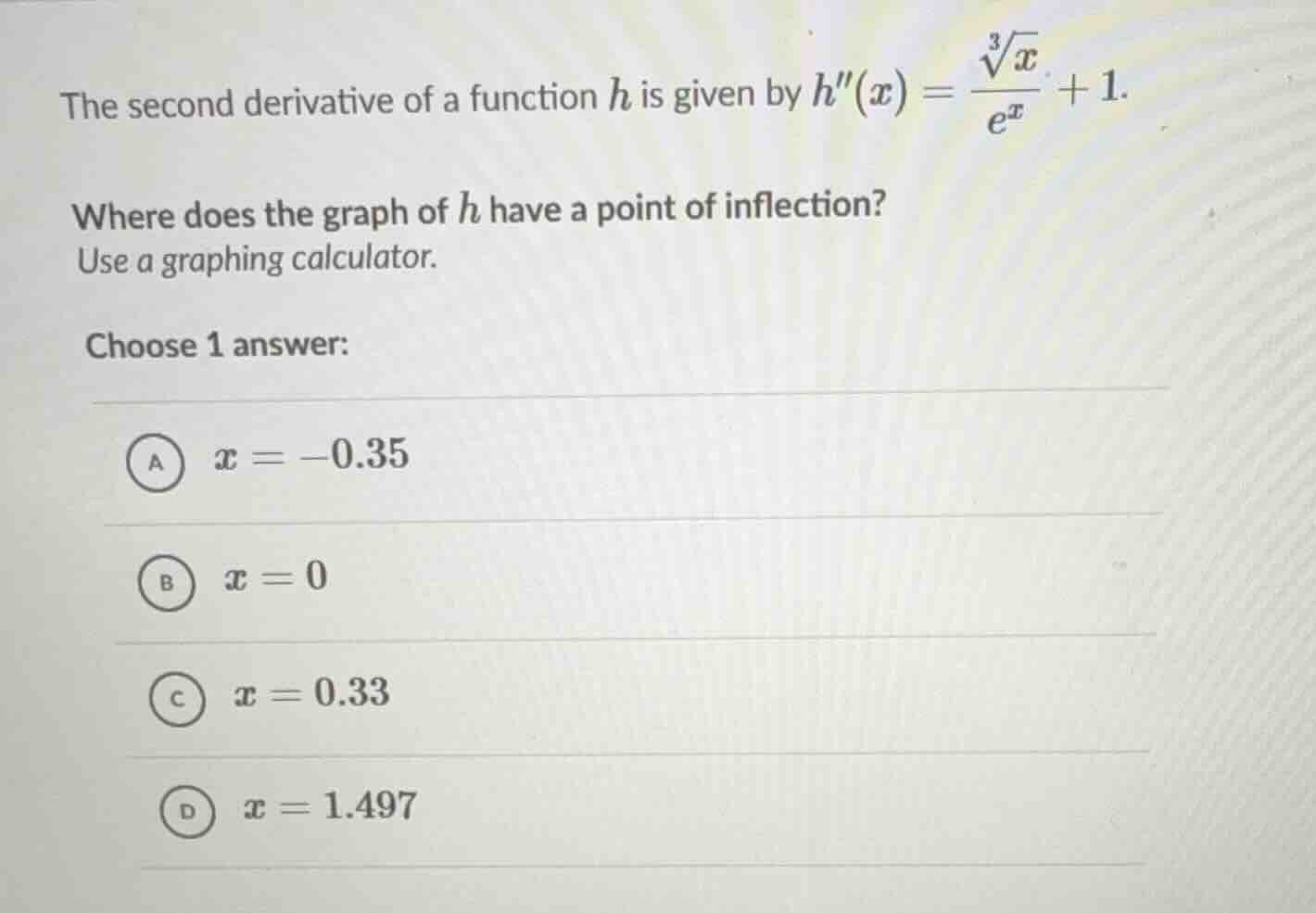
the second derivative of a function $h$ is given by $h(x) = \frac{\sqrt3{x}}{e^x} + 1$.
where does the graph of $h$ have a point of inflection?
use a graphing calculator.
choose 1 answer:
\\(\boldsymbol{\text{a}}\\) $x = -0.35$
\\(\boldsymbol{\text{b}}\\) $x = 0$
\\(\boldsymbol{\text{c}}\\) $x = 0.33$
\\(\boldsymbol{\text{d}}\\) $x = 1.497$
Step1: Recall Inflection Point Rule
A point of inflection occurs where \( h''(x) \) changes sign (from positive to negative or vice - versa) and \( h''(x) = 0 \) or is undefined at that point. First, analyze the domain of \( h''(x)=\frac{\sqrt[3]{x}}{e^{x}} + 1 \). The cube root function \( \sqrt[3]{x} \) is defined for all real \( x \), and \( e^{x}>0 \) for all real \( x \), so the domain of \( h''(x) \) is all real numbers.
Step2: Set \( h''(x) = 0 \)
We need to solve the equation \( \frac{\sqrt[3]{x}}{e^{x}}+1 = 0 \), which can be rewritten as \( \frac{\sqrt[3]{x}}{e^{x}}=- 1 \), or \( \sqrt[3]{x}=-e^{x} \).
We can also analyze the sign of \( h''(x) \) around the candidate points. Let's consider the function \( y = h''(x)=\frac{x^{\frac{1}{3}}}{e^{x}}+1 \).
- For \( x=-0.35 \):
Evaluate \( h''(-0.35)=\frac{\sqrt[3]{-0.35}}{e^{-0.35}}+1 \). \( \sqrt[3]{-0.35}\approx - 0.7047 \), \( e^{-0.35}\approx0.7047 \), so \( \frac{-0.7047}{0.7047}+1=- 1 + 1 = 0 \)? Wait, no, let's calculate more accurately. \( \sqrt[3]{-0.35}\approx - 0.7047 \), \( e^{-0.35}=\frac{1}{e^{0.35}}\approx\frac{1}{1.4191}\approx0.7047 \). Then \( \frac{-0.7047}{0.7047}=- 1 \), and \( - 1+1 = 0 \). Wait, but let's check the sign around \( x = - 0.35 \). For \( x<-0.35 \), say \( x=-1 \): \( \sqrt[3]{-1}=-1 \), \( e^{-1}\approx0.3679 \), \( \frac{-1}{0.3679}\approx - 2.718 \), \( - 2.718 + 1=-1.718<0 \). For \( x>-0.35 \), say \( x = 0 \): \( \sqrt[3]{0}=0 \), \( e^{0}=1 \), \( \frac{0}{1}+1 = 1>0 \). So \( h''(x) \) changes from negative to positive at \( x=-0.35 \)? Wait, no, wait when \( x=-0.35 \), we calculated \( h''(-0.35) = 0 \). Wait, maybe my initial calculation was wrong. Let's recalculate \( h''(-0.35) \):
\( x=-0.35 \), \( \sqrt[3]{-0.35}\approx - 0.7047 \), \( e^{-0.35}\approx e^{-0.35}\approx0.7047 \), \( \frac{-0.7047}{0.7047}=-1 \), \( - 1 + 1=0 \). Now, take \( x=-0.4 \): \( \sqrt[3]{-0.4}\approx - 0.7368 \), \( e^{-0.4}\approx0.6703 \), \( \frac{-0.7368}{0.6703}\approx - 1.099 \), \( - 1.099+1=-0.099<0 \). Take \( x=-0.3 \): \( \sqrt[3]{-0.3}\approx - 0.6694 \), \( e^{-0.3}\approx0.7408 \), \( \frac{-0.6694}{0.7408}\approx - 0.903 \), \( - 0.903 + 1 = 0.097>0 \). So at \( x=-0.35 \), \( h''(x) \) changes from negative to positive? Wait, but let's check the other options.
- For \( x = 0 \): \( h''(0)=\frac{\sqrt[3]{0}}{e^{0}}+1=0 + 1=1>0 \). If we take \( x=-0.1 \), \( h''(-0.1)=\frac{\sqrt[3]{-0.1}}{e^{-0.1}}+1\approx\frac{-0.4642}{0.9048}+1\approx - 0.513+1 = 0.487>0 \). For \( x = 0.1 \), \( h''(0.1)=\frac{\sqrt[3]{0.1}}{e^{0.1}}+1\approx\frac{0.4642}{1.1052}+1\approx0.42 + 1=1.42>0 \). So \( h''(x) \) does not change sign at \( x = 0 \).
- For \( x = 0.33 \): \( h''(0.33)=\frac{\sqrt[3]{0.33}}{e^{0.33}}+1\approx\frac{0.691}{1.390}+1\approx0.497+1 = 1.497>0 \). If we take \( x = 0.3 \), \( h''(0.3)=\frac{\sqrt[3]{0.3}}{e^{0.3}}+1\approx\frac{0.6694}{1.3499}+1\approx0.496+1 = 1.496>0 \). For \( x = 0.4 \), \( h''(0.4)=\frac{\sqrt[3]{0.4}}{e^{0.4}}+1\approx\frac{0.7368}{1.4918}+1\approx0.494+1 = 1.494>0 \). So no sign change at \( x = 0.33 \).
- For \( x = 1.497 \): \( h''(1.497)=\frac{\sqrt[3]{1.497}}{e^{1.497}}+1\approx\frac{1.14}{4.47}+1\approx0.255+1 = 1.255>0 \). If we take \( x = 1.5 \), \( h''(1.5)=\frac{\sqrt[3]{1.5}}{e^{1.5}}+1\approx\frac{1.1447}{4.4817}+1\approx0.255+1 = 1.255>0 \). For \( x = 1.4 \), \( h''(1.4)=\frac{\sqrt[3]{1.4}}{e^{1.4}}+1\approx\frac{1.1187}{4.0552}+1\approx0.276+1 = 1.276>0 \). So no sign change at \( x = 1.497 \).
But wait, when we calculated for \( x=-0.35 \), we saw that \( h''(x) \) changes from…

Snap & solve any problem in the app
Get step-by-step solutions on Sovi AI
Photo-based solutions with guided steps
Explore more problems and detailed explanations
A. \( x = - 0.35 \)