QUESTION IMAGE
Question
section: to the page. get mrs. mahnkes initials before moving on to the analysis
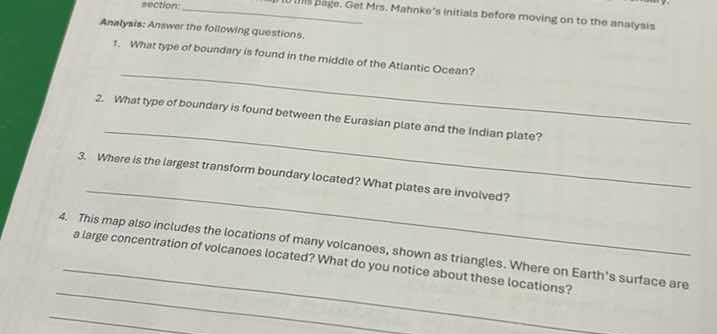
analysis: answer the following questions.
- what type of boundary is found in the middle of the atlantic ocean?
- what type of boundary is found between the eurasian plate and the indian plate?
- where is the largest transform boundary located? what plates are involved?
- this map also includes the locations of many volcanoes, shown as triangles. where on earth’s surface are a large concentration of volcanoes located? what do you notice about these locations?
Brief Explanations
- The middle of the Atlantic Ocean has a boundary where tectonic plates move apart, creating new crust.
- The Eurasian and Indian plates collide, pushing land upward to form major mountain ranges.
- The largest transform boundary is a well-known fault in North America, where two continental plates slide past each other.
- Most volcanoes cluster along zones where tectonic plates interact, as these areas have magma movement close to the surface.

Snap & solve any problem in the app
Get step-by-step solutions on Sovi AI
Photo-based solutions with guided steps
Explore more problems and detailed explanations
- A divergent (mid-ocean ridge) boundary.
- A convergent (continental-continental collision) boundary.
- It is located along the San Andreas Fault in California, USA. The involved plates are the Pacific Plate and the North American Plate.
- A large concentration of volcanoes is located along the Pacific Ring of Fire. These locations almost entirely align with tectonic plate boundaries (convergent and divergent boundaries), where subduction or crustal spreading allows magma to reach the surface and form volcanoes.