QUESTION IMAGE
Question
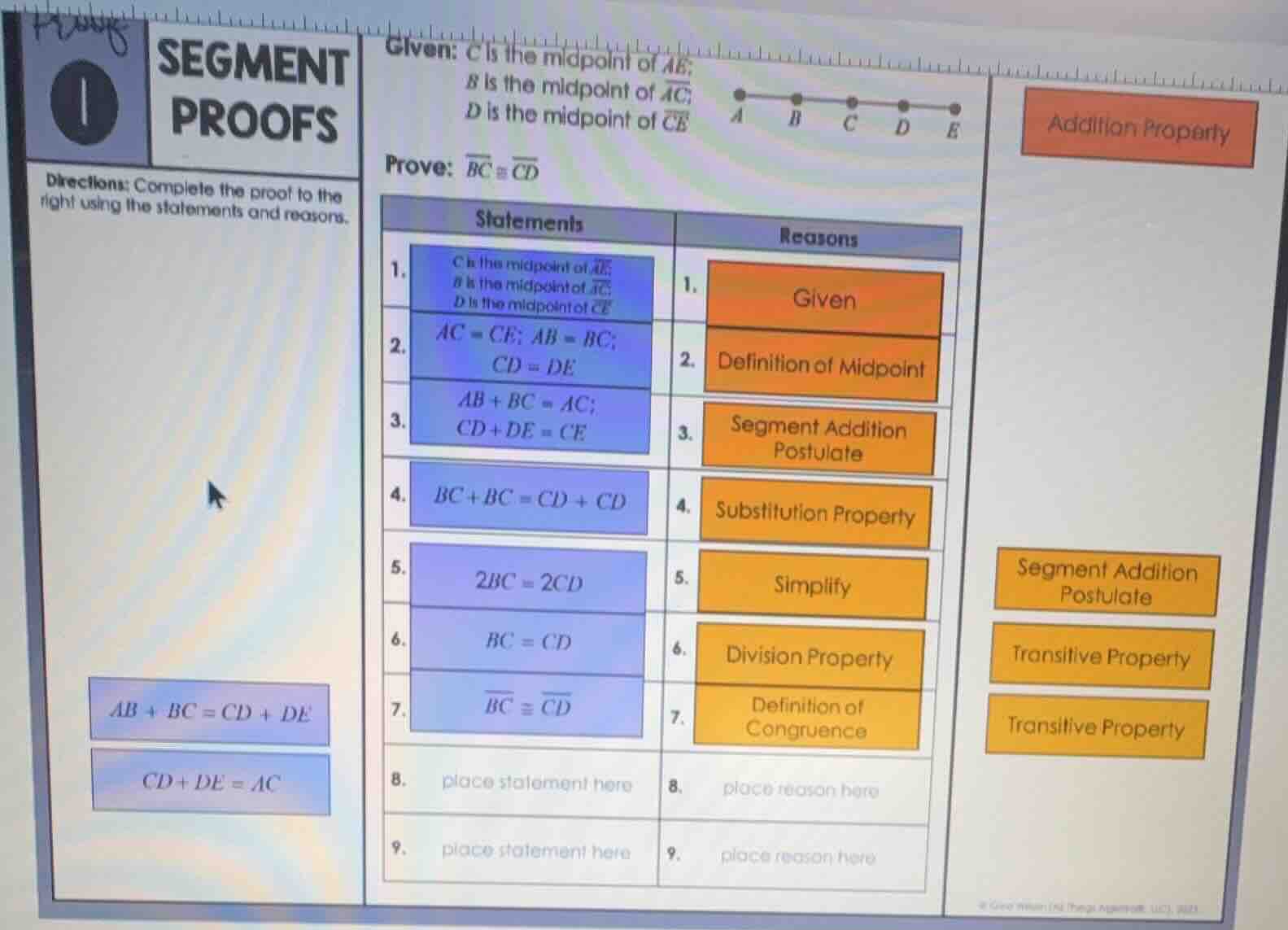
segment proofs
directions: complete the proof to the right using the statements and reasons.
given: c is the midpoint of \\(\overline{ae}\\);
b is the midpoint of \\(\overline{ac}\\);
d is the midpoint of \\(\overline{ce}\\)
prove: \\(\overline{bc} \cong \overline{cd}\\)
statements
- c is the midpoint of \\(\overline{ae}\\);
b is the midpoint of \\(\overline{ac}\\);
d is the midpoint of \\(\overline{ce}\\)
- \\(ac = ce\\); \\(ab = bc\\); \\(cd = de\\)
- \\(ab + bc = ac\\); \\(cd + de = ce\\)
- \\(bc + bc = cd + cd\\)
- \\(2bc = 2cd\\)
- \\(bc = cd\\)
- \\(\overline{bc} \cong \overline{cd}\\)
- place statement here
- place statement here
reasons
- given
- definition of midpoint
- segment addition postulate
- substitution property
- simplify
- division property
- definition of congruence
- place reason here
- place reason here
\\(ab + bc = cd + de\\)
\\(cd + de = ac\\)
To complete the proof, we analyze the remaining steps (steps 8 and 9) by using the transitive property and substitution:
Step 8:
Use transitive property with \( AC = CE \) (from step 2) and \( CD + DE = CE \) (from step 3), and \( AB + BC = AC \) (from step 3) and \( AB + BC = CD + DE \) (from the left box).
Statement: \( AC = CD + DE \)
Reason: Transitive Property (since \( AC = CE \) and \( CD + DE = CE \), so \( AC = CD + DE \))
Step 9:
Substitute \( AB + BC \) for \( AC \) (from step 3: \( AB + BC = AC \)) into \( AC = CD + DE \).
Statement: \( AB + BC = CD + DE \)
Reason: Substitution Property (replace \( AC \) with \( AB + BC \) in \( AC = CD + DE \))
Final Answers for Steps 8 and 9:
- Statement: \( AC = CD + DE \); Reason: Transitive Property
- Statement: \( AB + BC = CD + DE \); Reason: Substitution Property
(Note: The left box provides \( AB + BC = CD + DE \) as a hint, confirming the statement for step 9.)

Snap & solve any problem in the app
Get step-by-step solutions on Sovi AI
Photo-based solutions with guided steps
Explore more problems and detailed explanations
Substitute \( AB + BC \) for \( AC \) (from step 3: \( AB + BC = AC \)) into \( AC = CD + DE \).
Statement: \( AB + BC = CD + DE \)
Reason: Substitution Property (replace \( AC \) with \( AB + BC \) in \( AC = CD + DE \))
Final Answers for Steps 8 and 9:
- Statement: \( AC = CD + DE \); Reason: Transitive Property
- Statement: \( AB + BC = CD + DE \); Reason: Substitution Property
(Note: The left box provides \( AB + BC = CD + DE \) as a hint, confirming the statement for step 9.)