QUESTION IMAGE
Question
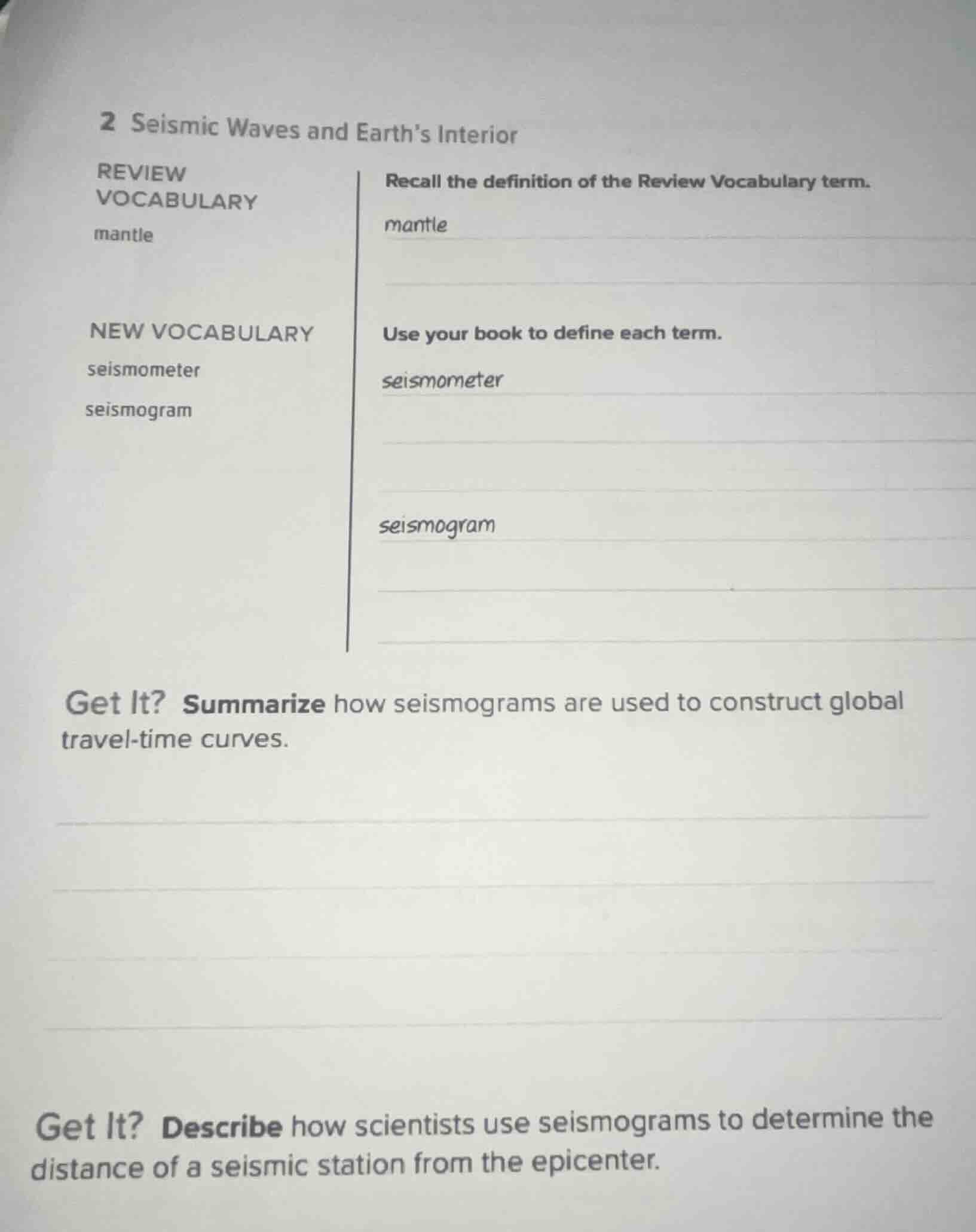
2 seismic waves and earth’s interior
review
vocabulary
mantle
recall the definition of the review vocabulary term.
mantle
new vocabulary
seismometer
seismogram
use your book to define each term.
seismometer
seismogram
get it? summarize how seismograms are used to construct global travel - time curves.
get it? describe how scientists use seismograms to determine the distance of a seismic station from the epicenter.
1. Vocabulary Definitions:
- mantle: The layer of the Earth between the crust and the core, composed mainly of silicate rocks and is semi - fluid in the asthenosphere part.
- seismometer: An instrument that detects and measures seismic waves (vibrations in the Earth) generated by earthquakes or other sources.
- seismogram: The record (usually a graphical plot) produced by a seismometer, showing the amplitude and time of arrival of seismic waves.
2. Summarize how seismograms are used to construct global travel - time curves:
Seismograms from many seismic stations around the world are used. For a given earthquake, the time of arrival of different seismic waves (like P - waves and S - waves) is recorded on seismograms at each station. The distance from the epicenter to each station can be related to the travel time of the waves. By collecting data on travel times (from seismograms) and corresponding epicentral distances (calculated or known) from numerous earthquakes and stations, scientists plot the travel time of seismic waves against the epicentral distance. This plot is the global travel - time curve, which shows the average time it takes for different types of seismic waves to travel through the Earth's interior over various distances.
Seismic waves, specifically P - waves (primary waves) and S - waves (secondary waves), have different speeds. P - waves travel faster than S - waves. On a seismogram, the time difference between the arrival of the first P - wave and the first S - wave (called the S - P time interval) is measured. There is a known relationship (based on the different speeds of P and S waves through the Earth's crust and upper mantle) between the S - P time interval and the distance from the epicenter to the seismic station. By using this relationship (often in the form of a graph or a formula derived from empirical data), scientists can calculate the distance of the seismic station from the epicenter.

Snap & solve any problem in the app
Get step-by-step solutions on Sovi AI
Photo-based solutions with guided steps
Explore more problems and detailed explanations
Seismograms from global seismic stations record seismic wave arrival times. For many earthquakes, travel times (from seismograms) and epicentral distances are correlated. Plotting travel time vs. epicentral distance from this data gives global travel - time curves.