QUESTION IMAGE
Question
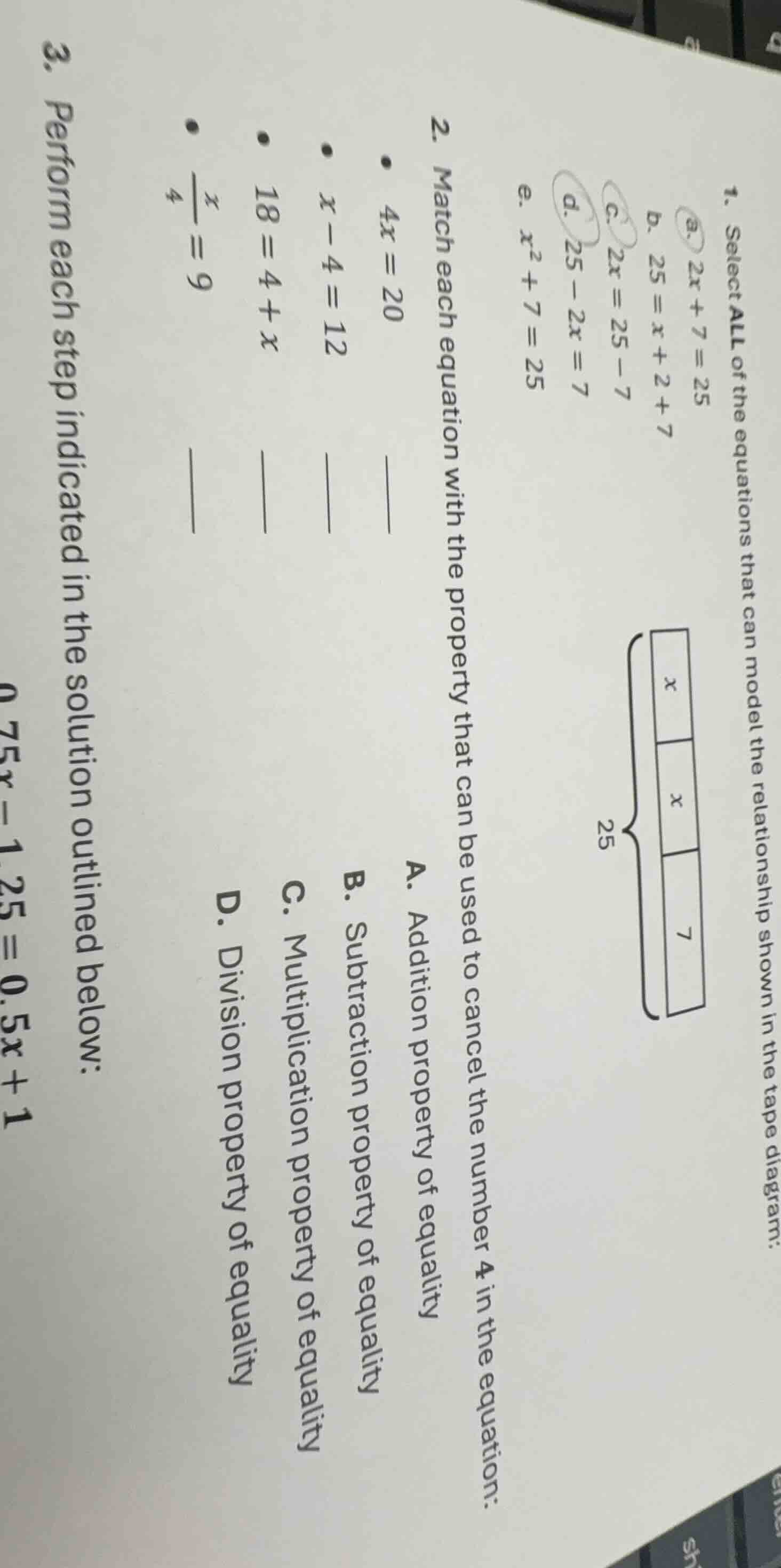
- select all of the equations that can model the relationship shown in the tape diagram:
a. $2x + 7 = 25$
b. $25 = x + 2 + 7$
c. $2x = 25 - 7$
d. $25 - 2x = 7$
e. $x^2 + 7 = 25$
- match each equation with the property that can be used to cancel the number 4 in the equation:
- $4x = 20$
- $x - 4 = 12$
- $18 = 4 + x$
- $\frac{x}{4} = 9$
a. addition property of equality
b. subtraction property of equality
c. multiplication property of equality
d. division property of equality
- perform each step indicated in the solution outlined below:
$0.75x - 1.25 = 0.5x + 1$
Problem 2: Match each equation with the property that can be used to cancel the number 4 in the equation.
for each match:
- For \( 4x = 20 \):
To cancel the coefficient 4 (multiplying \( x \)), we use the Division property of equality (divide both sides by 4). But wait, the options include "Multiplication property" (C) or "Division"? Wait, recheck: The options are A (Addition), B (Subtraction), C (Multiplication), D (Division). Wait, \( 4x = 20 \): To solve for \( x \), we divide both sides by 4 (Division property, D). But wait, maybe I misread. Wait, the problem says "cancel the number 4". Let's re-express each equation:
- \( 4x = 20 \): The 4 is a coefficient (multiplied by \( x \)). To cancel it, we divide both sides by 4 (Division property, D? Wait, no—wait the options: D is Division property. Wait, but let's check the other equations.
- \( x - 4 = 12 \): To cancel the -4, we add 4 to both sides (Addition property, A).
- \( 18 = 4 + x \): This is \( x + 4 = 18 \); to cancel +4, we subtract 4 (Subtraction property, B).
- \( \frac{x}{4} = 9 \): To cancel the division by 4, we multiply both sides by 4 (Multiplication property, C).
Step-by-Step Matching:
- Equation \( 4x = 20 \):
The 4 is a multiplier of \( x \). To isolate \( x \), we divide both sides by 4 (Division property of equality, D). Wait, no—wait the options: D is Division, yes. But wait, let's confirm:
- \( 4x = 20 \): Divide both sides by 4: \( x = 5 \). So property is Division (D).
- Equation \( x - 4 = 12 \):
The 4 is subtracted from \( x \). To isolate \( x \), we add 4 to both sides (Addition property of equality, A).
- Equation \( 18 = 4 + x \):
Rewrite as \( x + 4 = 18 \). The 4 is added to \( x \). To isolate \( x \), we subtract 4 from both sides (Subtraction property of equality, B).
- Equation \( \frac{x}{4} = 9 \):
The \( x \) is divided by 4. To isolate \( x \), we multiply both sides by 4 (Multiplication property of equality, C).
So the matches are:
- \( 4x = 20 \) → D (Division)
- \( x - 4 = 12 \) → A (Addition)
- \( 18 = 4 + x \) → B (Subtraction)
- \( \frac{x}{4} = 9 \) → C (Multiplication)
Final Matches:
- \( 4x = 20 \) → D
- \( x - 4 = 12 \) → A
- \( 18 = 4 + x \) → B
- \( \frac{x}{4} = 9 \) → C
Problem 1: Select ALL equations that model the tape diagram.
The tape diagram has two \( x \)s and a 7, summing to 25. So the total is \( 2x + 7 = 25 \). Let's analyze each option:
- a. \( 2x + 7 = 25 \): Matches (two \( x \)s + 7 = 25).
- b. \( 25 = x + 2 + 7 \): This is \( x + 9 = 25 \), which is not two \( x \)s. Incorrect.
- c. \( 2x = 25 - 7 \): Subtract 7 from both sides of \( 2x + 7 = 25 \), so this is equivalent. Correct.
- d. \( 25 - 2x = 7 \): Subtract \( 2x \) from 25, equals 7. Equivalent to \( 2x + 7 = 25 \) (rearrange: \( 25 - 7 = 2x \)). Correct.
- e. \( x^2 + 7 = 25 \): Involves \( x^2 \), not two \( x \)s. Incorrect.
So the correct options are a, c, d.
Problem 3: Perform each step (equation: \( 0.75x - 1.25 = 0.5x + 1 \))
Step-by-Step Solution:
- Subtract \( 0.5x \) from both sides (to get \( x \) terms on left):
\( 0.75x - 0.5x - 1.25 = 0.5x - 0.5x + 1 \)
\( 0.25x - 1.25 = 1 \)
- Add 1.25 to both sides (to isolate \( x \) term):
\( 0.25x - 1.25 + 1.25 = 1 + 1.25 \)
\( 0.25x = 2.25 \)
- Divide both sides by 0.25 (to solve for \( x \)):
\( x = \frac{2.25}{0.25} \)
\( x = 9 \)
Final Answers:
Problem 1:
Select ALL: a. \( 2x + 7 = 25 \), c. \( 2x = 25 - 7 \), d. \( 25 - 2x = 7 \)
Problem 2:
- \( 4x = 20 \) → D (Division property)
- \( x - 4 = 12 \) → A (Addition property)
- \( 18 = 4 + x \) → B (Subtr…

Snap & solve any problem in the app
Get step-by-step solutions on Sovi AI
Photo-based solutions with guided steps
Explore more problems and detailed explanations
for each match:
- For \( 4x = 20 \):
To cancel the coefficient 4 (multiplying \( x \)), we use the Division property of equality (divide both sides by 4). But wait, the options include "Multiplication property" (C) or "Division"? Wait, recheck: The options are A (Addition), B (Subtraction), C (Multiplication), D (Division). Wait, \( 4x = 20 \): To solve for \( x \), we divide both sides by 4 (Division property, D). But wait, maybe I misread. Wait, the problem says "cancel the number 4". Let's re-express each equation:
- \( 4x = 20 \): The 4 is a coefficient (multiplied by \( x \)). To cancel it, we divide both sides by 4 (Division property, D? Wait, no—wait the options: D is Division property. Wait, but let's check the other equations.
- \( x - 4 = 12 \): To cancel the -4, we add 4 to both sides (Addition property, A).
- \( 18 = 4 + x \): This is \( x + 4 = 18 \); to cancel +4, we subtract 4 (Subtraction property, B).
- \( \frac{x}{4} = 9 \): To cancel the division by 4, we multiply both sides by 4 (Multiplication property, C).
Step-by-Step Matching:
- Equation \( 4x = 20 \):
The 4 is a multiplier of \( x \). To isolate \( x \), we divide both sides by 4 (Division property of equality, D). Wait, no—wait the options: D is Division, yes. But wait, let's confirm:
- \( 4x = 20 \): Divide both sides by 4: \( x = 5 \). So property is Division (D).
- Equation \( x - 4 = 12 \):
The 4 is subtracted from \( x \). To isolate \( x \), we add 4 to both sides (Addition property of equality, A).
- Equation \( 18 = 4 + x \):
Rewrite as \( x + 4 = 18 \). The 4 is added to \( x \). To isolate \( x \), we subtract 4 from both sides (Subtraction property of equality, B).
- Equation \( \frac{x}{4} = 9 \):
The \( x \) is divided by 4. To isolate \( x \), we multiply both sides by 4 (Multiplication property of equality, C).
So the matches are:
- \( 4x = 20 \) → D (Division)
- \( x - 4 = 12 \) → A (Addition)
- \( 18 = 4 + x \) → B (Subtraction)
- \( \frac{x}{4} = 9 \) → C (Multiplication)
Final Matches:
- \( 4x = 20 \) → D
- \( x - 4 = 12 \) → A
- \( 18 = 4 + x \) → B
- \( \frac{x}{4} = 9 \) → C
Problem 1: Select ALL equations that model the tape diagram.
The tape diagram has two \( x \)s and a 7, summing to 25. So the total is \( 2x + 7 = 25 \). Let's analyze each option:
- a. \( 2x + 7 = 25 \): Matches (two \( x \)s + 7 = 25).
- b. \( 25 = x + 2 + 7 \): This is \( x + 9 = 25 \), which is not two \( x \)s. Incorrect.
- c. \( 2x = 25 - 7 \): Subtract 7 from both sides of \( 2x + 7 = 25 \), so this is equivalent. Correct.
- d. \( 25 - 2x = 7 \): Subtract \( 2x \) from 25, equals 7. Equivalent to \( 2x + 7 = 25 \) (rearrange: \( 25 - 7 = 2x \)). Correct.
- e. \( x^2 + 7 = 25 \): Involves \( x^2 \), not two \( x \)s. Incorrect.
So the correct options are a, c, d.
Problem 3: Perform each step (equation: \( 0.75x - 1.25 = 0.5x + 1 \))
Step-by-Step Solution:
- Subtract \( 0.5x \) from both sides (to get \( x \) terms on left):
\( 0.75x - 0.5x - 1.25 = 0.5x - 0.5x + 1 \)
\( 0.25x - 1.25 = 1 \)
- Add 1.25 to both sides (to isolate \( x \) term):
\( 0.25x - 1.25 + 1.25 = 1 + 1.25 \)
\( 0.25x = 2.25 \)
- Divide both sides by 0.25 (to solve for \( x \)):
\( x = \frac{2.25}{0.25} \)
\( x = 9 \)
Final Answers:
Problem 1:
Select ALL: a. \( 2x + 7 = 25 \), c. \( 2x = 25 - 7 \), d. \( 25 - 2x = 7 \)
Problem 2:
- \( 4x = 20 \) → D (Division property)
- \( x - 4 = 12 \) → A (Addition property)
- \( 18 = 4 + x \) → B (Subtraction property)
- \( \frac{x}{4} = 9 \) → C (Multiplication property)
Problem 3:
The solution to \( 0.75x - 1.25 = 0.5x + 1 \) is \( \boldsymbol{x = 9} \).